
The 2014 Tenzing Hillary Everest Marathon had a surprise entrant at the start line on Thursday 29 May—snow. More than a foot of snow impacted the nearly 200 runners, race organisers, and staff of the already grueling 42.2km (26.e mile) race from Everest Base Camp at 5364m to Namche Bajar at 3440m.
Three consecutive days of heavy snowfall prior to the race forced race organisers to move the start of the race from base camp more than 200m down the mountain to Gorak Shep. An additional loop was added at the race’s halfway point in Dingboche to make up for the lost distance at the start.
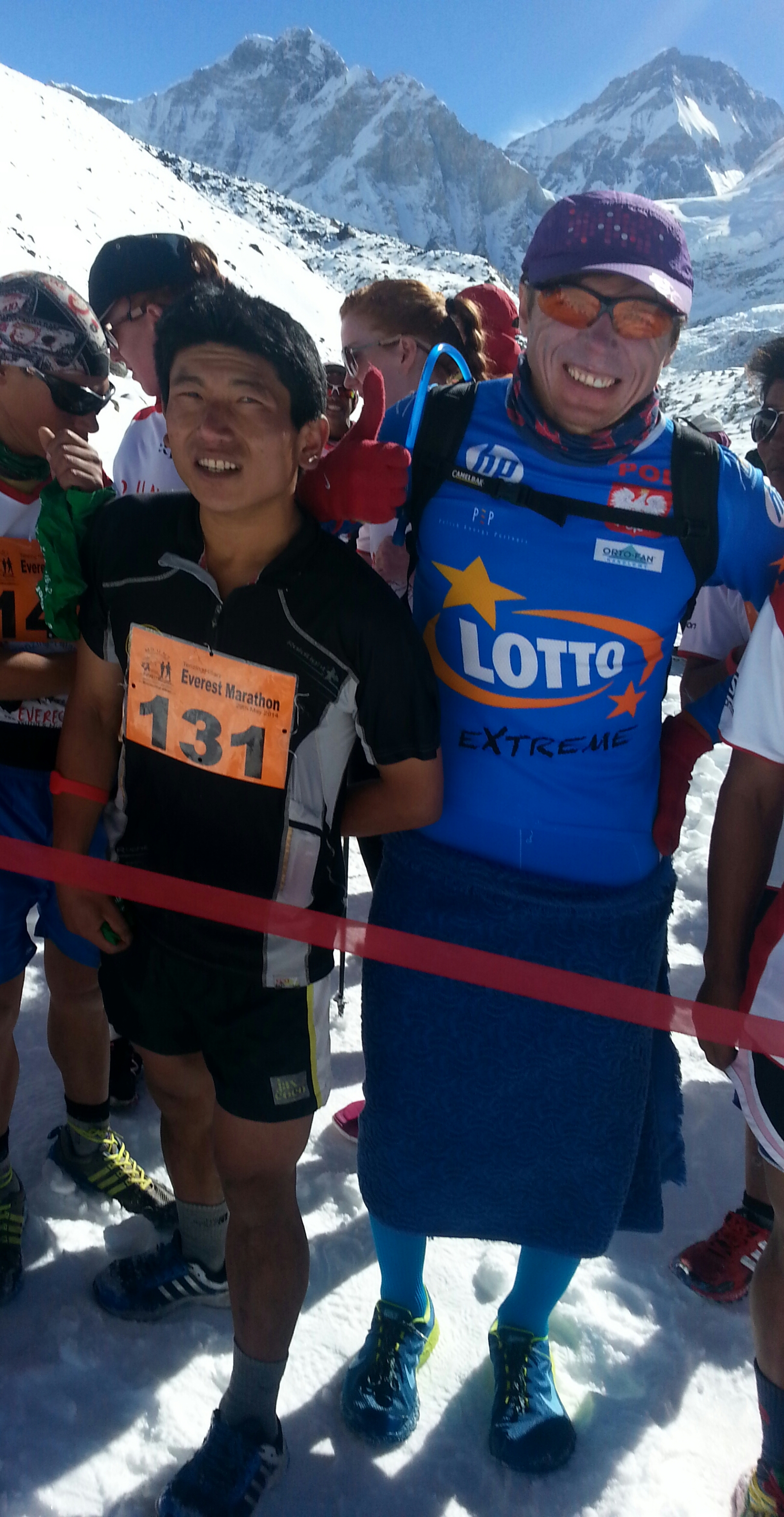 Top 2014 Everest Marathon finisher Sudip Kulung (left) with top foreign category finisher Robert Celinski (right) of Poland at the start line.
Sudip Kulung was the Everest Marathon winner, continuing a tradition of dominance by Nepali runners in high altitude trail races in Nepal. Wearing a black t-shirt and shorts Sudip won the event for the second time in 3 hours 52 minutes and 9 seconds, almost two minutes faster than second place Bhim Bahadur Gurung in 3:53:58. Sudip also won the event in 2011 in a faster time, but on a much different course in very different conditions. Suman Kurung finished third in 4:08:10.
Robert Celinski from Poland figured to be a top challenger to the top Nepali runners. However, loosing the course in the snow for what he said to be as many as 10 minutes, in addition to severely injuring fingers during a fall in the snow, ended his bid for the top overall position. Celinski finished in 4:39:39. Also from Poland, Radek Serwinski was second in the foreign category in 5:43:05, and Timothy Watson from the UK was third in 5:35:00.
For the second year in a row, the race organizers also contested a 60km ultra-marathon. The 2013 Tenzing Hillary Everest Marathon commemorated the 60th anniversary of Tenzing Norgay and Sir Edmund Hillary climbing the world’s highest mountain. In the cold at 6:00AM, 17 runners gathered to contest the 60km race from Gorak Shep. Samir Tamang won for the second year in as many tries in 7 hours 17 minutes and 55 seconds. Homlal Shrestha was second in 7:38:15, and last year’s marathon runner up D.B. Kulung Rai finished third in 8:26:20.
The Nepali women are equally dominant on their home trails, and the relatively large women’s field assembled delivered once again. Ang Chhutin Sherpa was the first female finisher in 5:08:05, while second place Mingma Lhamu Sherpa was less than one minute behind in 5:08:45. Lhahak Futi Sherpa was third in 5:22:00. All three were more than 20 minutes ahead of all but one foreign competitor, including male competitors, in the marathon field. This further cements the dominance of Nepali runners in high altitude trail races in the their home country.
The majority of the 107 foreign runners entered in the Everest Marathon started trekking to the start line on 18 May, and their plans to spend two nights in tents at Everest Base Camp prior to the race were upended as a result of the heavy snow. They trekked down to Gorak Shep in dangerous conditions the morning prior to the race. Combined with the warm temperatures for the spring season, the snow made the area from Base Camp to Gorak Shep very prone to avalanches. In addition, the cancelling of the Everest expeditions heavily reduced the foot traffic on the trail, making it more difficult for the race to start and break trail from base camp.
Full results are available on the Everest Marathon website.