
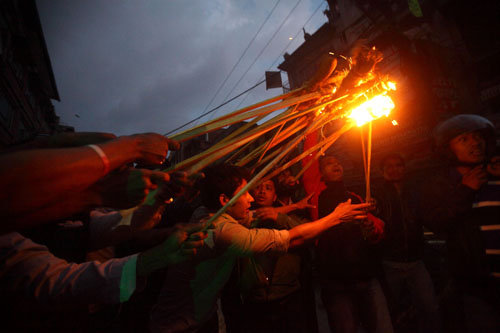
 Maoist cadres organise a torch rally in Kathmandu on Monday on the eve of their three-day general strike. Photo : Gopen Rai
The Maoist-Madhesi parties have decided to enforce their three-day nationwide shutdown despite criticism coming from all corners.
A meeting of the 30-party opposition alliance led by the UCPN (Maoist) on Monday decided to enforce the shutdown in a 'strong and effective way'.
Talking to Nepali Times after the meeting, Ram Janam Chaudhary of the MJF (Democratic), a constituent of the opposition alliance, warned of violence if 'people defied their strike'.
"We will use all our strength to make it (the strike) a success," he said. "If people defy our strike, we will be forced to resort to violence."
But, the government has hinted that it will not remain silent if the shutdown enforcers resort to violence. On Monday evening, police intervened in torch rallies carried out by opposition parties in Kathmandu.
The opposition alliance's spokesperson Prem Bahadur Singh said the shutdown enforcers will allow press, ambulances and vehicles carrying essential materials.
Of late, the general public mood about strikes and shutdowns has been negative. In the recent years, people have even come out on the streets to defy strikes enforced by political parties. And social networking sites have always been abuzz with anti-shutdown posts and comments.
The opposition parties, mainly the Maoists, have never respected people's opinion on strikes and shutdowns. In the past, they have even labeled people opposed to their strikes as 'vigilantes'
On Sunday, Prime Minister Sushil Koirala had requested the UCPN (Maoist) Chair Pushpa Kamal Dahal to withdraw their strike, saying the ruling NC-UML parties were 'positive about writing the new constitution through consensus'.
On Monday, Koirala met the MJF (Democratic) leader Bijay Gachhadhar and sought his help to avert the crisis. Though he leads the Madhesi Front in the 30-party alliance, Gachhadar has publicly criticised the opposition's inclination towards violent and disruptive agitation.
But, Gachhadar could not persuade the opposition alliance into calling off the shutdown. Sources say he was silenced by other Madhesi leaders. Of late, Madhesi party leaders, particularly Upendra Yadav, seem aggressive about deciding the contents of the new constitution through street protests.
Yadav rose as a Madhesi leader in the wake of the Madhes Movement in 2007 and apparently wants to reignite the same kind of uprising to regain his lost political strength. Encouraged by violent protests that have paralysed normal life in Rautahat since last week, Yadav is learnt to have convinced Gachhadar by saying that 'the timing is now perfect for a strong street agitation'.
In the recent weeks, the ruling parties, particularly the NC, have been trying to persuade the Maoist-Madhesi to write the new constitution by passing whatever issues they have sorted out so far.
Early in January, the NC-UML and the Maoist-Madhesi had reached an understanding on judiciary model and electoral system. The Maoist-Madhesi had even agreed to accept the NC-UML's proposal on form of governance by writing a note of dissent. They were divided only on name and number of new federal units.
Prime Minister Koirala is now trying to persuade Dahal for writing the new constitution by formalizing their understanding on judiciary, electoral system, form of governance and putting on hold the issue of federalism. Dahal wants the deal on all the four disputed issues or nothing.