
In April 2013 I went to Humla looking for clues about a doctor who had apparently hoodwinked donors and the people of this remote district for almost a decade. Yeshe Lodoe Lama wasn't just a fake doctor, but had embezzled millions in building and running the Citta Nepal hospital in Simikot.
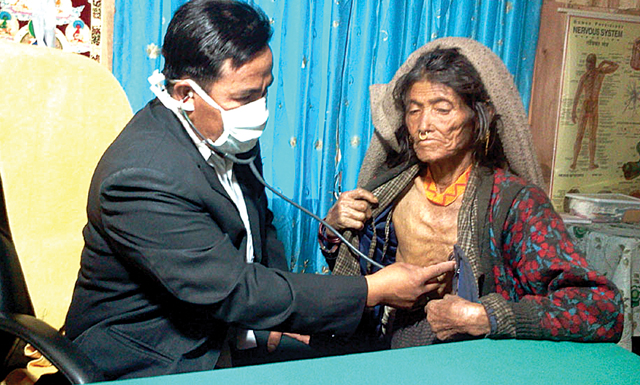 QUACK: Yeshe Lodoe Lama examining a patient in Humla in 2010
The spacious three-building complex with clean corridors, well-stocked medicine cabinets, and cosy interiors stood in stark contrast to the dirt-poor district outside. I befriended a local NGO officer, and posing as a development studies student, managed to sneak inside the hospital where Lama’s father Tsering Lama gave me a tour around the locked operation theatre and empty 15 room ward.
Locals trickled in throughout the day paying for the donated medicine as prescribed by the nurse and the health assistant there. Lama was in Kathmandu where he spent most of his time. I learnt that he used to don his white lab coat and stethoscope only during health camps and donor visits at the hospital.
When I returned after a week and filed my story about the fake doctor, Micheal Daube executive director of Citta USA that supported the hospital, was already in a legal battle against Lama accusing him of misappropriating almost Rs 70 million. Despite overwhelming evidence from forged signatures to fake audit reports of the hospital, Lama somehow managed to buy more time as the verdict on the case from Kathmandu district administration office got pushed back.
By then the name of Citta Nepal name had been changed to HEED Nepal by Lama and his new board members made up of cronies and relatives, where he continues to serve as the chairman.
Finally, last August Daube wrote to me ecstatically about the arrest of the fake doctor Yeshe Lodoe Lama on the grounds of providing the authorities with fraudulent documents. But the case took an unexpected turn last month when the Supreme Court released Lama on a bail of just Rs 1 million. This was inexplicable since the joint bench led by Chief Justice Ram Kumar Prasad Shah and Justice Jagdish Sharma Poudel had overturned earlier rulings of the district and appellate courts and granted Lama bail citing 'present available evidence do not show that he is at fault'.
How could the Supreme Court grant bail to a person who was arrested after overwhelming evidence? So we began digging deeper on the court verdict which then took shape of a follow-up report to my 2013 story.
Initially, no one directly related to the case wanted to speak to us. Some refused to take our calls while, others canceled appointments at the last hour. Our attempts to navigate through the labyrinth of courts with the help of inside sources proved futile. But my editor and I did manage to get some possible lead on the story after going through a binder full of documents gathered from Kathmandu district police office, Humla Land Revenue Office, Kathmandu District Court, Patan Appellate Court and Supreme Court.
Given the evidence against Lama including his fake medical degree and counterfeit transaction details for millions of rupees donated to the hospital, the bench’s recent order seemed odd. Since there is no higher body to appeal to regarding Supreme Court orders, we had to gather enough facts and evidence to question the Chief Justice's decision on the case. Reading between the lines of the 200 odd pages of government documents continued until we had a solid piece based on court documents.
Unlike past stories where I would wait until the last minute for that one crucial quote to give story the credibility, this time it was the excerpts from the befuddling court orders that replaced those all important sound bites. All we did was follow the paper trail.
In 2010 Tim Berners-Lee, the inventor of world wide web said that “data driven journalism is the future” and reporters should be hunting for stories in datasets. In many ways my follow up story on Humla was also a result of the same.
As civil service and local government bodies work to open up their data, it will be a new turf for journalists trying to interpret and question these data. Journalists will now have to be equipped with different skill sets to analyse available complex data, spot the details lurking behind them to reveal the larger picture and ensure that this well packaged information is really helping people make informed choice.
The next hearing on the case is scheduled for 28 April. With widespread call for action against corrupt judges, this case will be watched closely and its verdict could set precedence for similar cases where the accused have been let off with lenient sentences.
Bhrikuti Rai
Read also:
Getting away with (almost) anything Bhrikuti Rai
Doctor who? Bhrikuti Rai