
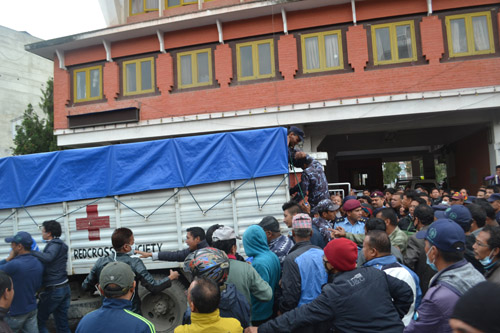
 Earthquake survivors jostle each other to grab tarpaulin sheets in Lalitpur on Tuesday. Photo by Om Astha Rai
A truck laden with tarpaulin sheets stopped outside the Lalitpur Sub-Metropolitan City office on the fourth day of the deadly earthquake that killed thousands and made many homeless in central Nepal.
The truck was immediately swamped with hundreds of locals who had been living in the open after the earthquake damaged their houses. They jostled each other to grab the sheets, ultimately forcing police to chase them away with batons and cordon off the whole area.
Earthquake survivors were expecting at least a sheet for each family, and they were outraged when told that five families would have to share a sheet. They started shouting slogans against authorities: "We're not refugees, treat us like citizens of this country."
As the authorities were trying to convince earthquake survivors that they did not have enough relief material eight trucks full of tarpaulin sheets and food were parked in the premises of an Armed Police Force (APF) base in Satdobato, Lalitpur.
"We asked the APF officers to distribute relief right away," says Sishir Gurung, a local resident. "But they said they had yet not got orders to do so."
The lack of coordination between government agencies has not only hampered relief distribution but also rescue efforts. As of now, 15 countries have sent their rescue missions to Nepal but there is little coordination from the Nepali side as to where to deploy them.
On Tuesday, when a team of French rescuers was pulling out a man alive from under the rubble of a collapsed hotel building in Gongabu, a Turkish medical team also reached the same place. The Turks wanted to help but the French rejected their support. The French requested Nepal's APF to send the Turks away.
"The dispute briefly interrupted rescue work," said a Nepali police officer helping the French team. "The French did not want to share the credit for rescuing a man alive after 82 hours, and the Turks also wanted it."
On Wednesday morning, locals in Gongabu informed rescuers that they saw signs of a girl still alive under the rubble of a collapsed building in Gongabu itself. But the APF team did not act with the urgency demanded because he hadn’t got the orders.
Saturday's earthquake, worst after 1934, left over 5,500 people dead and over 10,000 wounded. The death toll could reach higher as rescue teams have yet not been able to reach many far-flung villages of Gorkha, Dhading, Lamjung, Nuwakot and Ramechhap districts.
As thousands of families wait for rescue and relief in remote areas, earthquake survivors are left high and dry even in Kathmandu Valley. "The mighty have received relief, the helpless have not," says Ram Adhikari, who was hoping to get a tarpaulin sheet outside the sub-metropolitan office, Lalitpur. "We see no one who distributes relief equitably.”
In Nepal, lack of coordination is always a challenge when it comes to dealing with disasters. Saturday's earthquake has exposed how much worse it can be. Two days after the earthquake, Information and Communication Minister Minendra Rijal conceded lack of coordination on the part of the government and promised to do better from Wednesday. But these things change slowly.
Om Astha Rai