
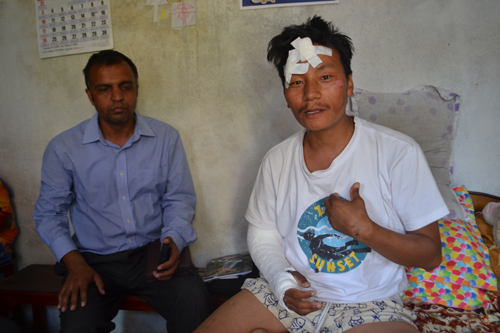
 Arun Moktan in his residence in Kapan on Sunday. Photo by Om Astha Rai
When a deadly earthquake struck central Nepal, just before noon on 25 April, nearly 80 Christians had congregated at a protestant church in Kapan, Kathmandu.
Arun Moktan, a 30-year-old taxi driver, a member of the congregation and he – like other worshippers – was kneeling down quietly when the church started shaking violently.
Everyone got up and started crying and screaming, but they did not try to run away because their church was on the sixth floor of a seven-story building.
"We realised that we would not be able to escape unhurt from a high-rise building," he says. "And our pastor was also asking us to stay calm."
In a matter of few seconds, the iconic building of Kapan area was uprooted and fell to the ground, killing 26 and wounding 49 worshippers.
"It tilted for a while and then just collapsed," he says.
Arun was holding on to the door, praying to God to save his life. "We were all buried under the rubble," he says. "I was lucky to survive."
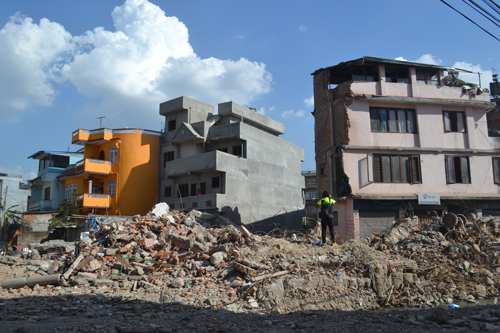 The debris of a seven-story building that collapsed in the earthquake in Kapan, Kathmandu. Photo by Om Astha Rai
Arun's right arm got fractured and he still has livid bruises almost all over his body. He had parked his taxi in the parking area of the church building. The taxi was completely destroyed by the debris.
Even after witnessing the horrific death of his church members, Arun has not lost his faith in God.
"Those who died in the earthquake were taken to heaven by God," he says. "God left me to struggle on the earth. My survival has a purpose and it is to continue serving god."
The earthquake demolished the Kapan church but could not deter the faithful worshippers from their weekly prayer. On the first Saturday after the earthquake, they gathered in a room under corrugated sheets to pray.
"Our bodies are mortal but souls are immortal," says Arun. "But our souls die the day we lose faith in God."
The Kapan church that collapsed in the earthquake was an extension of Cannan Pray House, a protestant church in Buddhanagar of Kathmandu. Ever since it was set up in Kapan, Arun had been going there every Saturday and on other religious occasions.
Cannan Pray House has its extensions in Thali and Gwarko of Kathmandu, Chilankha and Laduk of Dolakha and Peepal Chaur of Kavre as well. Its Kapan and Gwarko extensions were completely destroyed while other churches have some cracks.
More than 300 Christians affiliated with various extensions of Cannan Pray House have been affected by the earthquake.
Thousands of students possibly survived the earthquake because it was on a Saturday. But because of this same reason, more Christians were affected as they were in their weekly congregations.
No one has, yet, collected the information on the amount of damages on churches in central Nepal. National Council of Churches Nepal (NCCN) and Christian Federation of Nepal (CFN) have just started assessing the extent of loss.
The Kapan church collapse has also exposed the vulnerability of church buildings in Nepal.
Activities of churches and Christian organizations were restricted in Nepal until 1990. After the restoration of democracy, the number of churches flourished. However, most of them were set up in haphazardly-built buildings.
Radha Krishna Baral, pastor of Cannan Pray House, says they knew that Kapan's seven-story building was not earthquake resistant but they could not find any other safe place to extend their branch.
"Though Nepal is now a secular country, the state still doubts our activities and it is difficult for us to find a perfect place to build our church," he says. "So we set up churches in any building we get."
Baral, however, says the recent earthquake has taught them a lesson and they will not compromise the quality of buildings before setting up their churches in the future.
OM ASTHA RAI