
After 25 April earthquake, Nepalis were shocked to hear that the iconic Dharara tower in Kathmandu came down killing at least 70 people. It gave the first indication of just how serious the quake was, and also took away an important landmark that many had an emotional attachment to.
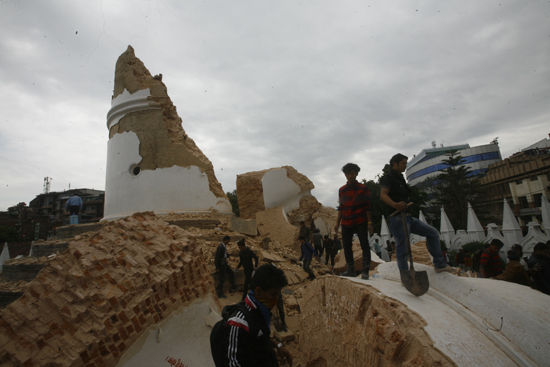 Photo: Bikram Rai
Prime Minister Bhimsen Thapa built two towers in the 19th century both of which went down in the 1833 quake. Only one was rebuilt, and it was destroyed again in 1934 and once more rebuilt. Now, some are saying that since it had gone down twice previously, maybe Dharara should not be rebuilt, but the ruins kept as a memorial to the 2015 earthquake.
Rohit Ranjitkar, conservation architect thinks rebuilding Dharara shouldn’t be a priority. “We can leave it as a memorial of 25 April earthquake,” he says. “It will also remind us of the risk of building high and unsafe constructions.”
Bhishan Rajbhandari, an artist who advocates for the reconstruction of all monuments of Kathmandu, doesn’t agree. He says the Moghul-style tower was part of Kathmandu’s identity. “It symbolised our acceptance of other cultures,” he said. “We must rebuild it by making sure it’s earthquake resistant.”
There are many examples from around the world of destroyed monuments being left as a reminder of the disaster that caused it. For example, the Hiroshima monument has preserved a building, and parts of the world Trade Centre building have been kept at Ground Zero in New York. The concentration camp of Auschwitz-Birkenau is now a museum to remember the human cruelty. In Sichuan, some of the ruined buildings in Wenchuan commemorate the 2008 earthquake and the loss of life.
Stéphane Huët