
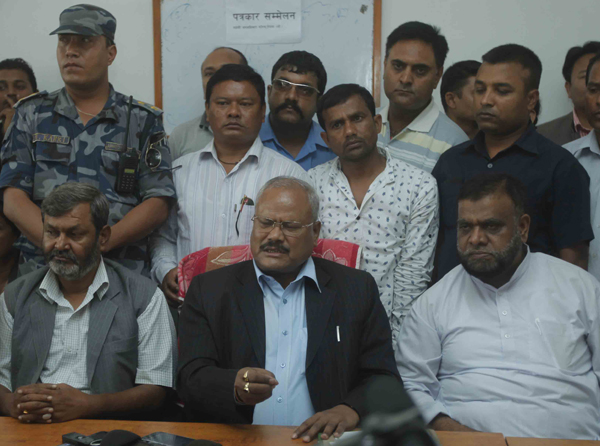
 MJF (D) Chair Bijay Gachhadar at a press conference in the Singha Darbar on Friday. Photo: Bikram Rai
Om Astha Rai
In a day of high political drama, the only Madhesi party that endorsed the 16-point deal, the blueprint for the new constitution, has disassociated itself from the four-party alliance.
The MJF (D), which signed the 16-point deal on 8 June and another follow up agreement on the six-province federalism model on 8 August, appears to have found it politically suicidal to keep backing the deal it struck with the NC, UML and the UCPN(M).
At a press meet in the Singha Darbar, the MJF (D) Chair Bijaya Gachhadar said, "We strongly condemn the seven-province federalism model that eliminate identity of the Tharus."
Gachhadar did not attend the meeting of a special committee formed by the Constituent Assembly (CA) on Friday. But the committee decided to replace the six-province federalism model with the new seven-province one without Gachhadar's consent. The province 2 of the previous model has now been divided into two separate provinces to create a Karnali province and Thori VDC of Parsa district has been shifted to the province 3.
A Tharu himself, Gachhadar appears to have found it politically untenable to back the seven-province model when Tharus, Madhesi and Janajati parties opposed to it have enforced an indefinite general strike in the plains. He has once again floated the idea of eight provinces model with a Tharuhat state comprising Kailali district too.
With the exit of the MJF (D), the ruling NC-UML coalition and the main opposition UCPN (M) will be isolated and their position further weakened. The MJF (D) has only 14 CA members and will not be able to stop the NC-UML-UCPN (M) alliance from passing the new constitution even if it forms a new alliance with other Madhesi parties, but its exit is likely to decrease the new constitution's acceptability.
In the second CA, Gachhadar has always presented himself as a moderate leader and given up his stance even at the cost of angering his own trusted aides to pave the way for the CA to write the constitution. It was he who persuaded the UCPN (M) Chair Pushpa Kamal Dahal to work together with the NC-UML, and not with the radical Madhesi, to end the deadlock.
Gachhadar even agreed to give up his claim on Sunsari, Morang, Jhapa, Kailali and Kanchanpur to sign the 8 August deal on the six-province model. His trusted aides Jitendra Dev and Ram Janam Chaudhary were not happy, and tried to stop him. But he went on to sign 'for the sake of the new constitution'.
But when the four-party alliance reconsidered the six-province model and floated the seven-province model in the wake of violent protests, NC leaders, mainly Sher Bahadur Deuba, reportedly humiliated Gachhadar by saying 'not an inch of land in Kailali district' will be given to the Tharuhat province. Gachhadar had proposed division of Kailali between the Tharuhat and the far-western province as a solution.
The second-wrung leaders of the MJF (D) are now happy that Gachhadar has now become assertive. Other some Madhesi leaders believe that Gachhadar is not a truthful Madhesi leader and his actions might have no impacts at all.
Political analyst Chandra Kishor Jha thinks otherwise. He says, "Gachhadar's exit has validated Madhesi agendas, and is likely to boost the ongoing Madhes movement." He says the new constitution's acceptability was already at stake and Gachhadar's exit will certainly diminish it further.
Some NC-UML leaders have also criticised their parties' arrogance that led Gachhadar to break the alliance. UML leader Shankar Pokhrel tweeted in Nepali: "It would be wise to bring back Gachhadar who has so far helped the constitution making process by modifying the proposed seven-province model."