
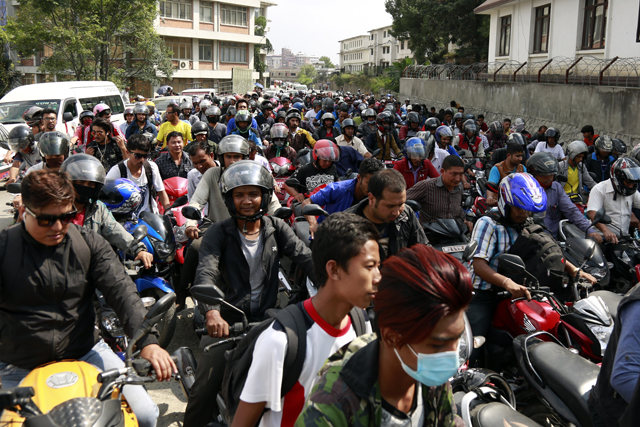
 People queue up outside a petrol pump at Bhadrakali. Pic: RSS
Nepal has asked international airlines to refuel their Kathmandu-bound aircrafts at origin airports, citing the looming shortage of aviation fuel due to an unofficial blockade by India.
India has blocked all border entry points with Nepal, expressing dissatisfaction with some provisions of the Himalayan nation's new constitution. Madhesi parties, who feel left out of the constitution writing process, have also blocked the East West highway and feeder roads leading to India, worsening the fuel crisis in Kathmandu.
As the fuel crisis deepens, Nepal has been left with no choice but to focus on the efficient consumption of whatever stock of fuel Kathmandu has. Top political leaders are holding talks with Indian officials to make a breakthrough, but an end to the crisis does not look in sight.
An emergency meeting of government officials on Sunday requested International Airlines to refuel only in small quantities at Tribhuvan International Airport (TIA), if really needed. Kathmandu's stockpile of aviation fuel is not going to last more than a week, say government officials.
However, the government's decision is unlikely to affect most of international airlines as they avoid refuel their aircrafts in Kathmandu. Only a few long-range airlines, like Turkish Airlines, are likely to be affected by shortage of aviation fuel in Kathmandu.
Domestic airlines have also been asked to refuel at airports in the Tarai, according to government authorities.
The government has also decided to ask China to export aviation fuel. Other alternative the government has come up with is to reduce the flights that are put on hold due to traffic congestion. Although the government had mulled over the idea of transporting aviation fuel in Nepal Airlines Corporation (NAC)' aircrafts, the NAC has said its aircrafts are in no condition to transport fuel.
The government has also decided to implement an odd-even system for all types of vehicles starting Sunday.
Issuing a press statement Ministry of Home Affairs said that obstruction in the cargo movement coming to Nepal from India has created an abnormality in fuel supply as Nepal has not been able to receive any oil from Indian Oil Corporation.
With the fuel stock decreasing the government decided to implement the odd-even system for vehicles other than those carrying essential goods, those used by security forces and those involved in monitoring.
Following the rationing, long queues of vehicles could be seen outside various petrol pumps since early morning on Sunday.