
 Pic: RSS
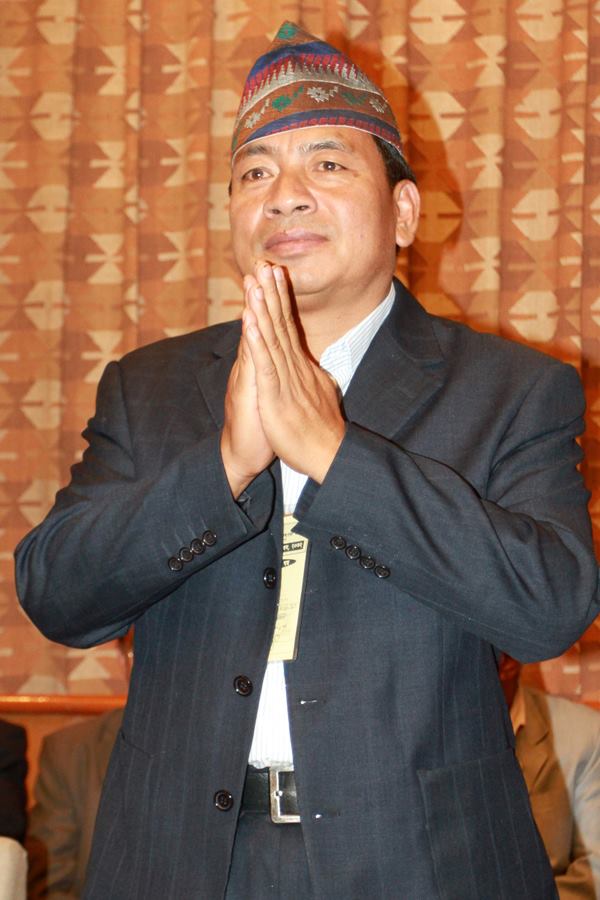
After a woman Speaker of Parliament and a woman President, Nepal now has a former guerrilla commander as a Vice President.
Nanda Kishor Pun, 49, became Nepal's second Vice President by winning a vote in the parliament on Saturday. He succeeds Parmananda Jha and is the first Maoist to become Nepal's deputy Head of the State. Early this week, Bidya Bhandari had created history by becoming Nepal's first female President.
Parliament Speaker Onsari Gharti Magar, herself a former Maoist guerrilla, announced Pun's victory. He defeated the NC's vice presidential candidate, Amiya Kumar Yadav, with 325 votes. Yadav secured only 212 votes. Despite being backed by the ruling coalition of UML, UCPN(M), RPP (N) and MJF (D), Pun's victory was not a foregone conclusion. The UCPN (M) had supported UML Chair KP Oli and Vice Chair Bidya Bhandari to become Prime Minister and President respectively, and it was expecting the leading party of the ruling coalition to reciprocate.
But a day before UCPN (M) nominated Pun's candidacy, some UML leaders belonging to the Madhav Kumar Nepal camp objected to his name and asked Maoist Chair Pushpa Kamal Dahal to come up with another candidate.
Dahal threatened to withdraw support to the Oli government if the ruling collation did not unilaterally agree on Pun's name. It was only then UML gave its nod to Pun's candidacy.
Nevertheless, the UCPN (M) was still suspicious that some UML lawmakers would not vote for Pun. Prime Minister Oli had to instruct all UML lawmakers to 'show honesty' by voting for Pun.
 Pic: Kiyoko Ogura
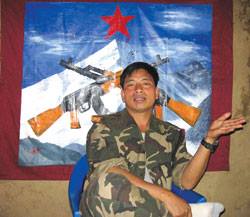
A reclusive and reticent warrior from the remote village of Rangsi of Rolpa, the epicentre of the Maoist insurgence, Pun was one of the four deputy commanders of the ‘People's Liberation Army’ (PLA).
Alongside Barsha Man Pun (Ananta), Janardan Sharma (Prabhakar) and Chandra Prakash Khanal (Baldev), Pun was second only to the Maoist Chair Dahal (Prachanda) in the PLA ranking. He is better known by his nom-de-guerre ‘Pasang’. Pun was the backbone of the Maoist military wing right from the beginning, and he not only planned but also led most of the major battles in western Nepal. In July 2006, he had revealed to Nepali Times that he had himself planned the first Maoist attack on an army base in Ghorahi of Dang in November, 2001. Until the Ghorahi attack, the Maoists had been fighting the police and the battle sucked the Royal Nepal Army into the war.
Pun was a communist right from his school life. He was a member of the first Rolpa district committee of the CPN (Unity Centre) — the precursor to the CPN (Maoist). He was involved in the CPN (Unity Centre's) Young communist League, which was turned into Ladaku Dal. After the CPN (Unity Centre) became the CPN (Maoist), Pun threw himself into a bloody war that lasted until 2006.
Despite being defeated in Bhalubang, Kusum and Khara and suffering heavy casualties in Beni, Pun was still considered to be a successful Maoist commander. Accustomed to underground political and military activity, he failed to leave a mark in open politics.
In the second Constituent Assembly (CA) elections, Pun was defeated in a Kathmandu constituency by the NC's more charismatic youth leader Gagan Thapa. After the election, and in failing health, he was gradually sliding into oblivion.
Pun wanted to become Deputy Prime Minister and Home Minister, but that was not possible because he was not a member of parliament. Dahal convinced him to agree on the post of Vice President, which was never his first choice.
By virtue of being vice president, Pun has now become the deputy Supreme Commander of the Nepal Army against which he fought bloody battles on many fronts and occasions between 2001 and 2006.
Om Astha Rai