
 Photos: Suresh Bidari
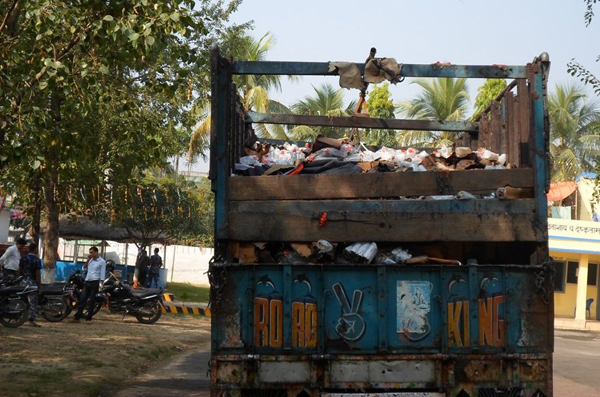
Hours after Madhesi Morcha decided to allow import and supply of medicines on 'humanitarian grounds', Madhesi protesters burnt down a truck laden with drugs in Birganj on Thursday night.
Cadres of the Morcha, which is an alliance of four Madhes-based parties protesting against Nepal's new constitution, set the truck (Na 2 Kha 8292) on fire without allowing its driver Laxman Sah to run to safety.
"The truck contained mostly liquid drugs, and fire could not spread rapidly," says Sah. "I would otherwise not have got chance to run away."
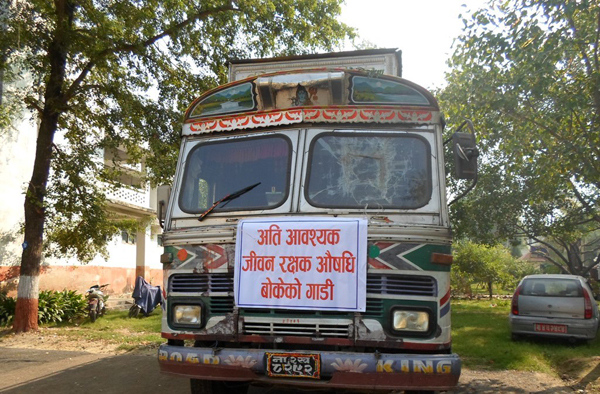 The truck had a banner on it to inform protesters that it was just carrying life-saving drugs. But protesters did not care about it. Parsa's police chief Raju Babu Shrestha told Nepali Times that medicines worth Rs two million were reduced to ashes.
On Thursday, the Morcha had decided to allow trucks carrying medicines, oxygen cylinders and medical equipment to enter Nepal.
After the Morcha started blocking Nepal's border posts with India to put pressure on the government to amend the new constitution, trucks carrying medicines, apart from other essential commodities, have been stuck on the Indian side.
As hospitals began running out of essential drugs, the Morcha had decided to not disrupt import and supply of medicines and medical equipment.
But the Birganj fire incident has prompted many to ask if the Morcha is losing control over its agitation.
Manish Suman of Sadbhavana Party, a member of the Morcha, said the Birganj incident was just a one-off case. "There could be some infiltrators, but we will not let them succeed," he said. "We condemn what happened in Birganj. We will investigate it and take action against whoever is involved."
Suman said the Morcha will effectively implement its decision to allow import and supply of medicines and medical equipment. "Trucks carrying medicines have already started to enter Nepal, and we have not harmed them," he said.
The Morcha has also allowed schools to open in morning from Friday. But many say the Morcha's decision is not practical because it would be difficult to run classes in winter morning in the Tarai.
In Nepal's southern plains, where schools have been closed for three months due to the Morcha's agitation, cold wave makes morning life difficult in peak winter. But Suman said cold wave has not started in the Tarai yet, and the Morcha will rethink its decision when low temperature begins to affect normal life.
"Cold wave will begin from December, and we hope we will have an agreement with the government by then," he said. "If not, we will make another decision about schools."