
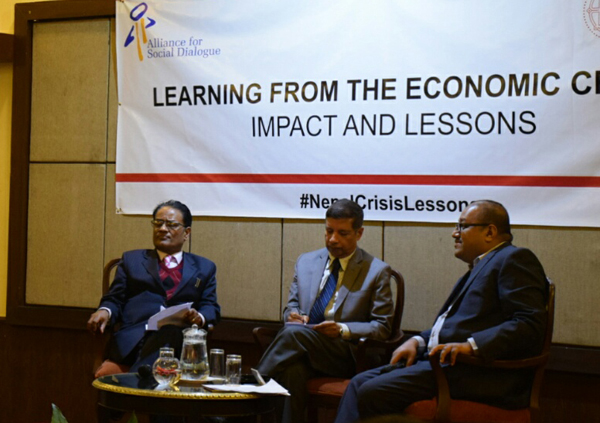
 Former commerce secretary Purushottam Ojha, former Vice Chair of National Planning Commission Shankar Sharma and facilitator Sujeev Shakya at the talk program. The event was jointly organised by Alliance for Social Dialogue and Nepal Economic Forum.
Experts at a talk program in Kathmandu on Tuesday stressed the need for a political solution to an economic crisis that has adversely affected Nepal.
Former commerce secretary Purushottam Ojha and ex-Vice President of National Planning Commission Shankar Sharma urged the government and Madhesi Morcha to find a political solution to a political crisis, which has adversely impacted Nepal's economy over the last three months.
"We should not further delay in diversifying our trade, and we must also raise issues of India's economic blockade at international forums like World Trade Organisation (WTO)," said Ojha. "But these are long-term strategies. We urgently need a political solution to the ongoing economic crisis."
Ojha added: "When we imported fuel donated by China, we realised how difficult trade across the Himalaya would be without developing necessary infrastructure. We must promote trade with China in the long run, but that cannot be an immediate solution to the crisis which we are now reeling under."
Ojha also asked Federation of Nepalese Chambers of Commerce and Industry (FNCCI) to lobby with Federation of Indian Chambers of Commerce and Industry (FICCI) to put pressure on New Delhi to lift the blockade. "FNCCI and FICCI use their joint economic council as a forum to sort out trade issues," he said. "This council must be used to lobby for lifting the blockade, too."
Sharma stressed the need for sustained efforts to ensure food and energy security, but said political solution was the best way out of the present crisis. "The April-May earthquakes made 700,000 Nepalis poor, and this economic crisis might push even more people below the poverty line," he said. "We urgently need a political solution. And when things get to normalcy, we must start working towards trade diversification."
It has been three months after Madhesi Morcah began a street movement in the country's southern plains against Nepal's new constitution. After the constitution was promulgated on 20 September, India also backed the Morcha by imposing a trade embargo against the land-locked Himalayan country.
Economists say the damage done by the Morcha's agitation and India's blockade to Nepal's economy is bigger than that caused by the April-May earthquakes. The government has already lost Rs 30 billion in revenue so far, and the Rashtra Bank has warned of negative economic growth and double-digit inflation.
Ojha says the government has lost Rs 2.17 billion in petrol and diesel revenues alone in the last three months. "If we factor in income of petroleum dealers and transporters, this figure could go up to Rs 2.88 billion," he says. "Our formal economy is losing this money to informal economy, which will have long-term economic impacts."
At the talk program jointly organised by Nepal Economic Forum and Alliance for Social Dialogue, Janakpur-based economics professor Surendra Labh, Birganj-based youth entrepreneur Ajaya Pradhananga and Saptari-based journalist Bhola Paswan shared their experiences about how the Madhesi movement and India's blockade have affected economic activity in the Tarai.
"People are giving up hope, and they want to flee the country," said Labh. "If something has kept economy afloat in the Tarai, it is remittance."