
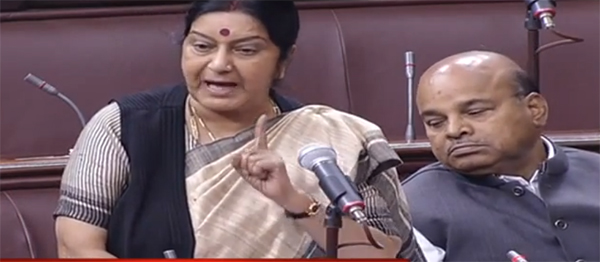
 Amidst growing speculation that New Delhi is siding with Madhesi dissenters to persuade the ruling parties in Kathmandu to revert to a Hindu monarchy, India's External Affairs Minister Sushma Swaraj on Monday clarified that the BJP government is for “a federal democratic republic Nepal”.
She was speaking at a debate in India’s upper house which was debating India’s policy on Nepal. Swaraj also criticised Nepal's ruling parties for “pushing through a constitution without adequate debate” and taking back progressive provisions of the interim constitution.
"When our Prime Minister Narendra Modi visited Nepal, he clearly supported the idea of a federal democratic republic state," she said. "So rumours that we want a Hindu monarchy in Nepal are unfounded."
Swaraj also denied that the Rashtriya Swayamsevak Sangh (RSS), an ultra-Hindu organisation affiliated to India's ruling Bharatiya Janata Party (BJP), is lobbying for restoration of a Hindu state or monarchy in Nepal. "The BJP is running the government, the RSS is not," she said.
Swaraj, as she has repeatedly, denied that India is imposing a blockade on Nepal and said that “disturbance in supply of essential commodities is due to Madhesi protests”.
"There are just two options to open the border: either shoot at Madhesis and remove them from there or find a political solution through talks with them," she said. "No one agrees on the first option, and we hope there will be a political solution in the next few days."
Reacting angrily to members of India's Rajya Sabha Mani Shankar Aiyar and Renuka Chaudhary, Swaraj said: "We are not imposing a blockade now, but the party you belong to had openly imposed blockade against Nepal for one and a half year starting 1986."
Aiyar and Chaudhary represent the Indian National Congress party in the Rajya Sabha. And they were critical of the BJP government's handling of diplomatic relations with Nepal.
"This is an act of bullying, and stop bullying Nepal," said Aiyar. "We want to tell the Nepali people that it is not India but the Modi government that is imposing blockade against them."
Aiyar also flayed the BJP government for siding with some discredited Madhesi leaders and arm-twisting Nepal into accepting their 'advice'. "Only 11 elected Madhesi lawmakers voted against constitution, but 105 elected lawmakers voted for it," he said. "How can we ignore these facts?"
Chaudhary flayed the Indian government for sending Foreign Secretary S. Jaishankar to Kathmandu to put pressure on Nepal's ruling parties to put on hold the constitution that was already passed by an elected assembly. "That was a blunder, and that resulted in today's stand-off," she said.
CPI (M)'s TK Rangarajan said: "Our constitution also had problems when it was passed. But we did not accept a third country's intervention to resolve our internal issues because we thought ours was a sovereign country. If we believe Nepal is a sovereign country, how can we put pressure on them to amend their constitution? They will do it on their own."
Most of the 14 Rajya Sabha members who spoke during Monday's discussion blamed the India government for interfering in Nepal's internal affairs and hurting Nepali people's sense of sovereignty. They also blamed Modi for pushing Nepal into the arms of China. But they also opined that Nepal's new constitution discriminates against Madhesis.
"Madhesis in Nepal have always been looked down upon, and the new constitution has taken back what was given to them by the interim constitution," said congress MP Karan Singh. "The India government must persuade ruling parties in Nepal to accept what was given through the interim constitution."
