
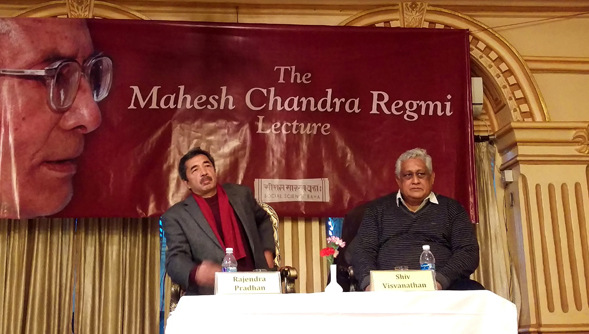
 Photo: Seulki Lee
At a time when ‘secularism’ has become something of a bad word in India, and the Hindu-right establishment in New Delhi is said to take a dim view of of neighbouring Nepal declaring itself ‘secular’ in its new constitution, a leading Indian thinker says the misunderstanding stems from semantics.
Delivering the 13th annual Mahesh Chandra Regmi Lecture on Monday, Shiv Visvanathan, professor at the Jindal School of Government and Public Policy, sees the problem as one of inaccurate translation.
Secular has been translated to mean ‘non-religious’, whereas it should mean ‘religious pluralism’, Visvanathan said, calling for “dialogic secularism” where there is conversation in the space of secularism.
Visvanathan has been examining the etymology of the word ‘secularism’, which contrary to popular belief, was not at first included in India’s post-independence constitution but only inserted with the 42nd Amendment in 1976 by Indira Gandhi during her emergency.
Secularism thus became a vehicle for political parties, mainly the Congress, to appease minorities. Over the years, secularlism therefore came to denote the non-Hindu agenda and the BJP made political capital out of it, used it as an electoral strategy to be voted to power in 2014.
In his talk entitled ‘Rethinking Secularism: An invitation to an experiment’ to an audience of 150 at Hotel Shanker on Monday, Vishvanathan called for a new perspective on secularism in the 21st century that moves away from its reductionist definition in western sociology.
Visvanathan stressed the need to redefine and refine the concept and role of secularism to end the cycle of violence and intolerance in India today. “We need a reinvented secularism which creates a dialogue between myth and history, science and religion, democracy and pluralism,” he said.
Visvanathan said he doesn’t want to perform a “premature post-mortem of the word” and examines the state of secularism in India through the perspective of its genesis in the separation of church and state in European history. He then went on to examine how it co-exists with scientific belief, and is portrayed in literature and film.
“(Secularism) is based both on a restricted idea of problem solving and a false history,” he stated, adding that his need to reconstruct secularism began with the defeat of the Congress by the BJP in 2014 mainly because of the secularism agenda.
Nepalis in the audience which included academics, ex-politicians and students said they found parallels to the secularism debate in Nepal’s new constitiuton. Srijana Giri, who is doing her masters in social science at Tribhuvan University said: “Although he is an Indian scholar and took examples of Indian cases, we understood the argument as our own issue because we are facing the same problem here.”
In conclusion, Visvanathan said secularism should not be demonised by a majoritarian regime, adding: “We need a new framework to understand a world where worship and secularism can coexist.”
The Mahesh Chandra Regmi Lecture is an annual public lecture series from 2003, instituted by Social Science Baha
Seulki Lee
Shiv Visvanathan’s lecture in full:
