
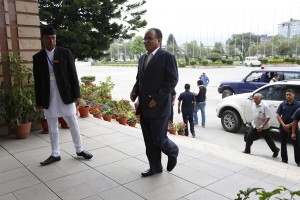
 Maoist leader Pushpa Kamal Dahal enters Parliament on Wednesday to register a no-confidence motion against Prime Minister KP Oli's government. Photo: Bikram Rai
The two political leaders once bayed for each other's blood. They waged a decade-long war in which 17,000 Nepalis were killed. This week, they joined hands to form a new government.
Maoist leader Pushpa Kamal Dahal suddenly switched sides, abandoning Prime Minister KP Oli for Sher Bahadur Deuba of the Nepali Congress. They also agreed to take turns to lead the government for the next 18 months. The new-found friendship between these former foes could prove costly. The first casualty will be the Constitution that all three leaders pushed through last year.
Deuba was prime minister when the Maoists submitted a list of 40 demands before launching the war in February 1996. In 2002, Deuba was prime minister for the second time when he put a price on Dahal’s head. Dahal in turn ordered his guerrillas to kill Deuba, who narrowly escaped a Maoist attack in Kailali. A lot can change in 20 years, and politics makes for strange bedfellows, but who could have predicted that Dahal and Deuba would one day be best buddies?
Oli foiled an earlier attempt to unseat him two months ago by charming Dahal out of an alliance with Deuba. But this time the Maoists and the NC agreed to topple the Oli government, and forge a new ruling coalition. Under the deal, Dahal will be prime minister first, to be replaced by Deuba after local elections in December and until provincial and parliamentary polls.
The Maoists registered a no-confidence motion in Parliament against the government on Wednesday, but Oli has refused to step down, preparing instead to face a vote in Parliament this weekend. But the arithmetic is against Oli: he is short of 50 votes. Madhesi and other fringe parties are backing the NC-Maoist alliance, so Dahal is on course to be the next prime minister.
Seven years after his resignation following the epic failure to sack the Army chief, Dahal may be Nepal’s 24th prime minister in 26 years. Deuba and Oli, one can be sure, will be ready to pull the rug out from under him at any time
Hours after CPN (Maoist-Centre) Chair Pushpa Kamal Dahal and Nepali Congress (NC) President Sher Bahadur Deuba registered a no-confidence motion against Prime Minister KP Oli's government in Parliament on Wednesday, NC legislator Amresh Kumar Singh warned in an interview that federalism will not work in Nepal.
Coming from a fervent proponent of ethnicity-based federalism in the new Constitution, his comments on BBC Nepali Service on Wednesday night set off a firestorm. Singh is an obscure NC MP who wields mysterious clout in Nepal’s politics, and is given to outlandish rhetoric.
When the NC agreed with the UML, the Maoists and the MJF (D) to fast-track the new Constitution after last year’s earthquake without the Madhesi parties on board, Singh nearly revolted. He allied with Madhesi leaders to foil the Constitution-drafting process led by his own party, and was even in the group that went down to Kailali to incite the Tharus to rise up in August 2015. The very next day, eight policemen and a child were lynched in protests. Protests ignited across the Tarai and lasted six months, leading to a border blockade supported by India. Nearly 50 more persons were killed in police action against the protests.
Although he is just one of the 206 NC legislators, and not even a Central Committee member of the party, Singh's remarks often create ripples across the political spectrum because he regularly boasts about his closeness to New Delhi. When his party fought against Gyanendra Shah's authoritarian regime, he was nowhere to be seen on the streets. Nevertheless, he rose dramatically as a key player in the post-April Uprising negotiations between the NC-UML coalition and the Maoists.
It is widely believed that New Delhi uses Singh to extract information straight out of political negotiations in Kathmandu, and continues to use him to facilitate negotiations among Nepali political forces. He doesn’t seem to mind that the public perceives him as speaking the Indian line during times of turmoil in Nepal, which is why he is often referred to as the ‘Octopus’ — referring to the smart cephalopod that once predicted the result of the Football World Cup.
Singh quickly retracted his statement through Facebook, accusing the BBC’s Rabindra Mishra of editing out crucial parts of his answers. He said he was still ‘committed to federalism' and clarified that he thinks 'this constitution should be more federal'. But his remarks have been podcast and hardly anyone believes his clarification. The question everyone is asking on social media is: Was New Delhi using Singh to float a trial balloon about scrapping federalism?
Singh was also involved in the back-room deal between Dahal and Deuba to unseat Prime Minister Oli and take turns to lead the government until local, provincial and federal elections are held in the next two years. Madhesi parties have vowed to vote against Oli when he faces no-confidence motion in Parliament this weekend.
The political course looks clear now: Dahal as the new PM, followed by Deuba next year, with Madhesis probably in the government and the UML as the opposition. But Oli's ouster has cast shadow over the implementation of the Constitution. Political analyst Shyam Shrestha believes that the Constitution is now in crisis, and addressing the issues raised by Madhesi, Janajati and other dissenters by amending the Charter is not possible.
"We will now face a new political deadlock, and the UML will not help break it," Shrestha, who is a Maoist MP, told us.
Maoist leader Narayan Kaji Shrestha is said to have been against toppling the Oli government at the present time. He calls the Dahal-Deuba friendship “unfortunate” because Nepal was moving in the right direction to reduce its over-dependence on India for trade by reaching out to China. "People had begun to see our party as a nationalist force," he said, "how will we redeem that image now?"
Political analyst Puranjan Acharya is convinced this week's political games were orchestrated by an “outside force” to foil the Constitution. "It wanted to break the Maoist-UML coalition, and restrict the UML to the opposition bench, and if it becomes a strong opposition the same power will try to split the UML.”
Madhesi parities, meanwhile, welcomed Oli's ouster. They are even ready to join the new government by signing a deal with the NC and the Maoists, but that will not help resolve the Madhes crisis. Says Acharya: "Without the UML, the Constitution will not be amended, and the radical separatists will be more powerful in the Tarai."
Meanwhile, inside a narrow room at the Tribhuvan University Teaching Hospital, anti-corruption crusader Govinda KC is growing weaker by the day. The political crisis has diluted his demand for the impeachment of the Chief of the Commission for the Investigation of Abuse of Authority (CIAA) Lokman Singh Karki, because that would not be possible without partnership between the NC and UML.
Om Astha Rai and Rameshwar Bohara
Rameshwar Bohara