
From the Nepali Press
Chandra Lal Giri in www.nepalkhabar.com 3 August
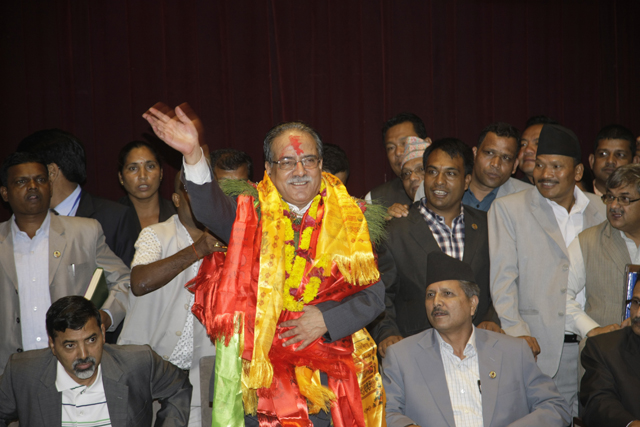
Whether CPN (Maoist-Centre) Chair Pushpa Kamal Dahal will succeed as Prime Minister this time largely depends on how he will deal with the following challenges:
1. Constitutional amendment
The ruling NC-Maoist coalition has reached a three-point deal with the Madhesi Front to amend the constitution, which could be Dahal's biggest challenge. Political analyst Puranjan Acharya says: "Without the UML, it would be difficult to address Madhesi issues by amending the constitution. And securing the UML's consent would be very difficult."
2. Constitution implementation
The Constitution categorically stipulates that local, federal and parliamentary elections will have to be held before December 2017. But without revising a number of laws in the Constitution, it would not be possible to hold any elections. Determining the number and areas of local administrative areas within federal provinces is also tricky. Madhesi parties have refused to take part in any elections unless their political demands are met.
3. Peace process
Even in 2008 when he became Prime Minister for the first time, Dahal could not use his power to nullify 6,000 legal cases pending against him, other Maoist leaders and cadre. He faces tremendous pressure from within his party to act on this critical issue. He needs to protect his comrades while respecting international norms of transitional justice.
4. Alliance with the NC
Dahal is the Chair of the third largest party, and he has become Prime Minister with the backing of the largest party, the NC. Ministers representing the NC in the government might not obey him, and it will be difficult for him to retain the NC President Sher Bahadur Deuba's trust.
5. Reconstruction
Dahal's predecessors, Sushil Koirala and KP Oli, were criticised for not acting swiftly to help post-earthquake recovery. Now, Dahal will have to prove that he is different, and cares for poor earthquake survivors while ensuring good governance.
6. Balanced diplomacy
Former Prime Minister Oli signed the trade and transit treaty with China, and Chinese President Xi Jinping's visit to Kathmandu was looking possible. If Chinese President Xi does not come to Nepal or Dahal fails to make progress in implementing the transit deal, it will be considered his failure. He has to balance this with India's sensitivity about closeness with China. It will be an uphill task for him to maintain equidistance with Beijing and New Delhi.