
 Santa Gaha Magar
On the first day of his visit to India last week, Prime Minister Pushpa Kamal Dahal told a gathering in New Delhi that his government has taken key steps to implement the Constitution, including setting up of High Courts in all seven federal provinces.
He was trying to assure officials in New Delhi, who have taken a keen interest in Nepal’s new constitution, that everything is on track and that he has understood Indian sensibilities.
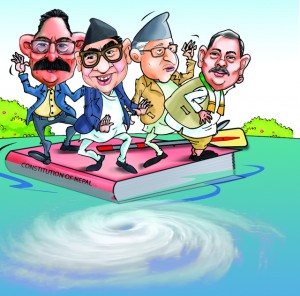
However, on the first anniversary of the promulgation of the Constitution this week, there is a sense of foreboding and crisis. Not because of opposition from those who were against it, but those who voted for the document last year.
The Big Three parties who signed the charter despite protests by Madhesi dissenters and open dissatisfaction of India are now divided. They are unlikely to forge a consensus to amend the Constitution to make it more acceptable.
Nepal’s new Constitution is a radical departure from previous ones not only because it has institutionalised republicanism and secularism, but because it has divided the country into seven federal provinces. The Legislature therefore needs to pass as many as 138 new bills apart from amending 315 existing laws to make the Constitution functional.
However, only four bills have been passed and two laws amended in the past year. The most important ones necessary to hold local and provincial elections have not been passed and amended. The Election Commission had warned that it would not be able to hold all three elections by January 2018, the deadline stipulated in the Constitution, if the necessary laws were not passed by mid-September. But neither the ruling nor the opposition parties has shown any sense of urgency to meet that deadline.
“The full implementation of the Constitution will only be possible when the new Parliament, Federal Provinces and Local Bodies are elected, but our political parties look oblivious,” says constitutional expert Bipin Adhikari.
With the January 2018 deadline looming, the numbers and boundaries of municipalities, village councils and local autonomous zones have still not been determined. Only half the Technical Panels headed by Local Development Officers in the 75 districts have submitted their reports to a Commission set up to delineate boundaries of municipalities and village councils. The Commission has not received reports from any district of the Tarai, where Madhesi people had protested against the Constitution for nearly six months last year.
Another Commission envisaged in the Constitution to set up federal structures has not yet been formed. Without creating these structures, it will not be possible to elect provincial and local councils.
Constitution promulgation became possible last year only when the NC, the UML, the Maoists and the MJF (D) reached an eight-point deal. These four parties stood together to get the Constitution endorsed by the Constituent Assembly on 16 September and promulgated by then-President Ram Baran Yadav on 20 September.
One year down the line, the NC-Maoist coalition has been as vocal as the Madhesi dissenters on the issue of amendment to the Constitution. Even ex-President Yadav, who himself promulgated the Constitution, has time and again expressed his misgivings over it.
However, the UML is dead against amending the Constitution for a second time. UML Chair K P Oli says the Constitution has already been amended once to address Madhesi-Janajati grievances, and his party would not be ready again to change anything in it under external pressure -– a clear reference to India’s perceived role in backing the Madhesi parties, unseating his government and engineering the NC-Maoist coalition.
The Constitution is being criticised even by those legislators who signed it last year. Baburam Bhattarai, now coordinator of the Naya Shakti Party, was president of a key legislative committee that helped forge a consensus among major parties. But he demanded an amendment to the Constitution soon after signing it, possibly to win over the Madhesi constituency.
The Nepal Federation of Indigenous Nationalities (NEFIN) President Nagendra Kumal and General Secretary Pemba Bhote were among the nominated legislators who signed the Constitution. But they are now leading the protests over the Constitution.
“Our Constitution is of course not flawless, and needs to be amended,” says political analyst Nilambar Acharya. “But what is not right is those who signed it just one year ago are now themselves pointing out its flaws.”
Constitutional lawyer Adhikari says the demand for the Constitution amendment is being pushed pretty blatantly by external rather than the internal forces. He adds: “If the Constitution is amended under external pressure, it will not fulfill aspirations of Nepalis.”