
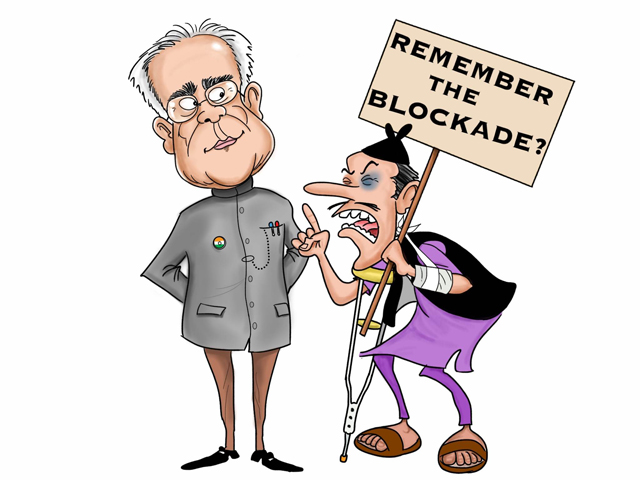
 Illustration: Diwakar Chettri
Indian President Pranab Mukherjee arrived in Kathmandu on Wednesday for a three-day visit, but what is supposed to be a fence-mending exercise seems to have reopened wounds inflicted by last year's crippling border blockade.
The visit triggered an avalanche of anti-Indian posts that reminded the Indian guest about his country's first involvement in the blockade that crippled the economy.
Photos of over-crowded buses, empty gas cylinders and serpentine queues outside petrol pumps from last year were posted online juxtaposed with Mukherjee's motorcade. The five-month blockade was imposed by New Delhi to pressure Kathmandu to amend Nepal's new Constitution.
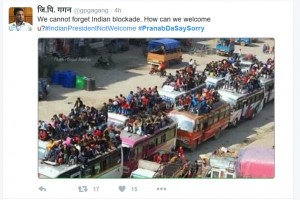 As President Bidya Bhandari welcomed Mukherjee at Tribhuvan International Airport, Nepalis on social networking sites demanded an apology from India for choking off the supply of fuel, medicines and other essential commodities. The hashtag #PranabDaSaySorry trended on Twitter. But the Twitterati also slammed Nepal's political leadership for kowtowing to India by declaring a public holiday on Mukherjee's visit with a hashtag in Devanagari script #लम्पसारवाद.
Police have not allowed pedestrians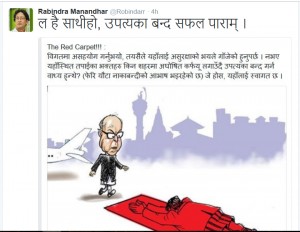 to drive or walk along the roads that Mukherjee's carcade will be taking during the three-day visit and Kathmandu commuters are furious. The streets in core Kathmandu wore a deserted look, and people said it was like a curfew.
Journalist Tirtha Koirala posted on Twitter a picture
of the deserted Baneswor road, and asked: "Are people not supposed to stand by the road with flowers and the national flags of the two countries in their hands to welcome Indian President? Is it an honour or insult to you, honourable President?"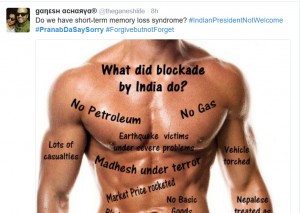
Writer Khagendra Sangroula tweeted in Nepali to lambast the way the government welcomed Mukherjee: "It is a total shutdown by the government, as if in a military dictatorship. I will be reading Pablo Neruda's poems about dictatorship."
Many compared the welcome to be of the kind more familiar in the streets of Pyongyang.
Ananta Koirala also tweeted in Nepali: "We have not forgotten the blockade, nor will we ever forget your inhumane behavior".
Others even used the hashtag #IndianPresidentNotWelcome, saying they will not welcome any Indian dignitary unless India apologises for imposing a blockade against Nepal that was just recovering from a 7.8 magnitude earthquake last year.
Indian Prime Minister Narendra Modi had sent a rescue team to Kathmandu hours after the earthquake struck central Nepal. But the way the Indian media covered the disaster was also ridiculed in Nepal and the hashtag #GoHomeIndianMedia drew a lot of attention.
But Modi was still considered a hero. In 2014, he had visited Nepal – the first by an Indian Prime Minister in 17 years, and delivered a dramatic speech in Nepal's Parliament that caught the imagination of the Nepalis. But he squandered the goodwill that he earned when he sent his special envoy S Jaishankar to stop Nepal from promulgating its new constitution.
The real disaster in the Kathmandu-New Delhi ties came when the Modi government refused to welcome Nepal's constitution, and imposed a blockade for five months.
This time last year, Nepalis were struggling to buy petrol, gas and other essentials. They celebrated their biggest festivals –Dasain and Tihar – without cooking gas. This year, the next day after Tihar, Mukherjee arrived with a mission to stop Kathmandu from cosying up with Beijing, and strengthen the Nepal-India ties that are still at the lowest point.
But it seems last year's blockade is still haunting Nepal-India friendship, and Mukherjee's visit has been clouded by its memory.
Om Astha Rai