
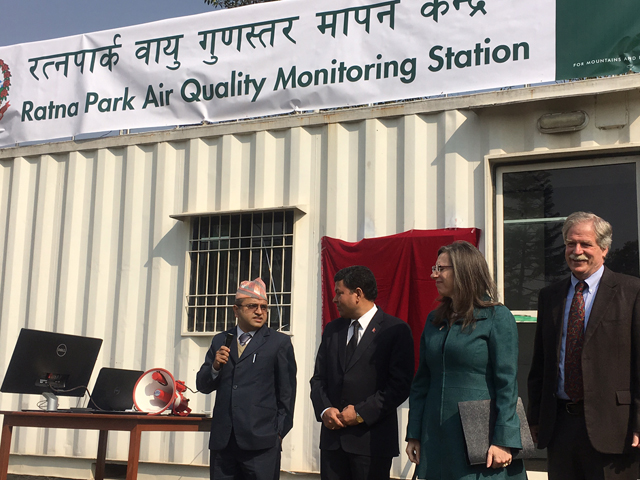
 The Ministry of Environment rolled out its air quality monitoring station at Ratna Park on Tuesday with US Ambassador Alaina Teplitz and ICIMOD director David Molden. Photos: Kunda Dixit
The Ministry of Population and Environment (MoPE) in cooperation with the International Centre for Integrated Mountain Development (ICIMOD) and the US Embassy on Tuesday unveiled the first of a series of air quality monitoring stations in Nepal that will feed live pollution data online.
Two monitoring stations at Ratna Park and the US Embassy in Phora Durbar were inaugurated by MoPE Secretary Bishwa Nath Oli, US Ambassador Alaina Teplitz and ICIMOD Director David Molden in back-to-back ceremonies. The US Embassy station will feed data to the Environment Protection Agency (EPA) in Washington DC as part of its real time air quality index measurements of major world cities.
Teplitz hailed the cooperation between the US and Nepal governments to improve air quality through data and public awareness. She said: “Improving air quality is good economic investment as well as an investment in improving health. It shows that enhancing prosperity must go hand-in-hand with protecting health, a healthy environment translates into a healthy population.”
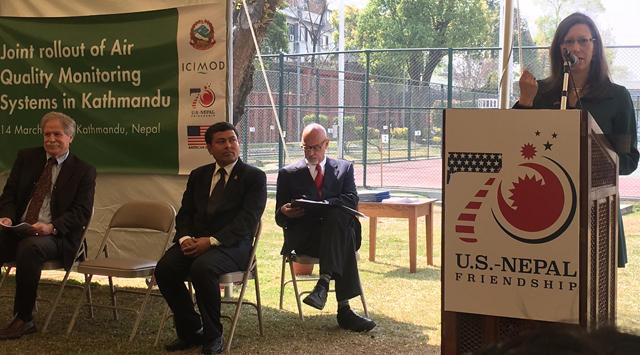 US Ambassador Alaina Teplitz during the unveiling of the air quality monitoring station at Ratna Park.
ICIMOD’s Molden said the Ratna Park station is part of a network that includes measurement stations in Lumbini, Chitwan, Pulchok and Dhulikhel and in future will form a more ambitious chain of 56 stations all over the country.
“The Nepali public will have live air quality data and this will open the door for people to make choices of activities based on pollution levels, provide the basis for emergency response by the government and help design better mitigation efforts,” Molden said.
Secretary Oli of MoPE said he hoped that live data would help the government determine the source of pollutants in order to take steps to reduce the concentration of suspended particulate matter. Public outrage about pollution has grown because of unhealthy levels of dust in Kathmandu caused by road construction.
Experts have said that dust, although very visible and uncomfortable, is not as dangerous as emission from vehicles. However, it has raised awareness about pollution, and has put pressure on the government to do something to reduce the health hazard.
Vehicular emissions is set to grow in Kathmandu because of larger numbers of vehicles, ineffective emission controls and poorly maintained heavy trucks and buses. Brick kilns and open burning of garbage also contribute to the pollution, which is exacerbated by temperature inversion in the Valley, especially in winter.
Besides detecting the concentration of suspended particulate matter, especially the ones below 2.5 microns from vehicular emissions, the Ratna Park and US Embassy stations also measure in real time the concentration of nitrous oxides and carbon monoxide from diesel exhaust, and sulphur dioxide from brick kilns.
After launching the US Embassy site, Teplitz said: “We are all breathing the same air, and we are all here to work together to improve its quality.”