
From the Nepali Press
Editorial in Nagarik, 20 June
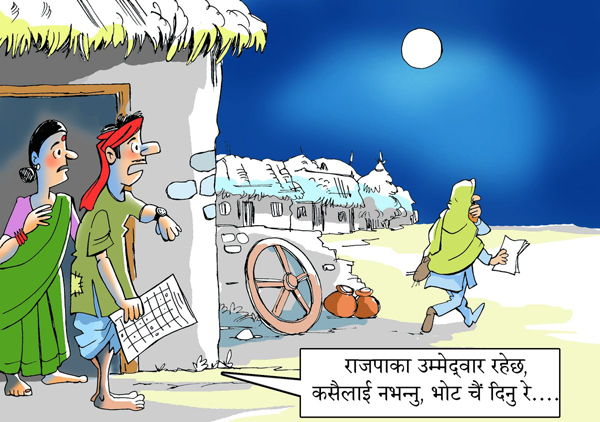
The Madhes-based RJPN and the Netra Bikram Chand-led Maoist party are boycotting local elections, but their cadres are contesting as independent candidates. This is proof that the ballot is superior to the bullet in a democracy.
Ballots have brought revolutions that even armed struggle has not achieved. In Nepal, the Maoists failed to topple the monarchy even after 10 years of bloody war, but an elected assembly abolished the 240-year-old monarchy. The RJPN and the Biplav Maoist have chosen not to study recent history, and are resorting to violence to push through their agenda. Their local cadres, however, know where real power lies and how to achieve it.
In Thabang in Rolpa district, independent candidates of the Biplav Maoist are in the electoral fray to become village chief and deputy. In this once-stronghold of the rebels in the midwestern hills, people had boycotted last local elections in 1997. None of them turned out to vote in the second Constituent Assembly elections, either. But this time, Amrit Gharti of the Biplav Maoist is contesting polls on 28 June to become Thabang village council chief. This confirms that contesting elections is the only way to gain power. The central leadership of the Biplav Maoist has failed to understand what its cadres in Thabang have already understood.
Ditto for the RJPN. Its cadres are independently contesting elections in Rupandehi, Kapilvastu and Banke districts in defiance of their party’s central decision to boycott and disrupt elections. It also shows that RJPN leaders who mostly live in Kathmandu do not have the pulse of their own supporters at the grassroots and have not grasped the general public mood in the Madhes. The parties that ignore the ground reality and fail to listen to the voices of the people cannot be called a democratic force. The RJPN and the Biplav Maoist must understand this at the earliest.