
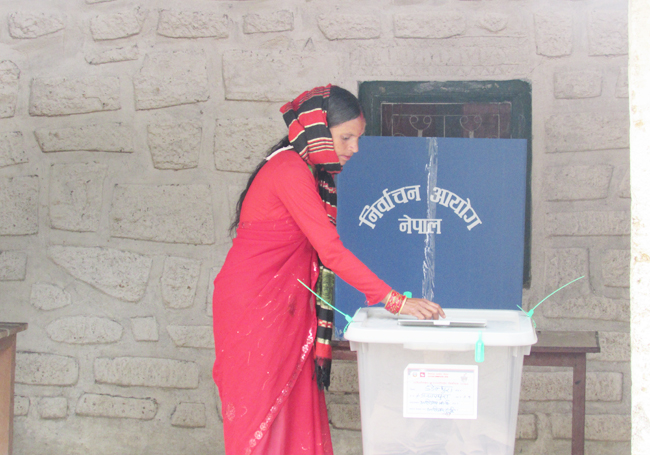
 A woman casts her vote in the second phase of local elections in Dadeldhura last week. Pic: Bachu BK
From the Nepali Press
Durga Dulal in Nagarik, 2 July
Amidst the euphoria that greeted the new Constitution’s provision to devolve the power of Singha Darbar to new local governments, a bill registered in Parliament aims to do just the opposite.
If the Management of Inter-governmental Financial Resources Bill is endorsed by the House, self-governing local councils will not be able to collect taxes, and will have to depend on limited revenue doled out by the Centre.
Khim Lal Devkota, an expert on local governance, dubs the bill “regressive”, adding that it reflects the mindset of the political establishment that doesn’t want to devolve powers to the grassroots.
"The proposed Bill is even more regressive than the Local Self-Governance Act of 1999," he says. "It is against the spirit of federalism, and humiliates the local representatives of people."
The Bill allows the Centre and provincial governments to collect all taxes from sectors like mountaineering, hydropower, forest, mines, minerals and other natural resources. And 85% of these taxes will go to the Centre, leaving only 5% to the village or municipality and 10% will go to provincial governments.
The Bill even clips those rights that were given to local councils by the 1999 Act. Earlier, local bodies used to get 5- 90% of land and house taxes. The new bill restricts this ceiling to just 5%. Local bodies used to get 50% of revenue collected from natural resources and hydropower, 30% from mountaineering and 10% from forests.
The Bill does propose to allocate 13% of the Value Added Tax (VAT) to local councils – something that was missing in the 1999 Act. But it prevents local councils from directly accepting loans from other countries. Local governments can take internal loans, but they have to inform the Centre. If local councils fail to pay back the Centre's loan the federal government will deduct it from their grants.
The Constitution has an Annex of 22 exclusive rights given to local councils. Apart from these rights, they also share other duties and responsibilities with federal and provincial government. But with limited financial rights and resources, local councils face the risk of being governed by provincial governments and the Centre.