who cares Jun 17, 2011
the younger leaders in the NC and UML, who say they can work well together in a national unity government as part of a package to resolve disagreements on sequencing demobilisation and meeting the constitution deadline. We believe them.
ya! they are the reason, maosit got away from previous pressure.
Naresh Jun 17, 2011
#Kunda
Should we not see 'the big picture' before we get starched up in these dry rhetorics?
First, the concept of capital is that it's the allocation of your wealth, may it be grossly virtual. Actually, in finance, it is. For the same thing you have can have different capital depending upon the curves of market.
This is again where you are down in the mire of illusion.
First, the banking sector crises has nothing to do with the government. It may have with Nepal Rastra Bank's policies, the peg of 1.6 and Trade deficit with India, low tax policies of previous governments etc. It's the bubbled pricked after you overinverst, sort of heat up, which is basically unsustainable. Let me exemplify:
Suppose, a man wants to buid up a big house, so he could profit in the future. But, every man wants profit/s, including the banks (and any financial institutions) that lend him money. What bank does him is lend the money so it could profit. Then, as demand soars, the price balloons. (It's natural that unless in some cases, demand soars the prices of commodities high.) It balloons up until it can't burgeon, and finally, ricochets the prickly wall of recession and busts up right before our eyes. Thus, all that is solid melts in the air.
Another episode of this phenomenon:
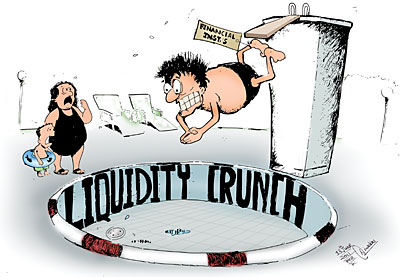
Suppose, this crisis persists. Many nationalists will cry. Why? They think their (mine too) country is alrady poor, what will this liquidity crunch kind of conundrum will do?? Oh God! They'll bewail for their country.
In fact, their investment'll be undervalued, their savings'll be vaporized, and illiquidity can punch them real hard in their coffers.
So what happens for the rural mass, who do subsistence farming, horticulture, animal husbandry, and etc.? Never think that they'll be whipped hard by the self-beaten lashes of bankers. If their products' price is down, so is what they buy. They are zero before, now too. Beware, some mediamen will demonstarte that this banking crisis has been real hard for poors, for example, to Rame of Ramegaun, Shyame of Shyamegaun and Kirte of Kirtegaun. Beside few, like petty burgeoisie, this crisis doesn't touch real mass of 95%.
What does this banking crisis do for bankers and rentiers (in Krugmanspeak)? Not so many big houses, not so consistent profit!!
Why do you care so much of this palgue, when in fact, structural economic problems are the main issues. Unless the economy diffusues upto the real non-haves, it's not the problem at all.
The capitalistic mode of production and exchanges, as esposed by Marx, suffers periodic blows, called recessions. It is the inherently acquired characteristic when the system itself becomes lax to the immunity it needs to sustain. Hence, no capitalistic mode can sustain without recessions. But, when Kunda feels that govt. must have some role in the market trends, is he not a socialist? Sensing that he blames Maoists the most, he must be a die-hard socialist.
Which makes me think: When Lehman tumbled down in the viral spiral of bankruptcy, it crated a domino effect to others like Fanny, Freddie, AIG, Citigroup, many car, insurance companies and even medium and small sized banks due to lack of lending. But at last, American govenment saved some too bigs to fail.
By whose money? Taxpayers'!
Nicholas Kristof and Paul krugman have repeatedly written about economic condition of America. Don't get confused in GDP! At first instance, almost 90% of Americans earn less than top 1%. R&P 10% exceeds some 15. Millions are jobless, some even unable to pay the debts. It doesn't matter how many credit cards you swipe in a day because one's earning is always dependent on the system he/she earns.
Now, American Government is trying to be pro-business at the leap of faiths of millions of taxpayers' lives.
Thus, your assetions that political powers are behind this crisis, which is the gross effect of reckless lending of profitwallas, is unmindful, ignorant and fatally loopholed wherein you basically demonstrate how little you know about economics. Better not try to speak on the topic you don't know.
Arthur Jun 18, 2011
Last week it was "demobilizing". This week it is "decomissioning".
Would it not be possible for Kunda Dixit to write about "integrating" the PLA into the Nepal Army?
"Integration" is the word used in the peace agreement. It means combining the two armies into one. It does not mean one of the two armies demobilizing or decomissioning to surrender to the other army. There is no question of surrendering arms. When the former PLA soldiers are integrated they will be equipped with more modern arms.
An honest anti-Maoist article could give reasons for opposing "integration" and demand a new peace agreement based on "demobilization" or "decomissioning" (or "surrender") instead of integration.
But instead of such honesty all we get is flat refusal to use the actual words of the agreement in order to pretend that the refusal of anti-Maoists to implement the agreement is actually the fault of the Maoists.
Does repeating this change anything? Does it convince anybody who did not already oppose integration to "forget" that they were once not opposed to it?
Or is the only point of this repetition to soften the impact of quietly admitting that a Maoist led national unity government is the only way forward?
Is it too embarassing to simply and directly acknowledge that it was a mistake to support Congress refusing to participate in such a government and to waste several years on trying to prevent the largest party from leading the government and so delay the peace agreement and constitution being finalized?
manohar budhathoki Jun 18, 2011
" be as corrupt as you want" ??????????
jange Jun 18, 2011
Kamred Arthur,
The correct word is rehabilitation. These are sick people who went around murdering, looting and extorting simply because some "leader" or "messiah" told the that it would bring salvation.
who cares Jun 18, 2011
3. Arthur,
"integrating"
you foolish, the 12pt agreement is written in nepal, the words like "integrating" is the out come of translation from semi knowledge brain.
who cares Jun 18, 2011
i had heard about presence of hitler's supporters in UK, US.
but just a few days ago, i came to know that those supporters in UK were against the war (anti war/pro peace)- may be the same in other parts of the world.
and i was some what surprised that those demanding peace were out-lawed by then govt. of UK and also jailed.
after all those, i am not surprised that the idiots, over smarts like arthur are still in existence.
just like in then UK, in nepal, we are going through the similar phase. where those who want peace, freedom are tagged as war mongers, where as those supporting/ helping agent of death in the name of peace are revolutionary.
(UK, EU, US too did everything to destroy hitler- assignation attempt, bombing, killing and what not.)
but just like in UK, after the phase passed, we too will have a new dawn. there will be a day where commies will be considered as evil in nepal too just like in EU, those commies, terrorist will no longer be able to show their filthy face then after.
in nepal, i think, we shall have that day sooner than EU did.
this fool, who calls himself arthur, does not know one thing that in nepal, there are some individual have started to come forward blaming for all the problems going on in nepal, unable to solve it to commies.
these maoist will not only destroy themselves, but will take all commies with them to hell.
ps- if you want to know more about me- read my past comments on blog.com.np under name "change(human right, prosperous nepal)".
Roshan Sharma, Australia Jun 18, 2011
WOW, What a Journalism!!!! Not a Single word of "Attacked Journalist"! even after a week! Should We award you as A REAL Civilised CitiZen!!!!!!
Naresh Jun 18, 2011
There is nothing new to add to what we wrote last week, or the week before, about constitution-making and the peace process. It's still one step forward and two steps back. The NC and the Maoists are bargaining hard over the number of fighters and weapons, but the real obstacle is the triangular infighting within the Maoist party.Kunda, I'm really sick of your contorted denominations. Just as I watched your quasi-academic, duff opinions rehearsed, I was yet vaguely expectant that you won't extrapolate your humbug express in this issue. Sadly, that's you defenestrated Arthur's and my opinions out to the dust bin.
I'm clear that there exists some real infighting within the Maoists. But, you say that's the real problem. It's just manifest content, but not a latent one. The closer approximation is: Maoists are former rebels, still having traces of revulsion of violence, but they fear if their struggle will be thrown into the air by other political parties and press. Do you like your existence vaporized (like your thoughts and identity as in Orwell's 1984)? This struggle is basically existentialist one--that Maoists fear they would be subdued unless they trounce others in some ideological and pragmatic grounds. You made them feel so, who basically labeled Maoists incompetent but forced them embroiled in some trifling issues during their government. They have some genuine agendas which they don't agree with you. So, their outlook of the governance, progress and real-politick differs in some core means. But your always blaming them is so really subversive. One day, you'll write that the real problems are Nepali people since they blundered the CA election to chance Maoists enjoy the limelight.
That's why you perspicuously write Maoists are not yet democratic party. It's so easy for you to be democratic, but not to the "marginalized caucus" who think that if its equities are not ensured, it has only but final option of struggle. Personally, I know if there were peace-loving people like you around, the world would have been so paradise. But it doesn't happen!! Why?
Because democracy doesn't necessarily ensure equality. Basically, what is the need of cropping shopping malls in Kathmandu when you have patchy, potholes-ridden roads out in my district? What is the need of establishing high-tech schools to glean profits from ambassadors, politicians and businessmen when you have at least 2 in 5 adolescents dropped out of schools due to strain of finance? Do you think you are serving the nation because your paper is the platform of some interesting ideas, generally waffled with tantrums of gossip of clothes, fashions, wines, restaurents in Thamel, concerts, foods, shopping malls, cellphones, hairstyle, Miss and Mr. Competitions etc.? Why don't you dare to write about your Indian friends when your sovereignty is directly encroached? That's because your friend is the enemy of your enemy. Is it not you dare not write tax evaders who are real scourges? I think you also have nexus with them in some ways. Have you ever dared you can pay significant sum of taxes, so everyone would benefit? I don't grandstand for the Utopian version to ghost away the real chance of peace to the twilight zone. Being a simple democrat , I believe the real appreciation of peace starts from such society when everybody is given a chance to perform some basic privileges and rights. It's Norway where you have highest income tax in the world but funds small, early starting business..It's Switzerland where people have notions that you ain't wealthy unless you cheat or exploit in some means. .. Otherwise, it doesn't matter whether you build two storied building or four storied building out in the shifting sands of desert. I mean first you need some basic rights, then only fiat of democratic governance. Journalist like you who have so much balance to enjoy movies out in the Italian airscape don't know what problem it means not to have fare to travel to Kathmandu. Nor do you know what kind of nationalism persists for landing in Arab than to perform concert in Kathmandu singing some schmaltz, sugary-coated songs. Kunda, your fight for democracy is merely an illusion, so ill-clad and ragged inside. You are the kind of people who lord some expressions to afford the whole crumbling of the State. You just parrot pitched phrases out in the heap of Everestly versions because it sounds really charming to int'l friends. Yes, for you, it isn't Maoists important, who notionally represent some two-fifth section of Nepal, but your int'l friends. That's why you like to trade your circumlocutions wholesale.
Am I a duffer or you?
Your seeing into problem is always one-sided. I request you to get it, not just publish it. You need to change the power of your lens, which always sees your own fellowmen warp and grotesque.
...so much for "nothing new to add".........
Arthur Jun 19, 2011
#6 and jange #5,
The text of interim Constitution in both english and nepali is available links here, including schedules with the Comprehensive Peace Agreement and Agreement for Management of Arms and Armies.
All versions use the term "integration". There is no way for anyone to confuse this concept with "rehabilitation" since rehabilitation is separately provided for since those Maoist combatants not registered at cantonments are explicitly excluded from integration. There is no mention of terms like "demobilize" or "decommission" but very clear insistance on "democratization" of the Nepal Army.
The problem is nothing to do with translation but with willingness to actually accept what was necessary for peace.
It is no surprise that someone who believes Hitler supporters are jailed in the UK for being anti-war and pro-peace (#7) has similar views about war and peace in Nepal.
Nor is it surprising that jange just repeats his mantra against the peace agreement. He has never pretended to support it.
What I drew attention to was that it was not jange, or "who cares" from whom one expects such stuff, but Kunda Dixit who is trying to invent a different peace agreement from what was actually agreed.
Naresh Jun 19, 2011
#ArthurNearly right!!
For now, the power of language is/has been revealed. Read Wittgenstein.
As being a linguist myself [hahaha!!! :) ], my belief is every translation is a fresh document, per se, a new agreement. I'm a little bit Derridean and Foucaultean.
jange Jun 19, 2011
# 10 Arthur
What I drew attention to was that it was not jange, or "who cares" from whom one expects such stuff, butKunda Dixit who is trying to invent a different peace agreement from what was actually agreed.
Kunda can read and understand Nepali too. And he is not too bad at translation into English and he hasn't made a mistake.
You miss the whole point Kamred. All the interpretations are correct. It was done that way so that the the Maoists, and their foreign supporters could claim that all the murder, loot and extortion was a glorious revolution while the rehabilitation work could continue.
In much he same way as one might go along with a child pretending to be Napoleon that he really is Napoleon until he gets tired of it.
Soni Jun 19, 2011
"Our message to the politicians is: it's the economy, stupid."
The politicians know it way better than anyone else, including Kunda Dixit. The fact that they have a huge patronage network to cater to, the NC, UML and the Maoists have to do what they are doing.
Normally, a democratic government would present the budget, the opposition would find flaws in it that would be debated, and if the majority government overrules their objection by taking advantage of the majority, there are a number of ways in which the opposition can benefit from that, or not.
But of course, this is no democracy. This is an Oligarchy.
"We believe them"
To expect someone of Kunda's stature to accept failure would be, well, not believable.
But Kunda appears to be supporting a man who has repeatedly justified the murder of many thousands (millions by denial as well), has not proposed a single original idea, including during his time as the FM, (and said nothing innovative and new even in his Phd thesis), has shown himself to be an extraordinary hypocrite by sabotaging his own party, for his own benefit, and saying just the opposite.
The list of this man's hypocrisy is probably exceeded only by Prachanda, and yet, Kunda believes him and others like him. Good.
"There is nothing new to add to what we wrote last week, or the week before, about constitution-making and the peace process."
Here is the thing, you have said nothing about these two topics ever. Other than to produce exhortations one way or another.
Have a look back at your editorials, publisher's note etc. You will know if you are honest with yourself.
Naresh Jun 19, 2011
#Soni1. Yours dart hits the bull's eye.
2. Now, Kunda has to learn from his own hortatory boomerang.
3. But I had been reading about Malalai Joya,, really a role model and a voice of dignity.
jange Jun 20, 2011
# 13 Soni
It is really naughty of you to remind Kunda tolook back at his editorials and other writings. We are supposed to forget about all those and concentrate on the present. Otherwise Kunda and NT will like a leaf fluttering in the wind.
Arthur Jun 20, 2011
jange #12,
"...All the interpretations are correct. It was done that way so that the the Maoists, and their foreign supporters could claim..."
This is so typical. Whatever is in your head is "correct".
What was necessary in order to reach an agreement simply does not matter to you.
The monarchy has gone, the credibility of the anti-Maoist parties has gone and the PLA and the Nepal Army are still there. So if the agreement was designed to paralyse the Maoists it seems to have done a better job paralysing the other parties.
Do you expect it will continue for ever?
Do you imagine that one fine day the PLA will be "rehabilitated"? You certainly keep saying the opposite.
Do you expect that military rule could succeed?
None of these are remotely possible.
All you can hope for is that the process which must eventually end up as already agreed will be delayed as long as possible so that people like you can continue collecting donor funds to look for elephants in Namche.
Naresh Jun 20, 2011
"Be as corrupt as you want, fight tooth and nail among yourselves for power, but leave the budget alone."
To suggest someone not to get away with habits that forces him/her to do something, but at instance, to oppose that very act of something is tantamount to to change the direction of Karnali towards Accham from Bardiya...that's what my wispy hairdo granpa quipped...following the rejoinder from granma...
What if the crux of tooth and nail fight is for that budget?...indeed it is..
Kunda,..what if your horse is so sick and you sicken it further, and for such horse at cantor, could you expect that poor horse of gallop just because you have a long whip, and a long hand to 'will' it?
Gentlemen, by messing around with the economy you are sawing the legs off the chairs you are sitting on.
Good that such pithy lines have long been admonished. Let us fantasize these trolls and orcs! These grisly sorcerers need to saw their chair they sit in...we must weed them out should we dream of something substantive development to be seen in peace process.
My foreboding is these rotten diehards like Mohan, Chandra & Co. should be strapped in shoulders and thrown into Bheri. At least, they must be muffled hard in their bronchitis so that they don't let my spine write in bygone Marxist verbatim.
The Chinese are reclaiming their glory since they opened the lid of modern capitalism with strict state's edicts. Don't these commie know these things happen regularly in Mao's land? Pushpa's as well as Babu's line is best these days...the ooze of vitriols from these rotten mindsets of Mohan & Co. is really depressing.
How much I hate Mohan I can't explain...
jange Jun 20, 2011
# 16 Arthur
So if the agreement was designed to paralyse the Maoists it seems to have done a better job paralysing the other parties.
You are perfectly correct. But the paralysis is due to the fact that the other parties thought appeasement would work and they should have known better. Appeasement never works.
Arthur Jun 20, 2011
jange #18, "...the other parties thought appeasement would work and they should have known better..."
But the other parties fought a long war against the Maoist and killed more than 10,000 and discovered that did not work.
You have not explained what you think would work and why your side has not done what you think would work.
It is reasonable to suspect that you are unable to do so.
jange Jun 21, 2011
# 19
For those who understand it is already explained- Appeasement does not work.
If you don't understand or don't wish to understand, that is your problem.