
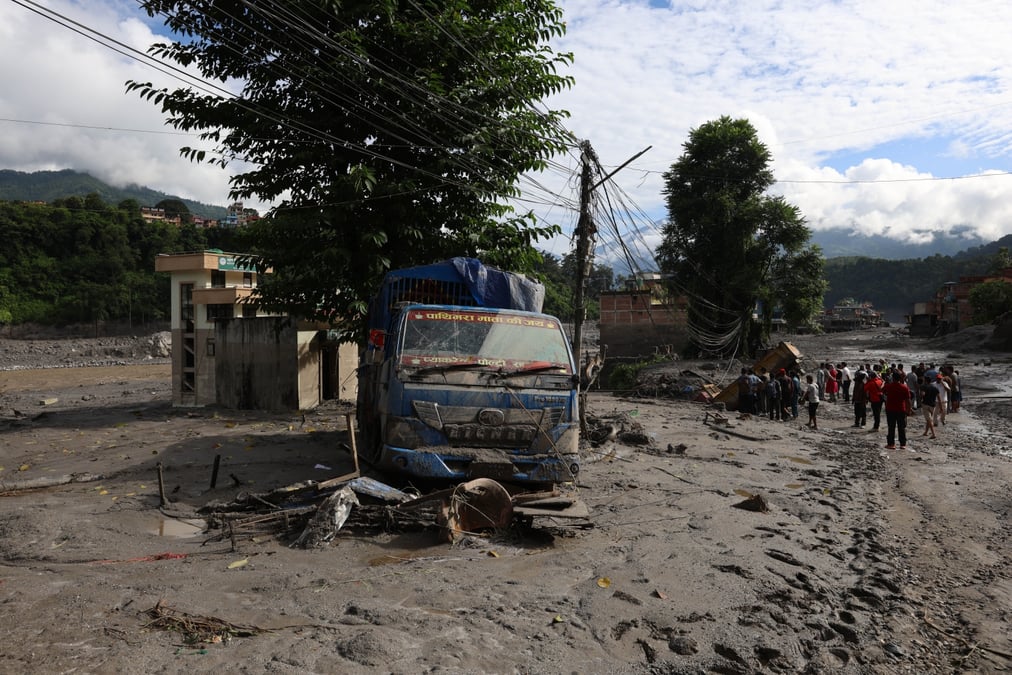
More than a week after the catastrophic Himalayan tsunami that tore through the Nepal-Tibet border and swept away entire villages downstream across five districts, the country is coming to terms with the human and economic cost of the disaster.
The death toll from the disaster has reached 1,287, with more than 5,000 people still unaccounted for in Nepal and China.
While the response to last week’s flood from foreign governments, multilateral agencies, and the international community has still centered on assistance and grants, the government in a letter to the newly established UN-backed Fund for Responding to Loss and Damage (FRLD) this week has claimed climate reparation.
Foreign Minister Shisir Khanal told Kantipur that Nepal’s post-disaster relief and rehabilitation must not be measured in bilateral aid or multilateral grants, but in terms of climate justice. He added that industrialised nations and major emitters have a moral and legal obligation towards Nepal.
On Wednesday, Prime Minister Balendra Shah in a rare address to Parliament after assuming office six months ago also said: “The entire world has contributed to climate change. Mitigating and managing its impact is therefore the shared responsibility of the international community.”
While Nepal has a strong moral and scientific claim to climate compensation, the challenge lies in building a data and evidence-backed international case that the disaster was caused by climate breakdown.
“International aid is generally provided voluntarily as humanitarian assistance, whereas climate compensation or reparations imply a much stronger recognition of responsibility and liability by major historical and current emitters,” explains economist Meen Poudyal Chhetri of the Nepal Center for Disaster Management. “That remains politically and legally difficult under the present international climate regime.”
To make its case stronger, Nepal now requires systematic documentation of economic and livelihood losses, infrastructure damage, disruption of education and health services, environmental losses, long-term recovery costs, as well as robust climate and disaster attribution science demonstrating how anthropogenic climate change has contributed to increasing the underlying risk.
“The global commitment to climate change is inefficient,” adds environmental economist Arjun Dhakal. “While the scale and transboundary nature of this tragedy has created global pressure and hopes for positive climate-responsible outcomes, how much the biggest global economies are willing to compromise will be decided by their internal politics.”
Nepal’s case may also be complicated by the fact that the past governments did not prevent the expansion of settlements along vulnerable floodplains, and due to its cascade of hydropower plants as well as highways along glacier-fed rivers known to be in a high-risk zone. Many of Nepal’s problems are a result of political and governance failures and pre-date climate change.
MAJOR SETBACK
The RSP government has been in power only six months after last year’s youth protest. It had ambitious plans to expand Nepal’s economy, attract investment and create jobs. Now, it must immediately confront post-disaster losses that will amount to billions.
“This disaster has dealt a significant blow to an already vulnerable economy still reeling from the impact of the 2015 earthquake,” says Dhakal. “It is a major setback.”
Finance Minister Swarnim Wagle estimates that post-disaster recovery could top $5 billion, but this is an initial estimate. Other experts say the overall economic cost when recovery and rebuilding are factored in could exceed the impact of the 2015 earthquake, which cost $7-$10 billion.
The Independent Power Producers’ Association, Nepal (IPPAN) has said that losses to the hydropower sector alone could amount to as much as $200 million. The destruction of a vital trade, tourism, and transport corridor will mean that the cost of the disaster will reverberate across Nepal’s economy, from soaring prices of consumer goods, electricity, aviation, as well as the insurance, reinsurance, and stock market.
The flood has either destroyed or dealt extensive damage to at least 40km of roads, and over 40 motorable bridges. Weakened by the floodwaters, a section of the Prithvi Highway at Krishnabhir collapsed into the Trisuli earlier this week. Meanwhile, at least 12 run-of-river hydropower projects, both operational and under construction, with a combined capacity of 669MW have been damaged. The 25MW solar plant in Nuwakot, Nepal’s biggest project of its kind, was also affected.
The flood has impacted up to 90,000 people across thousands of households in fifty-four wards across Rasuwa, Nuwakot, Dhading, Tanahu. In more than a dozen affected wards, entire villages and major local markets along the river corridor have been entirely wiped out.
Experts say that the country’s road, energy, and urbanisation have not accounted for its geography and terrain. For instance, even as more than 30 motorable bridges were swept away by the flood, the Mugling bridge, which was also directly on the path of the flood, remained intact due to its elevated structural design and steel and concrete arch framework.
The Super Trisuli hydropower project also only sustained minor damage, which its surveyor attributed to the flood-probability assessment carried out before construction, and its location away from the direct flow of the river.
“The scale of this disaster is not just attributable to climate change, but also to our negligence in building infrastructure,” notes Dhakal. “We have the knowledge and technology to build climate-resilient infrastructure, but we have compromised on safety. This is a policy as well as engineering failure.”
Much of Nepal’s roads, settlements, and hydropower projects are built along major river corridors without comprehensive hazard and risk assessments. The Trisuli corridor alone has 34 hydropower projects including on its tributaries.
“Recovery should be guided by transparent damage assessments, risk-informed planning and resilient infrastructure standards,” says Chhetri. “We should not continue placing expensive infrastructure and settlements in highly exposed river corridors simply because those locations are economically convenient.”
Economists say that Nepal also needs spatial and energy diversification to minimise risks to energy infrastructure, and introduce zoning laws that keep people from building on floodplains. This disaster provides an opportunity for Nepal to start from scratch and make the Bhote Kosi–Trisuli corridor a national model for climate-resilient infrastructure and economic planning, they add.
This means redesigning vulnerable hydropower and transport infrastructure, strengthening early-warning and real-time river monitoring, ensuring safe evacuation routes, and relocating settlements and critical facilities from high-risk riverbanks to safer areas. Integration of satellite technology, seismic and GNSS monitoring, glacier and permafrost observation, river gauges and community-based warning systems is also necessary.
“Most importantly, ‘Build Back Better’ should mean ‘Build Back Safer,” Chhetri adds. The lessons from this flood should be applied systematically across Nepal’s mountain and river corridors so that economic development does not create new disaster risks.”
YOUR VISIT MATTERS
This tragedy has come as Nepalis prepare to celebrate the festival season from next month onwards. The impact on trade is significant because the flood swept away the Trisuli-Rasuwagadi-Gyirong road to China which is the second most important cargo route after Birganj. On Tuesday, China also indefinitely shut off the Tatopani trading post citing new flood risks.
The flood has also led to the collapse in two places of the Prithvi Highway linking Kathmandu to Pokhara, Birganj and Dhangadi. The Department of Roads has in the meantime opened multiple alternate access roads, and says repairs will take weeks. Then on Wednesday morning, a section of the Nagdhunga-Naubise road collapsed, further impacting access to the capital. Traffic except trucks carrying fuel and two-wheelers have been diverted to the recently-opened Nagdhunga tunnel.
The blow to the transportation network is set to raise the cost of consumer goods, air travel, and deprive hundreds of people working across the trade, transport, and tourism networks.
Some trekking outfits and hotels have reported cancellations by tourists for the autumn season, as news from the Nepal disaster went global. But tour operators say the rest of Nepal is still open and preparing to receive visitors, adding that the best way to help Nepal economically is to visit the country. On Wednesday, Nepal Tourism Board put out a call for visitors to travel to the rest of the country, saying it would stimulate the local economy with the tagline: ‘Your Visit Matters’.
‘The Nepal flood disaster is pretty much localized to fairly small upper Trishuli and Bhote Kosi valleys with the vast majority of the country living business as usual,’ wrote Czech tour operator Michal Thoma on social media. “There is little to none reason to avoid Nepal travel.”
But while the macroeconomic impact is significant, the economic cost to the thousands of Nepalis is immense. Survivors across central Nepal have not only lost their loved ones, but their homes, agricultural lands, livelihood, employment, as well as access to markets.
Bustling local trade hubs including Rasuwa’s Timure and Syafrubesi as well as the historic Trisuli and Betrawati now lie buried in sediment. Survivors with no other housing and livelihood options could have no choice but to migrate to cities, or abroad.
“The reconstruction effort will present local employment opportunities, and skilled and semi-skilled human resources must be absorbed into recovery efforts,” says Dhakal. “And river corridors could revert back to various forms of agriculture.”
Nepal’s economic recovery now must not just focus on large-scale infrastructure, but must also provide support to survivors so that they can rebuild their lives and livelihoods.
Says Chhetri: “Losing family members, homes, farmland and livelihoods, while also being cut off from markets, can push already vulnerable families into debt and poverty. People need support to rebuild their homes, restore livelihoods, restart agriculture and small businesses, and regain access to markets and essential services. Recovery assistance should reach affected families quickly, fairly and transparently, with special attention to the most vulnerable.”