
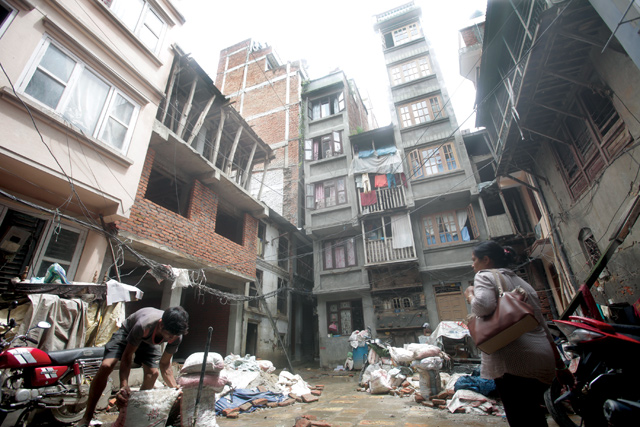
Two years ago, when the earthquake destroyed the mud-mortar houses in Kathmandu Valley, it convinced many that cement buildings were safer. But a new study has revealed that many of the reinforced concrete construction (RCC) buildings in the Kathmandu Valley do not meet minimum government standards and would not withstand a strong earthquake in future.
The two year-long study titled ‘Project for Assessment of Earthquake Disaster Risk for the Kathmandu Valley,’ led by the Ministry of Urban Development in coordination with Japan International Cooperation Agency (JICA) and other government agencies, found that out of 250,000 RCC houses in Kathmandu only 27,000 or so followed proper engineering and design guidelines.
“Only six per cent of the RCC houses in Kathmandu Valley follow engineer-approved designs, whereas 48 per cent of houses are non-engineer RCC building, meaning they were constructed by the house owners without keeping the earthquake safety in mind,” explained Suman Salike, senior divisional engineer at the Ministry of Urban Development who was involved in the assessment.
According to the 1993 building code, an RCC building needs to have 12×12 inch pillars, but engineers involved in the assessment said that many of the RCC houses were found to have 9×9 or 9×12 inch columns.