
|
|
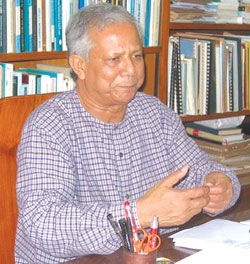
Muhammad Yunus and the institution he founded in 1976, Grameen Bank of Bangladesh, won last year's Nobel Peace Prize for 'efforts to create economic and social development from below'. Owned largely by poor women borrowers, Grameen Bank has long upset conventional banking paradigms. It does not ask for collateral, legal instrument, group-guarantee or joint liability of any kind when giving out small loans or microcredit. It enjoys a recovery rate of about 97 percent. Since its inception, it has disbursed $6.20 billion to over seven million women in 77,000 villages across Bangladesh. Grameen's microcredit model has been replicated in over 100 countries. Columnist Ashutosh Tiwari met up with Yunus in Dhaka.
What do you mean when you say "access to credit is a human right"?
We have the bill of human rights, which covers the rights to shelter, work, education, and so on. My question is: who's going to bring these rights? There is this expectation that the government will somehow provide these rights. But we have seen that the government is unable to provide them on a silver platter.
What it can do is create an enabling environment so that people can earn incomes for food and shelter. This makes earning an income a critical task. Textbooks say that the only way to create incomes is through jobs. But the governments of Nepal and Bangladesh cannot create jobs for all the people. If so, why not let poor people create their own jobs?
As it is, people sell food on the street, pull rickshaws and do other things to make a living. One way to support such self-employment is through financing. That's because once you have some borrowed money, you can use it to earn an income, which makes it easier to buy food, be healthy, and have a shelter and get an education.  You've developed a list of 10 qualitative indicators to assess whether a family is out of poverty. Are these Bangladesh-specific indicators or can they be applied widely?
We have been using them to monitor whether our borrowers get out of poverty. If others find these indicators useful, that's good. When you define a poor person as someone living under a dollar a day or surviving on less than 2200-calorie of daily food intake, who, except for the experts, is going to measure all that? This means that we need experts to tell us who is poor and who is not, and that gets us into academic debates that do not help the poor.
In our case, we regularly visit a borrower's home, and see what kind of roof she's got. If it's leaky, she's poor. If not, that's good. Does she sleep on bed with mosquito net? If yes, that's good. If not, she's poor. Does she have access to clean water and sanitary latrines? Do her children go to primary school? Does she have access to basic health service providers? Do her children go hungry at any time of the year? Only when our 10 easily verifiable criteria are fulfilled do we say that her family has graduated out of poverty. This check-list of simple monitoring indicators has worked well for us.
You have said, "We can put poverty into museums". Are you suggesting that microcredit alone can eradicate poverty?
My point is that all human beings are packed with a bundle of capacities that they need for themselves and to contribute to others' growth. But we live in societies that do not give opportunities to people to unpack the gifts that they have within themselves. If we find ways to unleash people's potential, then, yes, we can put poverty into museums.
I am not saying that microcredit alone will do all that. But it is one tool that helps unlock poor people's untapped potential to do good for themselves and others around them. A woman gets a loan. At first, she is scared because she has never handled borrowed money. Once she starts to use that credit to make money for herself through a small-scale entrepreneurial activity, she finds that new possibilities have opened up for her and her family. Those possibilities are likely to get her out of poverty.
If all our global formal banking systems collapsed today, that would have almost no effect on two-thirds of humanity. That's because billions of poor people are not even participants in what goes on in the name of financial services. Microcredit is one way they can open bank accounts, borrow money, make use of their ideas to make more money for themselves, learn to make their own decisions and empower themselves.
But not all poor women can be successful small-scale entrepreneurs. Does that mean that the success of microcredit is necessarily tied to there being a bundle of services to go along with credit?
Let's look at it this way. If you have a 15-course meal, that's good. But if you are hungry, and have nothing else, then plain rice will do just fine. In times of famine, when you don't even have that rice, then you might ask for the water that comes out when the rice is cooked at a wealthy neighbor's kitchen.
 In Nepal, government promoted microcredit programs through five regional grameen banks, all of which failed. Is microcredit an area in which a government can play an active role?