
Nepal’s past tax rebate and China’s technological innovation in affordable EVs had made battery-powered vehicles popular in Nepal, but the new budget of the new government could reduce the transition to renewable energy transportation.
Foot down, hard on the accelerator and BYD’s hypercar, the Yangwang U9, hit triple digits speeds seamlessly at BYD’s Zhengzhou race track, situated in Henan Province, China.
Before I realized it, the hit 193 km/h towards the end of a 500-meter straight stretch. Hard on the brakes, and in just a couple of seconds the car made a hard right-hand turn at just 65 kph.
BYD’s crème de la crème U9 featured a 240-kW motor setup in each wheel, totalling to 960 kW, and produced 1,680 Nm of torque, meaning it was capable of reaching 100 kph from a standstill in 2.8 seconds. Compared to that, the BYD Atto 3, widely sold in Nepal, comes with a 100-kW motor and produces 310 Nm of torque. The catch? The U9 has a hefty price tag of over $200,000 – making it unsuitable for the roads and pockets of Nepalis.
During a recent visit to the Zhengzhou facility, BYD also showcased its ultra-luxurious plug-in hybrid, the Yangwang U8, climb an artificially built 30m high sand dune. The U8 also featured a quad-motor system along with a 2.0L turbo-charged petrol engine that generated 1,280 Nm of torque and could actually do 0-100kph in 3.6 seconds. And, if ever this feature is needed, the U8 can also float in water.
How did China’s modest battery maker come this far? After a one-week trip to BYD’s Zhangzhou facility and headquarters in Shenzhen, the success behind this global giant was easier to comprehend.
BYD started small in 1995 producing Nickel-Cadmium batteries, and in the early 2000s signed up with Motorola and Nokia as their primary battery suppliers. BYD went public in 2002 in the Hong Kong Stock Exchange with a starting price of HK$10.95 per share.
However, it was not until after acquiring a state-owned automobile company that BYD produced its first internal combustion engine car, the F3, in 2005. The first hybrid, the FD3M, debuted in 2008 before the company transitioned into electric buses and monorails.
BYD’s next big breakthrough came in 2020 with the mass production of its Blade Battery, an innovative use of of Lithium Iron Phosphate (LFP), known for its lower costs of production, space efficiency and energy density. BYD famously pierced its battery with a nail without it going up in flames to prove it was safe.
The next iteration of the Blade Battery, the 2.0, came out last month. It has a longer life span, even higher energy density and the ability to charge up to 97% from 10% in just under 10 minutes.
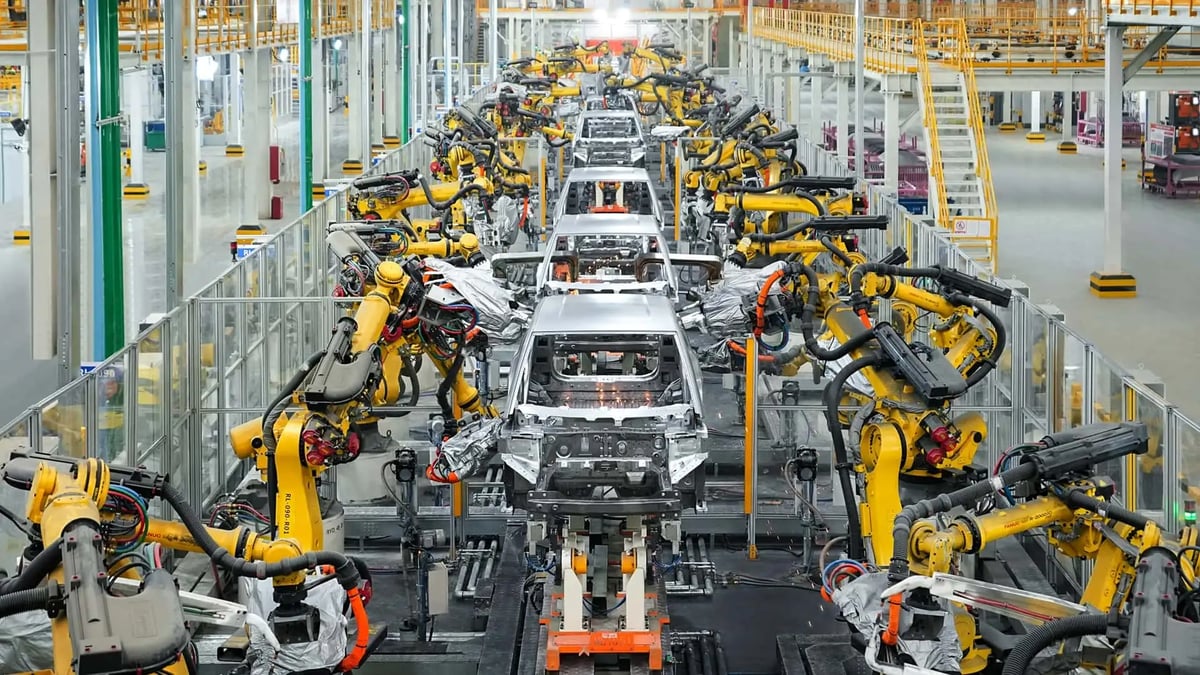
Today, BYD is at the forefront of technological advancement, and is a model vertical and horizontal integration in vehicle manufacturing. The factory floors at the Zhengzhou mega factory are impressively automated with armies of robots hard at work, intelligent warehousing and AI-driven quality control measures.
Human workers were only needed in the production line for complex interior works and small component sorting. All this means that the BYD plant rolls out one vehicle every minute. And even then, it is having difficulty keeping up with a surge in global demand for EVs because of the fuel cost hike after the West Asia war.
NEPAL MARKET
Despite its relatively small market size, next-door Nepal figures prominently in BYD’s scheme of things. The company’s aggressive marketing and Nepal’s favourable tax regime for EVs (till recently) means BYDs and other Chinese and Indian EVs are now coursing through the capillaries of Nepal’s roads and highways of Nepal.
Nepal is an important market to us,” BYD’s Asia’s Pacific General Manager Liu Xuelian told us recently at a round table at BYD’s headquarters in Zhangzhou. “We had seen great potential for EV development and for our cars in Nepal as far back as 2010.”
The combined effect could be that Nepal’s EV boom could cool somewhat, without completely collapsing. The two overarching questions in the upcoming months: will Nepalis still have an appetite for purchasing EVs at the new prices, and whether the additional revenue collected from the new taxes will translate into better long-term EV ecosystem development.
The technological innovation of companies like BYD comes at a critical point in Nepali automobile history. Finance Minister Swarnim Wagle’s new budget last week marks a shift in the country’s almost laissez-faire policies on EVs that made Nepal second only to Norway last year in proportion of new vehicles that were electric. (see box, below).
Putting a tax on electrons
The new tax on imported EVs will henceforth be based on the import value of the vehicle, and not based on motor capacity (kW) as previously. This means taxes now are calculated on a vehicle's CIF (Cost + Insurance + Freight) and could reflect the government’s perception that the EV market is maturing and a potential new steady revenue opportunity.
Previous excise duties have been replaced with a new Clean Infrastructure Investment Fee that the government claims will help pay for EV-related infrastructure. On paper, these reforms look to create a fairer and more transparent system. The old kW-based structure allowed expensive EVs with lower-rated motors to enjoy lower taxes, but by linking taxes to vehicle value, the government introduced a progressive tax mechanism to EVs, aligning it more traditionally with how ICEs have been taxed.
The budget also now encourages the installation of EV chargers at petrol pumps as minimum infrastructure, a move that, if enforced, could further reduce range anxiety.
However, the immediate concern is affordability. While a flat 20% customs duty has been introduced, higher-value EVs now face steep infrastructure fees. While the Rs 3-5 million segment that has driven Nepal's recent adoption boom may see relatively modest changes, premium and luxury EVs will face significantly higher import costs.
The change in foreign currency exchange rates between NPR and other currencies means that the CIF values at the time of import might itself fluctuate causing vehicles to shift between the new tax brackets.
The government also plans on introducing a 5% VAT for households that consume more than 50 units per month of electricity (see page 1 and Editorial, page 2). This further marginally decreases the running cost advantage EVs have enjoyed over petrol and diesel vehicles.
Nepal’s EV industry is therefore transitioning into a higher cost, more regulated, but infrastructure-rich operation environment. Which could be both good news and bad news for prospective car-buyers.
Arnav Upadhyay is a content creator who reviews automobiles and promotes road safety on Youtube, Tiktok and IG under the handle Casually Annoyed Driver, and writes this regular column Drive Line in Nepali Times.