
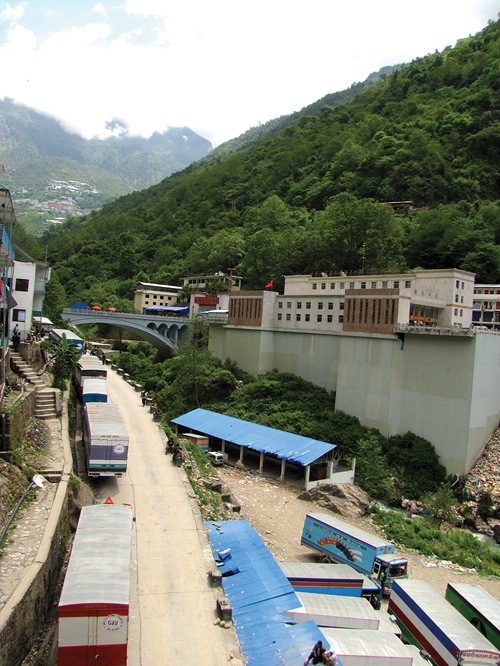
After India cut off Nepal’s trade lifeline with the south three weeks ago, the Nepali authorities have weighed multiple options to ease an acute shortage of fuel and other essential commodities. Their first option was to import petroleum products from China, but that turned out to be the least workable one because the earthquake has blocked the two main roads leading north: Tatopani and Rasuwagadi. The Rasuwa road reopened this week with Chinese assistance but the Tatopani highway remains blocked by huge boulders.
Ananda Prasad Khanal, the former Director General of the Department of Roads (DoR), is not surprised by the slow pace of repairs. “Nepal has never given priority to increase its land connectivity with China,” he says. DoR officials say the government was not serious enough to reopen the Tatopani road until the Indian blockade. Only Rs 6 million was allocated to reopen the Tatopani road, even though repairing just 1 km of the damaged section requires around Rs 10 million.
Laxmi Dutta Bhatta of the DoR, says the budget allocated for the Tatopani road was merely a drop in the ocean. “We needed at least Rs 50 million and if we had that we could have opened the road even before the blockade,” he says. The sluggishness with which the Tatopani road is being repaired bears testimony to the fact that Nepal has never given due importance to building connectivity with China, thereby relying heavily on India for essential commodities. In the wake of a crippling embargo enforced by India, Nepal finally seems to have realised the mistake that it made by not maintaining alternatives.