

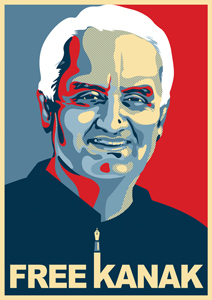
 Kanak Mani Dixit is one of the most vocal dissident voices on Nepal. I have known him for more than ten years as a journalist, human rights defender, teacher and a builder of institutions.
He has never run away from his responsibilities as a concerned citizen and has spoken out on many occasions against violations of human rights, abuse of power and corruption. One wonders whether the arrest of Kanak is the signal for a new clampdown on dissident voices in Nepal under the new constitution.
Kanak’s arrest and the manner of his detention in a police lock-up in Kathmandu on allegation that he has amassed disproportionate wealth by misusing his position as the Chairman of Sajha Yatayat raises serious questions of abuse of authority by Nepal’s Commission for the Investigation of Abuse of Authority (CIAA). This arrest is questionable particularly as the Supreme Court of Nepal on November 2015 had questioned the basis on which the accusations of financial irregularities were made against him.
This is not the first time that Kanak has been accused. In April 2014, a Maoist member of Nepal’s Parliament had accused Kanak of financial impropriety, and the reason was his campaign for the arrest and prosecution of the Maoists leaders who were involved in the abduction and killing of Krishna Prasad Adhikari in 2004.
Kanak Mani Dixit has been one of the most vocal critics of Lokman Singh Karki’s appointment to the post of Chairperson of CIAA by the Constitution Commission in 2013. Karki was Chief Secretary under the autocratic rule of King Gyanendra. The Rayamajhi Commission, set up to investigate the abuse of power during King Gyanendra’s autocratic rule, had accused Karki of using excessive force in suppressing the popular democratic movement in 2006.
It is unfortunate that Nepali political leaders did not support the demand for the cancellation of his appointment. Rather, it was with the support of political leaders that the person who tried to suppress the Second Democratic Movement became the chief ombudsman of Nepal.
Given the history of Kanak’s opposition to his appointment it is not unfair to suspect that the investigation against him is guided by Karki’s personal bias. The arrest on a Friday afternoon, when the office of CIAA and the courts were closing down for the weekend, suggests a deliberate intention to harass and intimidate. This was despite Kanak’s cooperation with the investigation by submitting a 13 page document listing his assets.