


Over the past few years, Nepali politics has been swept by a digital ‘youth wave’ as a reaction to established parties' inertia, the crushing despair of unemployment, and a fierce desire for change. Any change.
Meanwhile, in the past week India has been swept by a digital tsunami of the Cockroach Janta Party (CJP), triggered by a fusion of similar youth anger and algorithms, signalling a fundamental shift in mainstream politics.
On 15 May, India’s Chief Justice Surya Kant referred to young people as “cockroaches and parasites”. The remarks immediately exploded into an online satirical movement. The CPJ’s Instagram account amassed 20 million followers — overtaking even the official handle of Prime Minister Narendra Modi’s Bharatiya Janta Party (BJP).
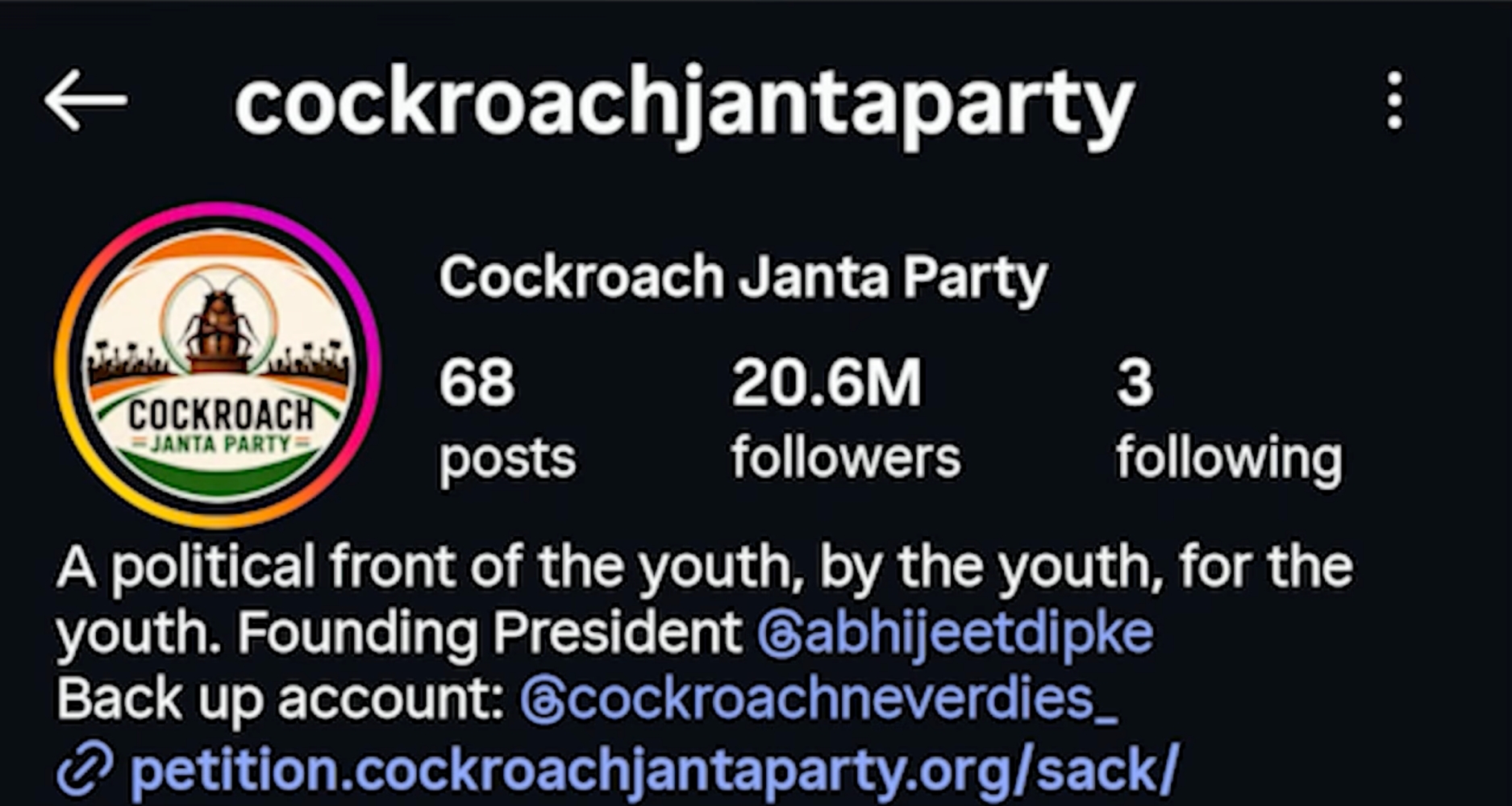
Abhijit Dipke, a 30-year-old Indian political communication strategist and a postgraduate student at Boston University, decided to weaponise this insult. Using AI tools, he built a website, a Google Form, and a satirical manifesto, naming it the Cockroach Janta Party.
“A cockroach lives only where there is filth and a rotten system, and this system has plenty of it,” Dipke said. The party’s membership criteria were equally witty and sardonic: applicants must be unemployed, lazy, and capable of expressing outrage.
CPJ is not confined to memes. Its ideological clarity and seriousness set it apart from other superficial populist movements. Looking at the wave of support for figures like rapper Balen Shah or other neo-populist forces in Nepal, one also finds a glaring void in their political ideology, economic vision, and roadmap for governance.
They talk of ‘change’ and ‘clean-up’, but remain silent on the fundamental structure of the state. CJP appears strikingly different and ideologically mature by comparison. The party has articulated its position on serious and complex issues, like socialism, secularism, and social justice, with remarkable clarity and conviction.
CJP’s influence is spreading like wildfire in India, not just among young people, but also intellectuals, workers, marginalised communities, and some political leaders. The CJP could conceivably convert its online wave into votes to challenge established parties like the BJP and the Congress.
The foundational agenda of the CJP targets the judiciary by demanding a strict, complete ban on appointing retired judges, specifically Chief Justices, to political or public offices. This proposal directly attacks the systemic practice of granting post-retirement rewards.
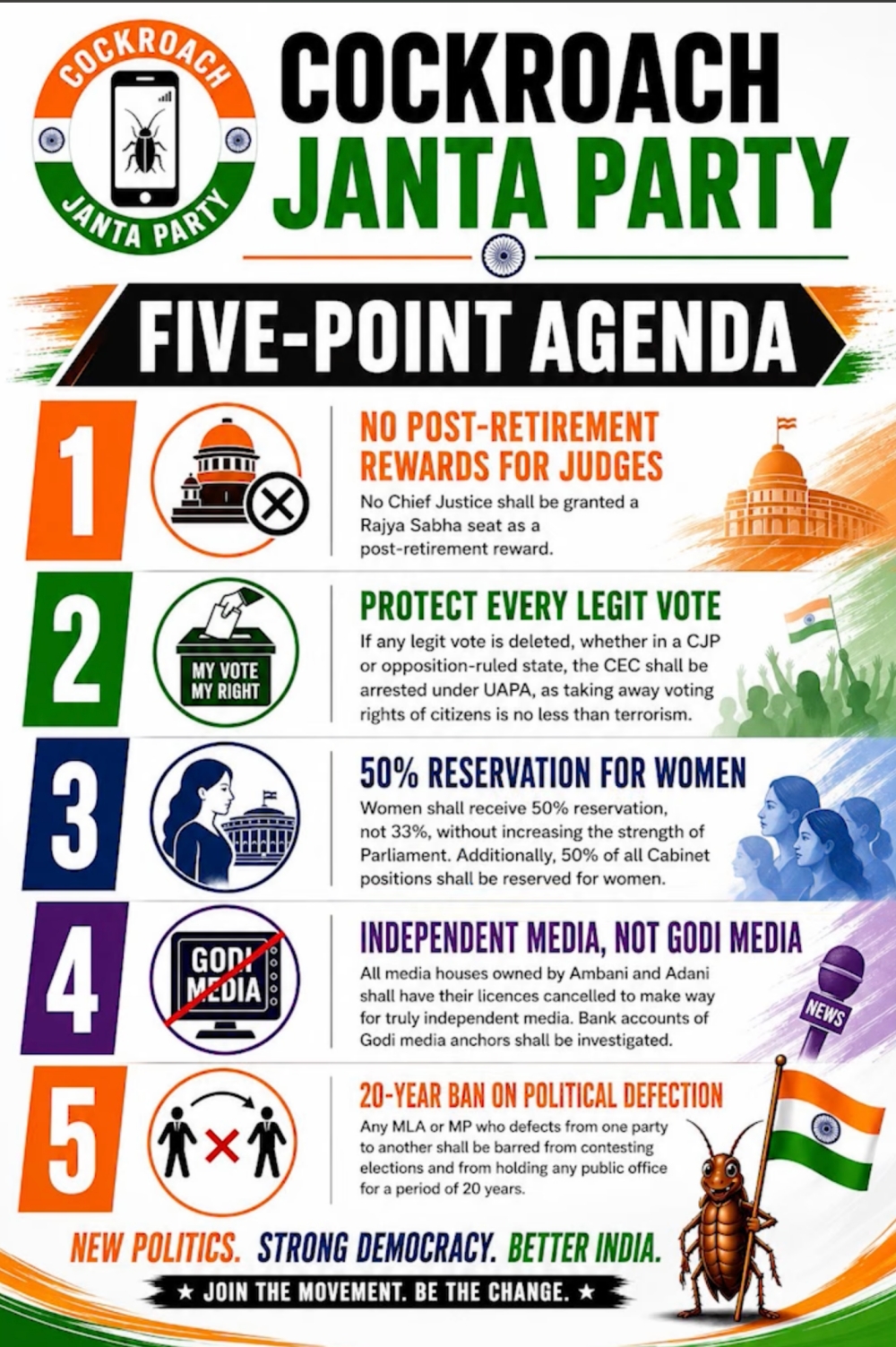
To secure democratic integrity, the CJP calls for the absolute protection of citizen voting rights across all states. It demands a 50% reservation for women in Parliament and Cabinet positions instead of the standard 33%.
The CJP also targets corporate monopolies over India’s national news by calling for the complete cancellation of broadcasting licenses held by mega-conglomerates like Ambani and Adani to make space for independent journalism. To eliminate biased ‘Godi Media’, it demands that the bank accounts of hyper-partisan, pro-government news anchors be probed.
Following its initial launch, the CPJ platform expanded through community suggestions from prominent activists like Anjali Bhardwaj on X to ensure financial transparency within the CPJ itself.
This meme-based digital political movement may sound like satire, but represents a serious desire for change. Young people have taken to the streets in cockroach costumes, joining clean-up drives and public demonstrations.“If we are cockroaches, then it is we who must clean up this filth,” they said.
The movement spread so rapidly that the Indian government had its main X handle and website blocked within India under the Information Technology Act. Pro-government commentators have dismissed parallels to similar youth-driven movements that toppled governments in Sri Lanka (2022), Bangladesh (2024) and Nepal (2025), saying Indian youth are “too busy with exams”.
Abhijit Dipke once handled social media for India’s Aam Aadmi Party (AAP), and he posted on X: ‘Many journalists have been asking me whether this GenZ movement will turn into what happened in Nepal or Bangladesh. Let me make this absolutely clear. Do not insult or underestimate the GenZ of India by making such comparisons. The youth of this country are far more mature, aware, and politically conscious than many give them credit for.
They understand their constitutional rights and will express their dissent through peaceful and democratic means.And please, do not demean them. Many of these young people are far more educated andinformed than those currently running the government.’
Dipke’s statement was not merely a response but it was also an unmistakable rebuke, effectively branding the youth movements of both Nepal and Bangladesh as ‘destructive’ for violence and burning down government buildings.

Indeed, the new forces that were elected after Nepal’s Gen-Z movement praised the youth and condemned the massacre of 8 September outside Parliament. But they have remained largely silent about the human cost of the arson and mayhem of 9 September. Dipke was critical of precisely this tendency.
Many of the issues being pushed by the CPJ in India are already being addressed in Nepal by the Rastriya Swatantra Party (RSP) of Prime Minister Balendra Shah. However, the question of judicial accountability is especially relevant because of his recent move to change the voting rules of the Constitutional Council by ordinance to appoint his preferred candidate Manoj Kumar Sharma as Chief Justice.
REGIONAL SPREAD
CJP’s support has been propelled by internet memes, AI-generated tools, and Instagram Reels much in the same way as young people have attempted to shake established power by riding social media platforms, each with its own story of success and failure.
• Nepal: Facebook and TikTok became mainstream channels for building an alternative political wave in Nepal. But the most strategic and clandestine communication took place on Discord where 20,000 young people crafted the movement’s strategy and trolling guidelines without the traditional media even noticing. This managed to shake the old parties, but the wave has yet to produce an institutional blueprint for nation-building.
• Bangladesh: Young people steered the movement through Facebook groups, WhatsApp, and the encrypted messaging app Signal. When the government shut down the internet, they resorted to offline mesh-networking technology. While they succeeded in toppling Sheikh Hasina’s 15-year rule, the movement appeared to fail in managing the political instability, attacks on minorities, and anarchy that followed.
• Sri Lanka: ‘Aragalaya’ means ‘struggle’ in Sinhala. In 2022, Sri Lankan youth suffering from a severe economic crisis used X and TikTok with the hashtag #GotaGoHome. Through crowdsourcing, they digitally mapped crisis locations using Google Maps and eventually stormed the Presidential Secretariat, forcing the ruler to flee the country. But the revolution could not be institutionalised, the country ultimately returned to the hands of the same old political elite.
• Pakistan: When the military establishment and the government moved against former Prime Minister Imran Khan, Pakistan’s youth launched a counteroffensive through X Spaces, TikTok, and YouTube via AI-generated virtual rallies. In the general elections, they achieved what was seen as the greatest digital success in history, winning seats for Khan’s independent candidates while he remained behind bars. However, the military’s crackdown and legal entanglements prevented them from changing the country’s power equation.
• Maldives: Young people used Facebook and X to drive ultra-nationalist and geopolitical sentiment. The #IndiaOut campaign brought a change of government, but when that same government became mired in debt and economic recession, it confirmed that the youth were political pawns.
• Bhutan: Commenting on CJP’s rise in India, Vidhyapati Mishra, a Bhutan journalist resettled in the United States, posted on Facebook: ‘In Bhutan too, educated young people are dreaming of leaving the country due to lack of employment and rising costs, which is dangerous for any nation. Stability alone is not enough; without opportunity, frustration is born. Leaders must respect the intelligence of young people, otherwise this satirical revolt will turn into a serious one.’
In Nepal, a curious new intellectual class has emerged that dismisses critics of the RSP government as pseudo-intellectual status-quoists opposed to change. These self-styled enlightened figures have promoted a new narrative in the public sphere that excuses excesses of the new government and labels critics of its authoritarian tendencies as reactionaries.
Recent analytical pieces in both social media and the press have identified the RSP’s critics as being those who had close ties with the three mainstream parties. But the government’s supporters show similar behaviour to prove their loyalty to the prime minister and his RSP. Within populist forces it seems there are those who hold traditional establishment views, and within the old establishment there are populists.
The new generation of young Nepalis who voted for the RSP because they were fed up with the old parties will not wait much longer for results. This generation is impatient, and can use the same social media platforms that brought the populists to power to bring them down with another digital wave.

MODI AND BALEN
The rise of the Cockroach party in India has spotlighted two populist figures: Indian Prime Minister Narendra Modi and Nepal’s Prime Minister Balendra Shah.
In terms of style, there are clear differences. Modi is twice the age of Shah, and although he avoids journalists, he can speak aggressively and fluently in forums of his own choosing. The Balen brand is built entirely on silence. He communicates not through speeches but through sharp, targeted social media posts.
Yet despite these differences, there are striking similarities between them. Both are well-groomed and dress immaculately, building their own wardrobe brands. They have a shared contempt for the mass media and both bypass institutional media to communicate directly with their audiences one-way.
Both have cultivated an image of being ruthless and action-oriented. Neither really minds being called authoritarian, and both bulldoze over laws and systems.
“The opposition and the young protesters knew very well that the old order had to end and that its fall was inevitable — but they had no concrete blueprint for what should come on the day after,” Czech democratic leader Vaclav Havel once said.
This is the dilemma facing Balendra Shah and his RSP, India’s CJP and other rebellious youth movements across South Asia. They have removed bad actors, but what is the plan to run the country once the old order is swept away?
Nepal’s populist leaders and their defenders may harbour the illusion that the monopoly on digital power, the ability to understand social media algorithms and exploit them for political gain, belongs to them alone. That old leaders and their loyalists can easily be trolled into silence.
But the unexpected and unprecedented rise of India’s CJP proves that the internet and technology are not the exclusive preserve of Balendra Shah or Narendra Modi. Digital technology moves at a pace that is both dynamic and merciless, it can forget its old heroes in an instant and give birth to new, even more aggressive voices.
The same generation that showered Balen Shah with Facebook likes and TikTok shares and carried him to power can deploy even sharper satirical digital weapons against him. If populists do not perform, the virality of the internet will bring them down.
If populists rely merely on algorithms and fail to address structural problems, another digital wave can sweep them away. Nepal’s new rulers rose on the foundation of youth outrage, they must engage sincerely with society and understand the true character of internet-driven revolt.
Binod Dhungel has been the Nepal Correspondent for Reporters Without Borders (RSF) since 2004. Watch video
.