
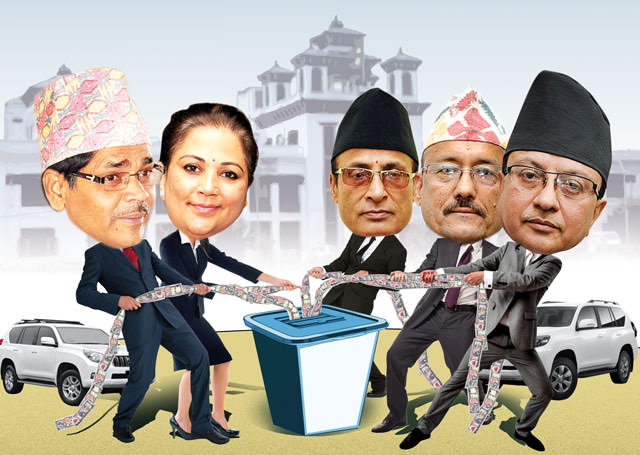
Santa Gaha Magar in Himal Khabarpatrika
In 1992, when Nepal held its first parliamentary elections under the 1990 Constitution, the polls cost just Rs110 million.
In November-December last year, when the first parliamentary-provincial elections under the 2015 Constitution were held, the Election Commission (EC) spent that much in just repairing old vehicles.
The total cost of the November-December polls was Rs10 billion—181 times higher than in 1992, and double the amount allotted for the second Constituent Assembly (CA) elections in 2013.
One might argue that the election budget may have sky-rocketed because of inflation and the necessity of simultaneously holding two tiers of elections. But the 1992 elections budget is equivalent to just about Rs810 million in today’s currency.
“The latest elections were much more expensive than all the past polls, even after adjustment for inflation,” says Nilkantha Uprety, former Chief Election Commissioner. A Himal Khabarpatrika investigation has found that the parliamentary-provincial polls were wasteful because all Election Commissioners were hand in glove for kickbacks.
They bought luxurious vehicles and unnecessary equipment and materials at inflated prices. They even submitted fake bills, and transferred the secretary who refused to go along with the scams.
Chief Election Commissioner Ayodhi Prasad Yadav and Election Commissioners Ila Sharma, Ishwari Prasad Poudel, Sudhir Kumar Shah and Narendra Dahal unanimously decided to buy five luxury vehicles for themselves. When Secretary Gopi Nath Mainali opposed their decision, he was transferred out of the EC—a move that violated the election code set by the EC itself.
After removing Mainali, the EC fast-tracked the procurement process to buy the five vehicles, each costing Rs23.3 million. Sources say the five commissioners got a cut of R 10 million from this purchase, which they divided up among themselves.