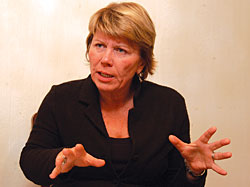
Tove R Wang is the head of Save the Children Norway and the chair of the
Rewrite the Future campaign that is working with the 40 million children who are
out of school in conflict-affected countries around the world. She was in Nepal
last week and spoke to Nepali Times about why children in conflict areas need
special attention.
|
MIN RATNA
BAJRACHARYA
|
Nepali Times: What is the reason for your special focus on
children in conflict areas?
Tove R Wang: Major donors are
reluctant to invest in countries that are in conflict and in a fragile state.
They expect good strategies and firm plans and a system that works, and
obviously conflict affected areas are usually poorly governed. Children in these
countries have an even greater need for education and the support that education
brings to restore social stability. So they are doubly disadvantaged in a way:
they don't get education and they are affected by conflict.
Do you think we are on track to meet the MDGs?
The Millenium Development Goal wants all children to have access to
education by 2015. There is no way we can reach that goal unless we invest in
and concentrate on children in conflict-affected areas. The trend of the past
years is that the number of children not having access to education is going
down, but the portion of the children not having access to education in
conflict-affected areas is at the same level. So what will happen is that the
number of children who don't go to school will keep going down but we will reach
a barrier when we count the children in conflict areas. So we are challenging
international donors through a campaign to invest more on children in conflict
and fragile states. We are working in 20 countries and Nepal is one of the five
countries in Asia.
How does the status of children here
compare to, say, Aceh?
One of the things that strikes us about
Nepal is that through the conflict years we had some access to the war zones and
we could conduct programs. Still, the needs for education are not being met, the
ministry (of education) thinks the percentage of children not going to school is
13 percent, we think the figure is much higher than that-maybe about 30
percent.
Nepal has got a lot of attention in the past year because the country is
coming out of conflict and there is a peace process. But what is not so
well-known is that there are new conflicts arising for instance in the tarai. So
it's not that there is peace and everything is now going to be all right. We
believe that if the government and NGOs and local communities work together it
is possible to significantly increase the number of children going to school.
But are there classrooms to accommodate all the new
children?
The only way to solve that is by paying attention to
training teachers. A key factor for quality education is a good teacher. It's
nice to have a nice building as well, but if I had to choose, I'd rather have a
good teacher. And it is more costly to upgrade a school than to upgrade teacher
training. The ministry of education estimates 62,000 additional teachers are
required. But the higher the quantity, the more challenging maintaining the
quality will be.
What are you focusing on in Nepal?
We work in 14 districts with government schools with a
comprehensive program that includes teacher training, mobilizing the community
and encouraging children's participation in education. After all, children are
smart; we should learn to listen to them more. I have heard that some children
have actually helped mediate between teachers and the Maoists to reopen their
schools.
If you involve the community from the beginning of the process then they will
participate and we get immense support. Essentially, its not poverty that people
are fighting but lack of knowledge. We are also involved in ensuring that
children are a zone of peace.
The government's
response?
It's not very helpful only to criticize but to see
what is working and move from there. Giving education to children is not rocket
science, it is about political will. And for us it is being able to demonstrate
that we can do it in difficult parts of the world.
