
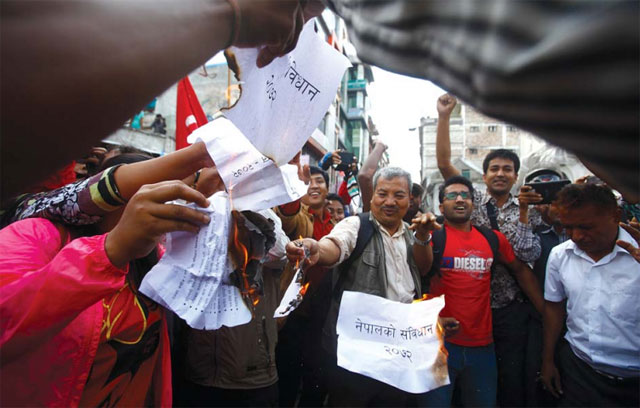
President Ram Baran Yadav’s promulgation of Nepal’s new constitution at the Constituent Assembly on Sunday marked the end of Nepal’s long drawn transition, and culmination of the Comprehensive Peace Agreement signed in 2006. There were jubilant celebrations in many parts of the country, but in the plains the constitution was symbolically set ablaze.
Undoubtedly, all these years of deliberations in the CA, protests on the streets and pacts signed behind closed doors should have yielded a much better document. But it is also essential to appreciate both complexities and limitations of this democratic exercise.
For common Nepalis, the entire purpose of the constitution was to reclaim their sovereignty which was repeatedly violated since the days of the absolute monarchy. For the political parties with diverging ideologies, it was a battle for contending visions of a ‘New Nepal’. Unfortunately, neither ‘we, the people’, nor the political groups representing us are a homogeneous category. There are layers of aspirations within the electorate and partisan agendas.
Our unflinching faith in this democratic exercise, overlooking its complexities and limitations, perhaps explains our disappointment. We may have forgotten that more than half the population were illiterate till two decades ago. Exploitative social relations between the stronger and weaker section of the population still exist and the political class is yet to internalise the essence of democracy. It is perhaps unreasonable to expect a bunch of conservative Brahmin men schooled in patriarchy and steeped in ultra-nationalism to suddenly shed their bias towards women and Madhesis.
The good news is that the fundamentals of this constitution have not betrayed us, and as long as the sovereignty rests with the people, there is no limitation to improving this document.
It is not the inequities enshrined by this constitution, but the mindset that conceive them should worry us. In a democracy that privileges the majority, if the parties with numbers on their side do not support an idea they can be criticised for it, but not coerced. But the intolerance shown by the government towards dissenting voices and the way state power was abused to suppress them in the name of restoring law and order is unacceptable and must be questioned.