
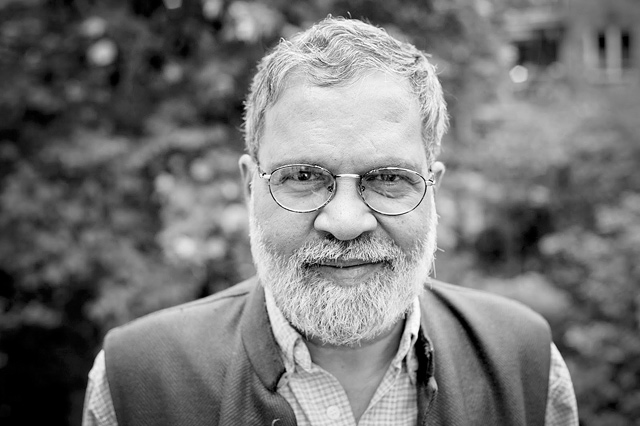
‘The funeral for Praful Bidwai is scheduled for the 27th June 2015.’ That blunt email announcement on 25 June came as a shock.
How does one come to grips with the fact that this low-key but vital journalist, scholar and activist, one of India’s finest writers and columnists, a true humanist, secularist, and peacenik, is no more? Perhaps by remembering that the only thing certain in life is death. Bidwai had worked with the Times of India where he was a Senior Assistant Editor before embarking on a prolific freelance career with a long association with the wire service Inter Press Service (IPS).
Besides being a journalist, Bidwai was a scholar with solid academic credentials. He was a Professorial Fellow at the Centre for Social Development, New Delhi, and a Senior Fellow at the Nehru Memorial Museum and Library. He had served as a member of the Indian Council for Social Science Research, the Central Advisory Board on Education, and the National Book Trust.
His books included An India That Can Say Yes: A Climate-Responsible Development Agenda for Copenhagen and Beyond (Heinrich Boell Foundation, New Delhi, 2009) and the critically acclaimed New Nukes – India, Pakistan and Global Nuclear Disarmament, co-authored with Achin Vanaik (Interlink, 1999). In 2000, the International Peace Bureau awarded Bidwai and Vanaik the Sean McBride International Peace Prize in recognition of their work opposing nuclear weapons development in South Asia.
As an activist, Bidwai was one of the founders of the Movement in India for Nuclear Disarmament (MIND), a member of the International Network of Engineers and Scientists against Proliferation, and one of the leaders of the Coalition for Nuclear Disarmament and Peace, India, set up after India’s nuclear tests in 1998.
Bidwai was busy writer in the causes he took up. His syndicated columns were published in over 20 news outlets around the globe. The subjects he took up ranged from climate change, to nuclear (non) proliferation, and human rights issues such as discrimination against Muslims and Dalits in India.