
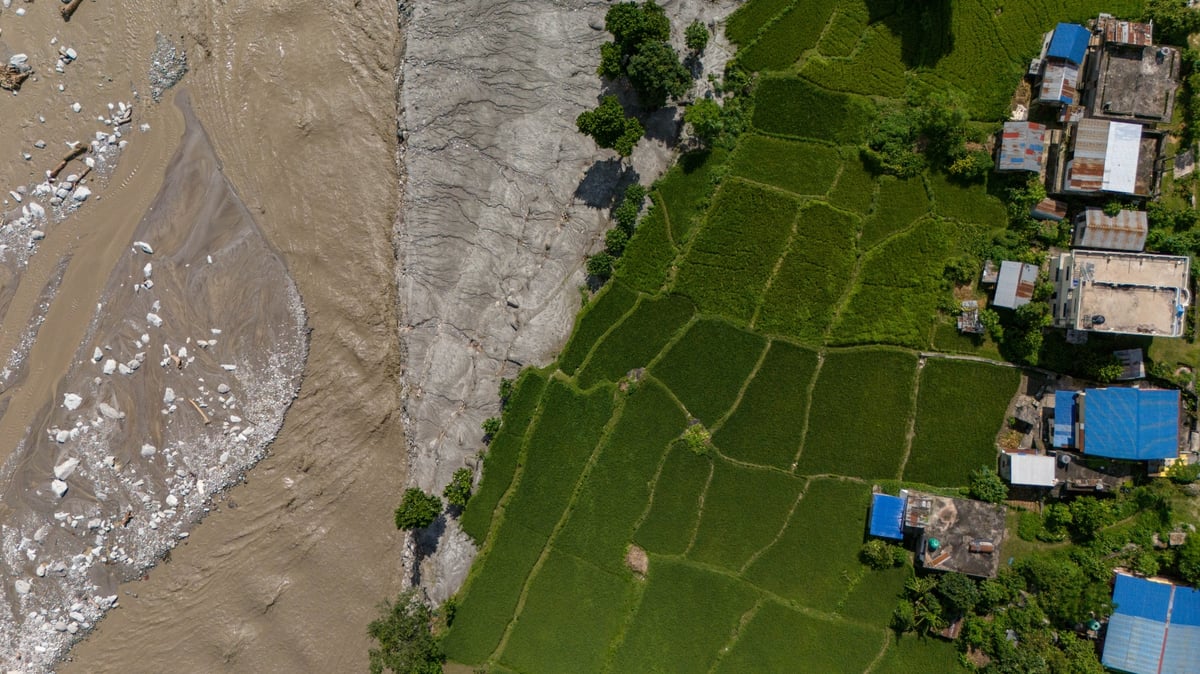
What happened in Rasuwa and Nuwakot points to a larger problem than flood management, it reveals how decades of development has reorganised an entire valley around roads, trade, and border infrastructure, concentrating people and investment in places increasingly exposed to climate hazards.
The Trisuli Valley was a landscape already familiar with disaster. On 8 July 2025, a flood originating from the Purepu Glacier in China destroyed the same bridge at Rasuwagadi, killed or left missing at least 28 people, and wrecked 60% of the Timure dry port, a Rs2.8 billion facility that was 81% complete.
The bridge was rebuilt. The dry port was still being repaired when the flood came again.
TRADITIONAL SAFETY
Traditional Tamang settlements in the valley were organised around flood mitigation. Rice fields were often located close to the river, where access to water and fertile soil made them productive. Houses were built higher up the slopes.
Over the past 70 years, development altered that relationship. Roads, outmigration, and the shift from agricultural livelihoods toward trade and wage-based economies reorganised where people live and work.
Roads are frequently built along floodplains because they are easier and cheaper. Houses and businesses then follow the roads, concentrating settlement precisely in areas most exposed to flooding.
Infrastructure attracts economic activity, economic activity attracts settlement, and settlement increases exposure when rivers overflow their banks. What once functioned as agricultural floodplain become real estate and transport corridors.
Across Nepal, roads have become the organising principle of development concentrating homes, businesses, and public infrastructure in narrow river corridors where hazards are growing faster than planning systems can adapt.
Nepal has contributed almost nothing to the warming now destabilising the Himalayan watershed on which it depends, yet it is losing bridges, roads, trade, homes, and lives to that warming faster than it can rebuild them.
The question is not whether Nepal should develop. It is who that development is for -- and who absorbs the cost when it fails. Those two groups are rarely the same.
The benefits of a road, a border post, or a construction project are distributed broadly and often captured at a distance: by traders, contractors, transporters, national governments, and consumers hundreds of kilometers away.
The losses, by contrast, are absorbed locally and specifically: by the shopkeeper in Timure, the porter at the truck park, the family living in a house built where land was cheapest, and the workers whose livelihoods disappear each time the corridor shuts down.
And the people who bear those risks most directly are almost never in the room when the decisions that create them are made.
The World Bank has offered Rs25 billion in emergency assistance for rescue, relief, and reconstruction. The government is separately moving to mobilise about Rs20 billion of its own. But financing reconstruction is only part of the challenge.
Rebuilding the border crossing is necessary. Rebuilding it exactly as before is a choice. Each disaster creates pressure to restore what existed previously and to do so as quickly as possible. Yet speed often comes at the expense of asking harder questions about design, exposure, and long-term resilience.
A bridge can be rebuilt. A highway can be repaired. The more difficult task is deciding whether infrastructure that has repeatedly failed should be reconstructed according to the same assumptions that governed it before.
Climate finance remains part of this debate. Countries like Nepal should not be forced to shoulder alone the costs of a warming world they did little to create.
Taking on fresh foreign debt to respond to a disaster Nepal did not cause risks reproducing that vulnerability if reconstruction simply restores development patterns that existed before.
Who will control the reconstruction? Will planning and design decisions be made locally, with knowledge of the river, the monsoon, and the communities that live alongside them? Or will reconstruction once again prioritise engineering timelines and commercial demands over local experience of risk?
The danger is not simply that Nepal will borrow money to rebuild, but that reconstruction will restore the same infrastructure that made the valley vulnerable in the first place.
The challenge is to rebuild not simply what was lost, but the terms on which development takes place.
Sebastian DiPirro is a Fulbright student researcher in Nepal.