

Devendra Raj Panday who died 15 July in Kathmandu lived a remarkable life that was a shining multidimensional mosaic. The constant guiding beacon he followed and espoused for others was ‘integrity’.
He himself was exemplary in the practice of integrity in both his personal and professional life, and this was widely known and appreciated in Nepal and abroad. It was his defining trademark, making him a genuine rarity.
Later in his career, he became engrossed with a different perspective: the ‘idea of integrity’ as a foundational normative principle necessary to create a just and equitable society and nation.
His initial exposition of this idea was related to his steadfast role as an anticorruption campaigner in Transparency International. He was not just appalled at the level of public corruption in Nepal, but sought to better understand and analyse the causes and consequences of corruption more generally.
As he read the wider scholarly literature on corruption and economic development, he was dissatisfied with conventional frameworks used to identify causes and prescriptions to control it.
His key insight on why anticorruption campaigns in Nepal and elsewhere have been ineffectual, regardless of the menu they followed, is that they missed the critical element of integrity in their underlying values systems.
He espoused a broader meaning of integrity as a fostering value focused not just on self-interest, but also on genuine concern for ‘the other’.
‘Integrity deficit disorder’ in political or socio-economic systems leads to many other ills – injustice, inequalities, discrimination, and even violence in such communities.
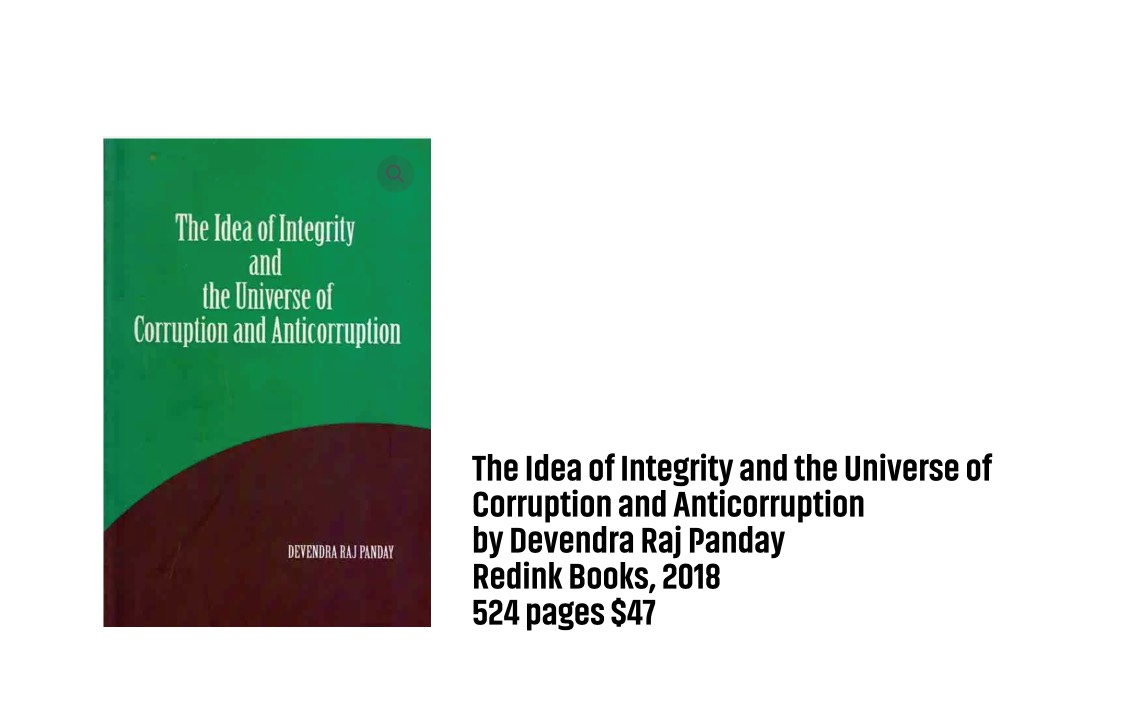
He developed this in the scholarly 2018 book, The Idea of Integrity and the Universe of Corruption and Anticorruption. On periodic family visits to the United States over several years, he went to university libraries and diligently took copious notes that resulted in this enthralling book.
The Introduction chapter begins with: ‘The best way to be acquainted with a subject is to write a book about it (Benjamin Disraeli)’. I came upon his book late during a call on him in mid-2025, when I received a now cherished autographed copy. I had only read it cursorily and was looking forward to discussing his views and his scholarship in my next stay in Kathmandu this year. But alas that was not to be.
I first met Devendra Raj Panday on starting work in 1981 at the then Integrated Development System (IDS, now the Institute for Integrated Development Studies, IIDS). He was Executive Director and new to IDS, which itself was new. As with new and small things, we had a lot of close interactions that helped define my career and world view. It was my very good fortune.
Reviewing and even critiquing some aspects of his ‘idea of integrity’ is now my way of paying tribute to my mentor, an institution builder and distinguished scholar.
His grand thesis was the need to develop integrity at the system level as a prerequisite for a just and fair society, without corruption.
This is an extensively researched book, covering many different academic disciples and perspectives on the sources, types, and consequences of corruption. He delved into copious citations from and analyses of the grand themes in the philosophical, political, and religion and ethics literature on corruption.
He also reviewed narrower perspectives on the economics of corruption, focusing on the design of incentives and punishment that can make the expected returns to corrupt behaviour lower than the returns to honest behaviour.
He is critical, however, of this narrow economic approach which sometimes lead to the absurd conclusion that some level of corruption may not only be inevitable, but even desirable.
He also analyses concrete examples of different types of corruption, especially political corruption from many countries, including the US. There is even a short Appendix titled ‘US and Nepal: same same?’ to illustrate his key point that despite great differences across countries with unique histories and different levels of democratic processes and economic development, there is also a common source for corruption due to a value system deficient in the idea of integrity.
In other words, while political structure and socio-economic contexts differ across countries, and over time within a country, corruption is always on the menu. In the case of Nepal, it is indeed a big disappointment for him that corruption has persisted so strongly, despite several major political paradigm shifts and advances in the democracy journey that he himself helped usher in.
His other disappointment was that despite the rapid expansion in anticorruption advocacy globally, such as by Transparency International and now including major donor agencies like the World Bank, there has been little improvement to show for it all.
Again, he notes the missing link is the absence of an integrity framework that defeats the anticorruption agenda.
He also worried about the dangers of anticorruption activities and corruption going hand in hand. Anticorruption agencies and actors themselves become protectors or shield for their corrupt political masters, and also engage in vindictive campaigns against political opponents or preceding government officials.
There is not much discussion in the book on what the specific stepping stones are to build and enhance the integrity framework. Nor does it offer advice on specific practical steps needed to design an effective anticorruption toolkit even when the integrity framework is not fully developed.
But even in this limited dimension of the book, he has a clear message: the proper metric for assessing the effectiveness of anticorruption remedies is not the processes or legal actions taken, but rather the changed outcomes generated for the common citizen.
Since the direct and indirect costs of systemic corruption are mainly borne by ordinary people, the effectiveness of any remedies should also be based on what has changed in their outcomes and lived experiences.
This is a novel and valuable insight – rooted not much in the corruption literature he mastered but more so in his vast experience and insights gained from the rural ‘swabalamban bikas’ campaigns at IDS starting from Jhadewa of Palpa, and later at the Rural Self-reliance Development Centre.
Another prescription in this book is the special role attached to professional groups (engineers, doctors, lawyers) in building the integrity framework. Professionals are enjoined not just to be experts in their fields and to practice it well, but also to build character based on the values and norms they wish to stand for and advocate for others.
This is no doubt a reflection of his civil society activism campaigns that he ably led, and which demonstrated the great merits of coordinated action by professional and other groups based on shared values and visions.
Given the usual secretive nature of corruption, it is not feasible to empirically test the novel thesis of this book: that building integrity at a systemic level is the key pathway to reducing corruption. There are no easy ways to devise an ‘integrity index’ and relate it to the also difficult-to-measure levels of corruption in the real world.
However, there is some indirect corroboration of this thesis from a surprising source: the now growing literature on laboratory-based experiments conducted by economists and other corruption researchers.
SIMULATING CORRUPTION
These experiments create specific settings that simulate the environment in which corrupt decisions are made, with small but real monetary payments made to the players (usually university students) as per the rules devised for this game.
There are of course problems in studying corruption through laboratory experiments, and the generalisations to be made from them. But well-designed useful insights do follow because such experiments make it possible to directly observe corrupt behaviour at the individual-decision level in a specific controlled setting where other confounding factors are absent.
One strand in this experimental literature focuses on the role of intrinsic motivations of individuals in the fight against corruption. The results show that the control of corruption depends on incentives embodied in existing institutions, and the broader accepted values.
One person’s decision to engage in or abstain from corruption in a simple experiment can depend critically on the level of corruption shown by other players in these experiments. The results are that the levels of corruption in the game playing are unpredictable. There can be multiple outcomes with varying levels of corruption even if the underlying rules of the game and monetary incentives are the same.
The real world inference is that corruption levels can differ in unexplained ways even if the political and socio-economic settings are similar across different countries, Multiple ‘corruption equilibria’ are possible for any given setting.
And some countries can converge to the lower ends (worse types) of these multiple equilibria, creating a ‘corruption trap’ from which it is extremely difficult to escape.
When corruption becomes so systemic, one needs a ‘big push' to get out of this trap. And such a system-wide big push is something I can readily relate to the ‘idea of integrity’.
Another indirect validation comes from an intriguing laboratory bribery experiment done with a sample of Oxford University students from over 40 countries, characterised by markedly different levels of corruption.
The findings showed that even in a faraway laboratory setting the corruption preferences behaviour of these students could be predicted by the level of corruption in the students' home countries, as proxied by Transparency International's Corruption Perception Index.
I believe this reflects the persistence of the ‘idea of integrity’ that individuals inherit from the settings they have grown up in.
Let us then say farewell to Devendra Raj Panday with the conviction that the efforts to find strong antidotes (vaccines?) against corruption must be built on the DNA of his ‘idea of integrity’ at the systems level, notwithstanding how difficult that task is.
Prem Jung Thapa is an economist, with degrees from the University of California at Berkeley and The Australian National University. He worked at IDS for ten years from 1981 and for most of this time Devendra Raj Panday was the Executive Director and a mentor.