
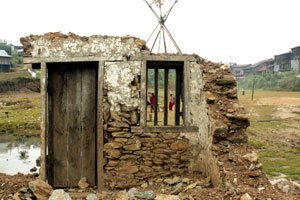
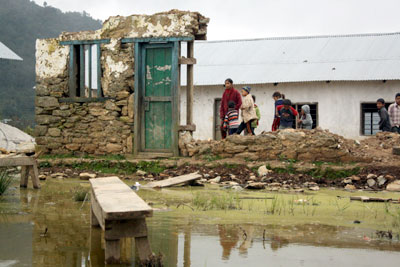
 PICS: ANURAG ACHARYA LEFT: Students play in front of their destroyed school building in Jorpokhari. |
There are neat black topped roads, busy markets, private schools and colleges, satellite cable operators and FM stations. However, a half-hour outside Fungling, you begin to understand why there is seething anger against the state for its apathy and neglect following the 25 September earthquake.
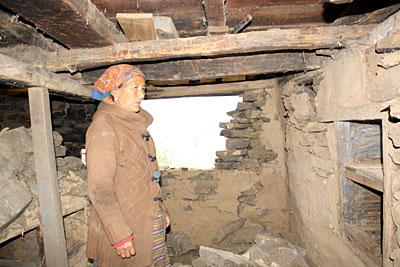
The epicenter of the 6.8 magnitude quake was right underneath Mt. Kanchanjunga, the third highest mountain in the world on Nepal's border with India's Sikkim state. Two months after the earthquake, there is still devastation everywhere. Trails wiped out by massive rockfalls, schools and homes in ruins. We met families living in plastic tents provided by the Red Cross but as the winter approaches, the families fear the worst.
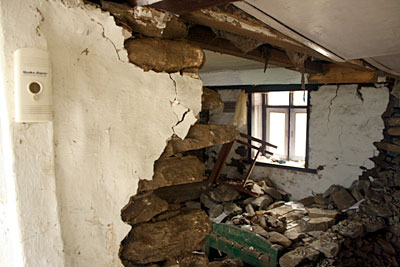
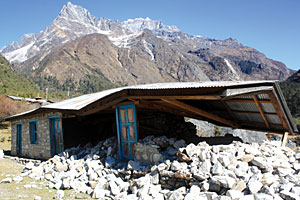 Newly built concrete school building in Pholey is destroyed. Less than hundred meters away old mud houses remain unaffected by the earthquake. |
The chairman of the Kangchenjunga Conservation Management Committee (KCMC), Khagendra Limbu, says trails damaged by the earthquake need to be repaired before the next rainy season, otherwise it will be inaccessible for trekkers going up to base camp. But Lobsang is more concerned about his own community. "Tourists can choose not to walk on these dangerous landslides," he says, "but we don't have a choice."
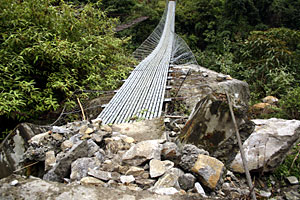
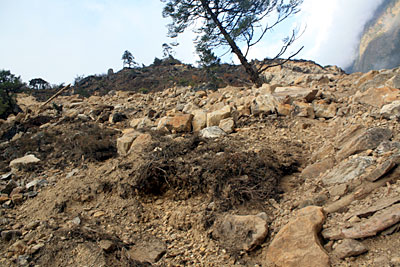
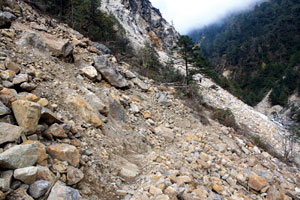 Huge landslide between Pholey and Ghunsa. The earthquake has damaged trails and bridges on the Kangchenjunga Trail. |
Underneath the fatalism and acceptance, there is lingering anger over the lack of response by the government. Penji Sherpa of Ghunsa and others like her make fun of the "relief package" sent by the government. The Taplejung CDO and a bureaucrat from the home ministry landed in a helicopter with Rs 60,000, handed it to a local police officer and left within minutes. They didn't even bother to go and see how the people whose houses were destroyed are living.
 |
Back in Fungling, the Local Development Officer says he has 29 secretaries looking after 50 villages, the others have refused to work in remote areas. Most VDC buildings in Taplejung that were not bombed during the conflict have been illegally occupied.
The earthquake was just the latest in a series of disasters that has afflicted Taplejung: state neglect, poverty and the war. The people here, like Nepalis in other remote regions, cope the best they can. They have learnt to live with disasters, and they don't expect anything from the state. They will survive the aftermath of the the terrible night of 25 September as well, long after its memories fade.
 |
 |
 |
 |
 |
Beyond repair
The earthquake completely destroyed 1369 houses in Taplejung displacing as many families. The official record also shows 56 school buildings, 7 police posts, 5 health posts and 9 other government buildings were damaged in the district. The locals say many destroyed school buildings including the ones that were constructed under the community supervision were of low quality and if the earthquake had struck during the school hours, lot of children would have died. Although reports say 86 people lost their lives in the adjoining Indian state of Sikkim and 11 people died in other parts of Nepal it's a miracle that there was no casualty in the district. The government has distributed relief worth Rs. 6.7 million but Local Development Officer Prem Kumar Shrestha admits the amount is too little, given the extent of damage. The local authorities are hopeful that KCMC along with The Great Himalayan Trail Program are working to raise funds to repair the damaged trails and broken bridges.