

The sight of a grassland where Rani Pokhari used to be exposes bureaucratic greed and lack of accountability
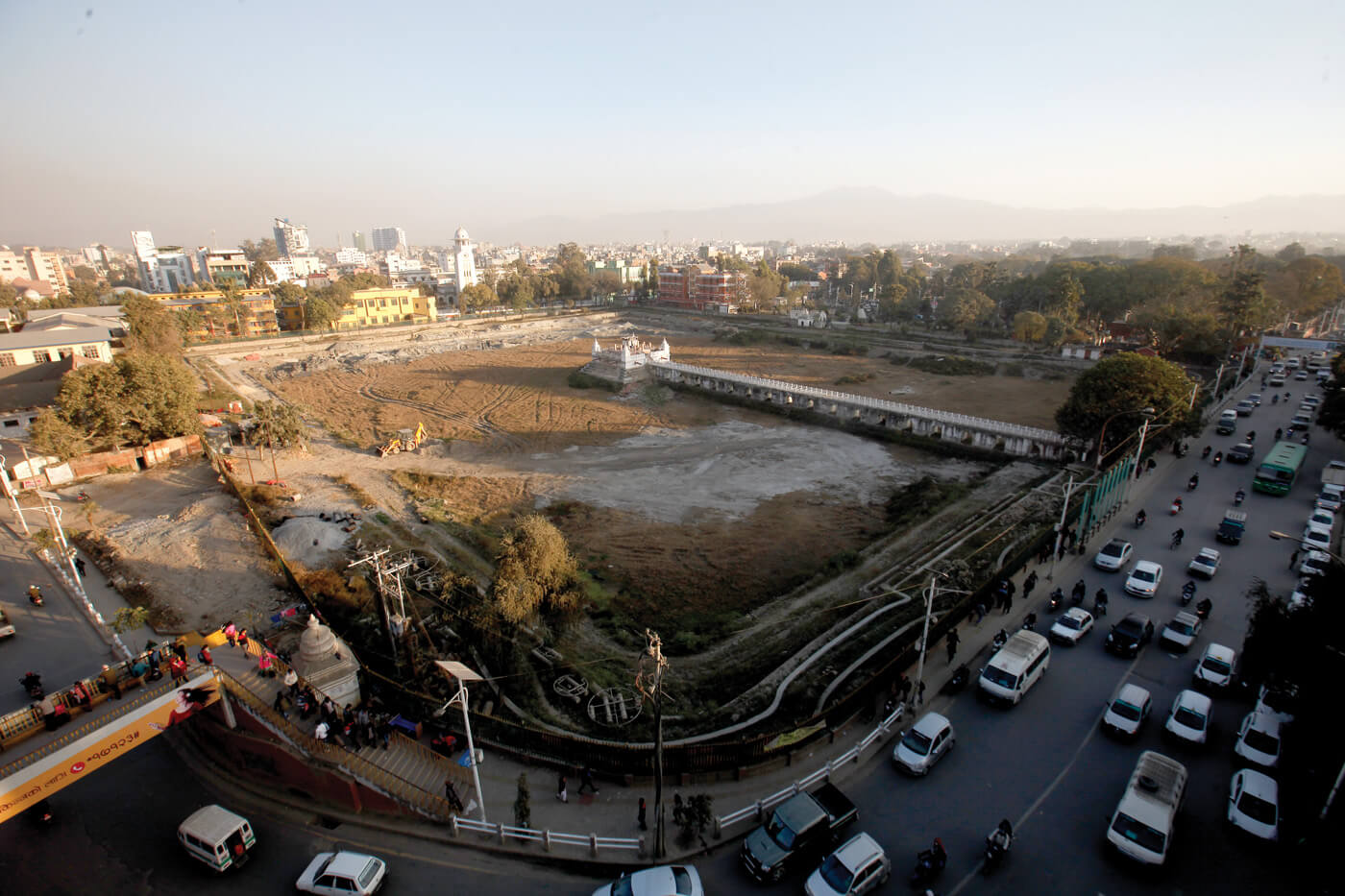
Nepali politicians are rarely in the good books of the people. They cannot seem to get anything right. But who will punish the slow, corrupt and over-protected bureaucrats?
It is these civil servants who are having the last laugh over the fiasco at Rani Pokhari. For those who haven’t followed the saga of the restoration of this historic pond, here is a brief recap:
Reconstruction of the Balgopaleswor Temple in the middle of the pond started in August 2016 using concrete pillars.
This was before local elections, when Kathmandu Metropolitan City (KMC) was run opaquely by bureaucrats who even managed to fool President Bidya Bhandari’s PR team, by having her lay the foundation stone to launch post-quake reconstruction. What she was inadvertently agreeing to by her presence was a beautification plan that was in motion even before the earthquake damaged the temple.
The pond perimeter was draped in tarp and the construction site hidden from view. There was no public hearing or community engagement. When activists protested, chief engineer of Kathmandu Municipality Uttar Kumar Regmi argued that he was just re-using old construction material.
Regmi said he had permission from the Department of Archaeology (DoA) for his design, even though DoA Engineer Sampath Ghimire promised traditional design and materials would be used in reconstruction. Giving into the public pressure and protests by activists, DoA chief Bhesh Narayan Dahal said his department would take charge of the reconstruction, and admitted to lapses.
By December 2017 activists had to again rally to save Rani Pokhari from a concrete perimeter wall that the KMC said was needed to ‘beautify’ the pond. Mayor Bidya Sundar Shakya’s remarks broadcast on Facebook live exposed complete lack of understanding in how traditional ponds are built, lack of faith in the people protesting, who where in fact trying to work with him, and his blind trust in a bureaucracy that made a complete fool out of him.
When the media and activists later prodded him, Chief Engineer Uttar Kumar Regmi said on camera he was only executing approved plans. The DoA’s Engineer Sampath Ghimire admitted that DoA approved the use of concrete.
Demand by activists and even journalists for drawings, plans and contract details all went unheeded. Activists then sought to educate everyone on the traditional water management system, and demystify the 24-hour water in the stone sprouts. The KMC, DoA, and MPs were all invited, but only two MPs showed up.
Then something unexpected happened: the deputy mayor lead a team that padlocked the construction site. The mayor lost his cool and broke open the lock. All this high drama lead to some frenzied coverage in the media.
DoA Director General Bhesh Narayan Dahal went on national television to say the department never gave explicit permission to use concrete contrary to what his chief engineer had said earlier.