
 |
"At 3am I heard my neighbour scream. I ran to his house and saw his whole family standing in a foot of water. We realised we were being flooded. The water level rose quickly. We didn't have time to collect anything, we just ran for our lives," recalls Shakil Ahmad Khan of the floods that engulfed his village in 2063 BS. Back then the lack of an early warning system in Kamdi VDC of Banke district almost cost Shakil's family and their neighbours their lives.
Things have changed in Shakil's community since. With Practical Action's Community Based Flood Early Warning System (CBFEWS) in place, communities in Banke, Bardia, Chitwan and Nawalparasi districts, threatened every monsoon by the Kosi, Narayani and Karnali river systems, receive warnings at least three to four hours prior to potential floods.
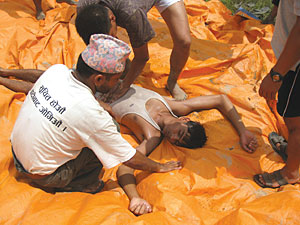
The mechanism of CBFEWS is fairly simple. Disaster Management Committees (DMCs) are set up with volunteers in both upstream and downstream communities. These committees are trained in flood awareness and preparedness before and after floods. But it is the communication between these DMCs that is crucial to saving lives and loss of moveable properties.
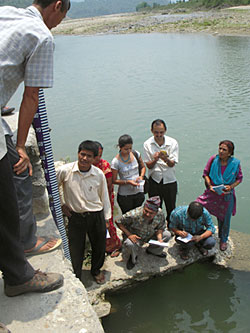 |
"Upstream DMC members read the gauges installed in the river (pic,right) and if the reading indicates possible flooding downstream we immediately get a call of warning. We then call the DMC here, the police personnel, FM radio stations, and we also use a hand siren to attract everyone's attention," explains Akbal Khan of Kamdi VDC.Â
On 19 July 2010, for instance, Bhadra Bahadur of Kusum VDC, Banke, reported river levels of 5.8m. During a 2008 community meeting, an upstream reading of 5.8m had been signalled as dangerous for downstream communities in Binauna. A level of 5.8m at 9.30 am in Kusum, it was estimated, would cause a possible flood in Binauna around 11.30am. The reading was reported to the CDO of Banke, who alerted all the parties concerned. DMCs in Fattepur and Holiya, too, alerted their communities with hand sirens. Though Binauna escaped flooding that time around, quick communication from upstream to downstream helped alert those most at risk and allowed them to prepare safe evacuation. What's more, the incident prompted the communities to raise the danger level to 6m (upstream) for the future.