
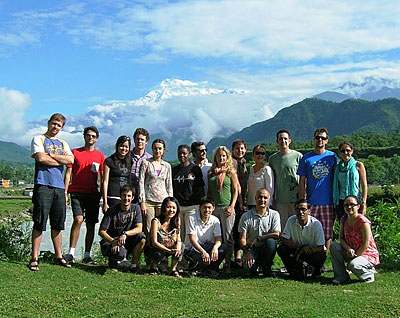
 JAYA BURATHOKI INSEAD students before they set out on a social entrepreneurship trek around Pokhara |
In early July, Entrepreneurs for Nepal – an organisation of Nepalis who promote an ecosystem for entrepreneurs through discussion series, networking events, boot camps and advisory help – hosted a group of MBA students from the Singapore and France campuses of the INSEAD Business School. Led by Professor Mahmood Mahboob, the students were in Nepal for a week to explore potential areas for social entrepreneurship.
In the course of their activity-packed visit, the students visited NGOs in Kathmandu and Pokhara, interacted with farmers to understand how agricultural value chains work from procuring seeds to selling crops, visited communities to see how water distribution and solid waste are managed locally, met with some of Kathmandu's leading businesspeople and social entrepreneurs, and got a sense of how, despite seemingly unending political problems, it is relatively easy to do business in Nepal.
On the last day, the students made a presentation, from which four issues are worth discussing further: (i) challenges for development, (ii) the markets that surround Nepal, (iii) how Nepal can promote a Nepal-specific brand to drive growth in tourism, agriculture and hydropower, and (iv) how private equity funds can be set up to finance development work.
Development challenges: 
These include political instability, mismanagement of human resources, and a growing dependence on aid. When politicians quarrel for days on end over who's going to head the government, and the bureaucracy, civil society and the media are reduced to being mere spectators, it signals that those who are supposed to lead the country lack direction themselves.
Without raising literacy levels to produce a skilled workforce that in turn helps create jobs locally, going abroad to work will always be a priority for Nepal's talented youth. And successful variations on the aid model work best as ways to prime the pump, to transfer know-how, and to get things started locally. When aid uses the same set of interventions for many years, Nepal's transition from an aid recipient to being aid dependent is characterised by a general lack of accountability, thereby providing a disincentive to start companies that create jobs.
Markets all around:
Development elsewhere affects Nepal, and there are some positive trends. The rise of China and India opens up opportunities for Nepal in ways Nepal has yet to exploit on a nationally coordinated level. The Gulf and the Middle East, only five hours away from Kathmandu, are growing in terms of population and economy. They are another untapped market for Nepali goods and services. The rest of Asia has populations that are now more prosperous and want to visit new destinations. Besides, the globally growing interest in organic food, green lifestyles, and sustainable commerce play to Nepal's potential, just as the shortage of electricity in the region lends an urgency to turning Nepal's hydroelectric potential into commercially viable services.
Credible Nepal: 
Nepal does a poor job marketing itself to the world. In many cases, it lets other people define what it is. But Nepal has certain characteristics, of which Nepalis are justifiably proud, and which ring true to visitors. These characteristics can be used when developing a sort of Brand Nepal that imparts Nepal-specific images, feelings and values to customers worldwide.
Sherpa Adventure Gear has done just this. This apparel company has taken the story of what's unique about Nepal and married it to western retailing practice. Its products appeal to customers whose idea of Nepal is a series of adventures in the mountains. Similarly, given the growing demand for sustainable tourism, Nepal could carve out a niche by using Green Nepal as a way to appeal to tourists who value greenery and nature over conveniences found in hotels in the concrete jungle.
Nepal Development Fund:
A fund worth several million dollars could be set up, either by mobilising domestic resources or with international partners, to invest in entrepreneurs who are working on areas that have the potential to make economic transformations: agriculture, tourism, hydropower, renewable energy, and the like.
One caveat is that such funds, like many donor-supported incubation centres and venture funds, often fail because they are likely to be led by accountants and look-alike mainstream company professionals who are so afraid of failure that they play safe and end up hurting the very goal (i.e. promote innovations) for which they work. If this problem can be addressed by getting a mix of skill sets on board, such a fund could take calculated risks that identify areas for growth, promote entrepreneurship that creates returns and jobs, get involved in the management of some of the companies it invests in, and overall, help strengthen the ecosystem for doing business in Nepal.
A week was too short for the students to delve into the details. But their presentation provided a snapshot validation of what local entrepreneurs feel represents Nepal's challenges and potential.
READ ALSO:
Mind the children, INDU NEPAL
Valley belly, BUDDHA BASNYAT