|
|
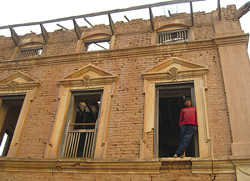
| GHOST TOWN: The mansions of Thapagaun may have fallen into disrepair |
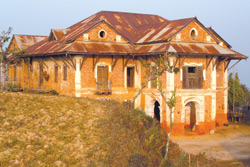
On a foggy winter day, the traveller first sees the village from a kilometre away, down the slope and round a bend some two hours' walk from Pakhribas bajar, itself an hour's drive from Dhankuta by way of Hile. Four or five brick-and-lime mortar Rana-era houses stand tall on otherwise empty, uncultivated ground marked by red earth. The place is called Muga, after this colour.
Slowly, fine cornices and engraved windows come into view. Some houses have multiple roofs of sloping jasta, and others, wood and glass sunrooms with pious words worked into their carved facades. Muga's Thapagaun, spread along a ridge in Dhankuta district above the Arun river, has a dozen or so such houses, which give it an air of rural grandeur unique in Nepal.
Why are these stately buildings even here? Muga was never an administrative centre, nor does it lie on an old trading route of any import. It is far from the capital and in a region not particularly productive.
It seems that wealthy and powerful Lamichanne Thapas came to settle here from around Pokhara, in the footsteps of the expanding Gorkhali state. Their income came from the harvests of rice fields nearby and mauja in the tarai. Originally served by itinerant Bahun priests from Khotang, the story goes that the Thapas invited one of them to settle down in Muga, offering him choice land amidst the Chhetri households. This explains the presence of Ghimires in a cluster of houses called Bahungaun in the middle of the Thapa village. Kamigaun lies further up the hill, and Raigaun down the slope to the south.
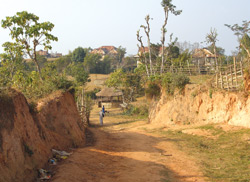 |
| but they still dominate Muga's skyline. |
Those who remember Muga's days of glory say that Thapagaun is now just a sad remnant. Neighbours from nearby villages remember the hubbub in these, by Nepali hill standards, mansions, the high living, the horses, and the crowds of retainers. Thapagaun's houses were built by masons from Kathmandu, and it was one of the first villages in the hills to receive piped water. The principal spigot, known as Kaptan Dhara, has the date BS 2001 inscribed into its rock and still works. The residents' regular contact with Banaras and Calcutta facilitated cultural and material exchange. This hillside was once full of majestic trees-now all hacked down-and exotic fruit orchards. Kedar Ghimire, a local Congress (D) politician, describes how an expert from the Pakhribas agricultural centre once gave a long lecture on guava cultivation, only to find that there was a fruiting guava orchard on the next terrace.
That Thapagaun declined is not surprising. The pull of the power and privileges of Kathmandu was too strong to resist for its feudal scions, educated in Darjeeling, Calcutta, and Allahabad. As the country moved on from Rana rule, these Thapas became part of the national elite, and participated in the task of modernisation as engineers, administrators, and managers. The accelerated and massive centralisation of the country over the past five decades is seen in this emptying of Muga.