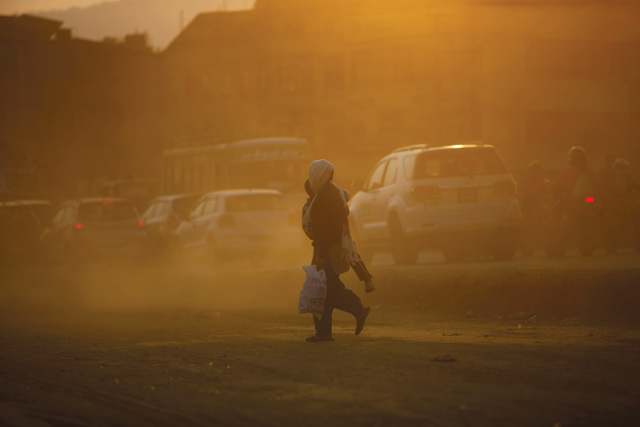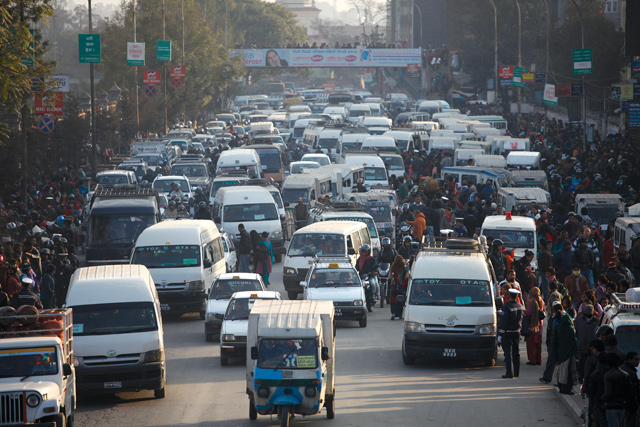
Alarm bells have been ringing about the dust that blankets Kathmandu, but experts say that vehicular exhaust is much more harmful.
The earthquake, endless road-widening, and the dumping of construction material on sidewalks have all helped turn the Valley into a dust-bowl. But the increase in the number of vehicles and lack of emission control have led to a worrisome rise in the level of the most harmful pollutants.
“The impact of air pollution on health isn’t limited to respiratory infections but is a leading cause of heart diseases and strokes,” said environmentalist Bhushan Tuladhar. “And a major source of this pollution is transportation which will increase unless we invest in a proper mass transit system.”
Although the concentration of dust in the valley’s air is off the charts, dust particles are bigger and not necessarily toxic, meaning they are blocked in the nasal passage. However, diesel soot is microscopic, can be embedded deep in the lungs, and even be absorbed into the bloodstream.
The dust from the valley’s road-widening therefore is a symptom, and not the disease. The dust will ultimately settle as the roads are completed. However, wider roads mean more cars and therefore more pollution in future.
Explained Tuladhar: “The problem is we haven't seen beyond road-widening. We need to get over the fixation that a bigger road is better. The backbone of a transportation system in any city must be its public transport.”
Kathmandu’s poor air quality has become serious enough for the UN’s World Health Organisation (WHO) to take notice and send Carlos Dora of its Department of Public Health in Geneva to Kathmandu last week. He told Nepali Times: “The government is widening roads and reducing sidewalks. That is going to increase pollution in the long run."
The good news is that increasing public awareness is translating into government action. A task force led by the Department of Environment submitted a 12-point recommendation to the National Planning Commission on Wednesday which highlights the importance of improved mass transit.
Task force member Arnico Panday, an atmosphere scientist at ICIMOD said: “PM2.5 (particles below 2.5 microns) in diesel exhaust is the most harmful. Measuring air quality helps us see trends and plan mitigation efforts.”
Going up in smoke
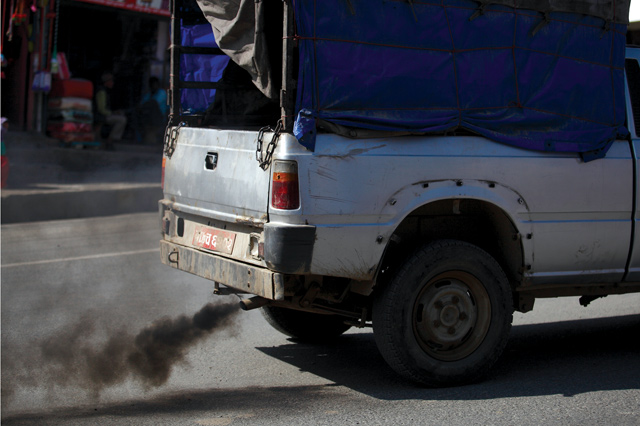
You cannot solve a problem until you understand what the problem is. To effectively reduce Kathmandu’s horrendous air pollution crisis, scientists say, it is important to measure the nature of pollutants. Solutions must be data-driven.
Which is why the Kathmandu-based International Centre for Integrated Mountain Development (ICIMOD) in collaboration with Department of Environment set up air quality observatories in Ratna Park, Pulchok, Dhulikhel, Chitwan, Lumbini and Langtang. The idea is to investigate the nature of pollution in Kathmandu and track the transfer of suspended particles from the Indo-Gangetic plains up to the Himalaya.
“It is important to understand the emission and the meteorology that affect air pollution, so that we have effective mitigation measures that can solve both technical and behavioural issues,” said Bhupesh Adhikary, ICIMOD’S Air Quality Specialist, while inspecting the equipment at the Dhulikhel observatory.