
|
|
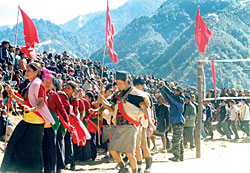
While their leaders say the revolution will follow the path of "bourgeoise capitalism", here in the Maoist heartland party faithful are planning to expand existing communes.
During the conflict, the Maoists set up four communes in Jajarkot, Rukum and Rolpa. Each has between 30-40 families, there is no private property, labour and harvests are shared. Marx's famous dictum, 'from each according to their ability and for each according to their need', is the credo here, and for the most part members of the communes seem happy with it.
"Life is easier living in a commune, work in the farm is easier since everyone helps out and agricultural productivity is higher," says Dipak Khadka, the head of the 'Balidan' commune in Rukum.
The 'Juni' commune in Jajarkot was set up after the police killed 20 farmers in two separate massacres in 1999 to take care of surviving family members, widows and orphans. Farmers handed over all their land and property to the commune.
In Thawang, the 'Ajambari' commune was set up by the survivors of an army helicopter raid which destroyed most of the buildings in the town. ( 'Rolpa is waiting', #389 and 'From Maoism to tourism', #340.)
The communes all have departments looking after health, education, culture, development and security. All the members have to take part in physical exercise and there is military discipline. Alcohol is banned, as is untouchability. There are no religious festivals and 15 Feburary, People's War Day is celebrated as the new Dasain. Funerals are marked by draping the body in red cloth and commemorating the dead with social service.