
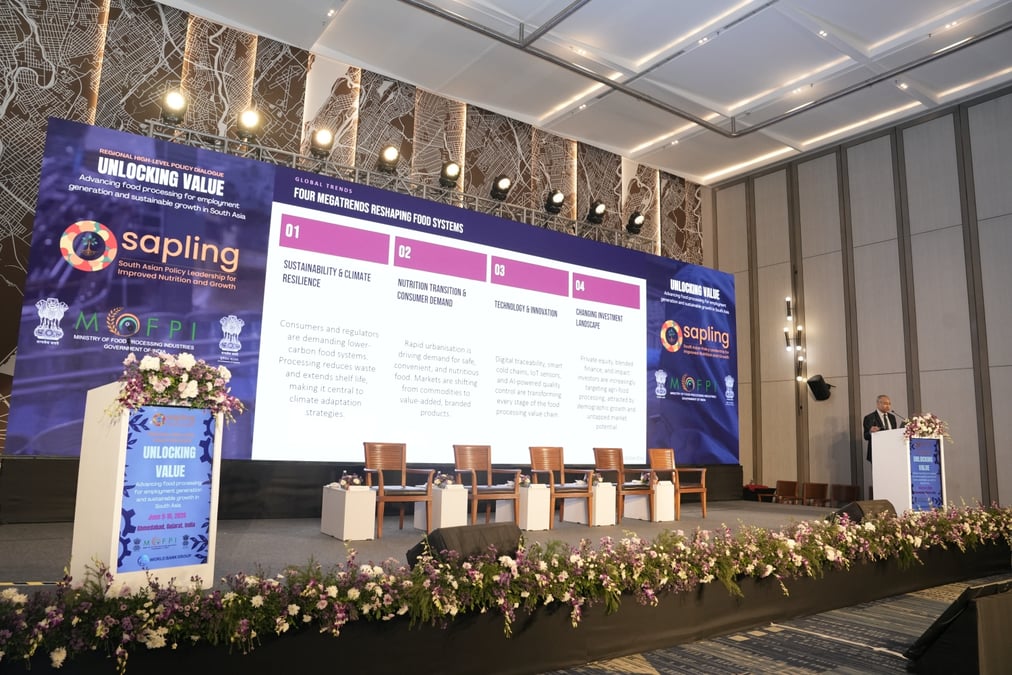
Policymakers, development partners, innovators, and the private sector came together at a high-level regional policy dialogue in Ahmedabad this week to explore ways of connecting farms, firms, and finance to build more resilient food systems across the region.
The Unlocking Value: Advancing Food Processing for Employment Generation and Sustainable Growth in South Asia from 9-10 June was co-organised by the World Bank Group's regional platform South Asian Policy Leadership for Improved Nutrition and Growth (SAPLING) and India's Ministry of Food Processing Industries.
Chirag Paswan, India's Minister of Food Processing Industries, was one of the keynote speakers at the event, and during his opening remarks said that South Asian nations need to "reach out to each other's best practices" to strengthen the region’s food ecosystem.
Over 30% of all food across South Asia is lost or wasted annually before it reaches consumers, which is enough to feed almost 300 million people. Strengthening post-harvest infrastructure is therefore crucial to food security in the region, noted experts.
During two days of panel discussions, participants shared their expertise on, linking food processing to employment, strengthening agricultural supply chains, and bringing informal processors into regulated value chains.
Among participants from across the region was Prithwi Parajuli of Poshilo Foods in Nepal, who was part of a panel where speakers discussed how regulatory and compliance barriers limit small processors from being part of the formal food system. Parajuli pointed out that while western countries have done tremendously well in welcoming innovators from around the world, South Asia has comparatively not been very innovator-friendly.
“What we are lacking in our region is that we put regulations before innovators,” Parajuli said. “I believe that regulations should follow when innovators become mature.”
Meanwhile an innovation fair that ran parallel to the sessions platformed product and service developers from across the region who exhibited technologies, systems and practices addressing issues across the value chain, from climate-resilient biofertilisers, soil-health enhancing polymers made from biowaste, AI-driven sustainability and compliance platforms, to compostable menstrual pads made from bamboo and banana fibre.
Sujan Dulal, Country Manager of aQysta which initially facilitated renewable irrigation technologies for smallholder farmers in Nepal, was one of the innovators showcasing his company’s demand-driven initiative Grown in Nepal that connects farmers to consumers. Dulal was part of a panel where participants shared their experiences as drivers of emerging technologies in the sector.
“Something that needs to be acknowledged by the farmers, farmers’ groups and cooperatives is that the market is the main driver in terms of the quality and quantity it demands,” he said. However, he added, subsistence and smallholder farmers are reluctant to move beyond their existing farming methods toward more demand-driven practices. He noted that a change of mindset was necessary in farmers and actors across the value chain.
Discussions during the second day also encompassed the public and private sectors’ role in mobilising investment for food processing, including foreign direct investment, digital investment, as well as infrastructure investment.
Yamuna Ghale of the Institute for Integrated Development Studies in Nepal moderated the final panel where participants discussed ways of regional collaboration and policy action to shape a shared food future in South Asia.
Closing out the two days of panel discussions, Ghale said, “Policies are political. And policies and potentials are unlocked with possible collaborations between the private sector, development partners, and regional collaborators. Regional platforms are very important to harmonise cross-border trade.”