
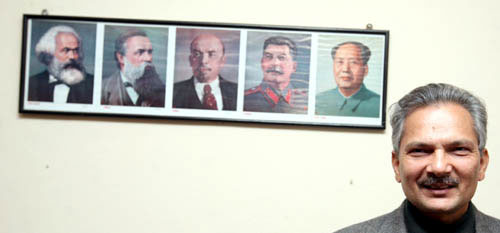
 KIRAN PANDAY LINEAGE, LEFT: Baburam Bhattarai is at home in the company of his fellow ideologues. |
Hardliners in each of the three big parties are making it more difficult for the top leadership to find a compromise power-sharing formula, prolonging the stalemate and threatening the peace process. This could be why senior leaders all sounded conciliatory after their numerous one-on-one and joint meetings this week, but came out with uncompromising stands the very next day.
"The problem is not between the political parties, it is within the parties themselves," one senior adviser told Nepali Times. For example, the UML has an almost right-wing faction, while the NC has a leftist fringe that is acceptable to the Maoists.
The Maoists, weakened by serious internal rifts, need an acceptable face-saving way out of their 'civilian supremacy' stance. Conservatives in the NC and UML, however, smell blood and don't want to give the Maoists an easy way out. Although the Kailali incident this week and the vicious Maoist attack on Rukum journalist Tika Bista have sharpened the rhetoric on both sides, the three were said to have edged closer to a formula for an all-party coalition.
Maoist ideologue Baburam Bhattarai (interview below) represents the pragmatic aspect of the Maoist hierarchy, although one wouldn't guess that from what he has to tell us in an extensive interview this week. His clarification that ethnic autonomous regions are just 'symbolic' betrays his party's need to extricate itself from an issue that is spinning out of the leadership's control.
Peeling away the rhetoric, one senses his hurry to resolve the political deadlock to pay attention to the economy and to development. "Our society is afflicted with poverty, unemployment, discrimination, dependency. We have to do away with these as soon as possible. We have to hasten our pace," Bhattarai says.
When asked about how his party's labour militancy is hurting industry, he replies: "National investors and multinational companies are most welcome to invest in Nepal and contribute to the development of the country. We have no policy to discourage investment in the country."
INTERVIEW: BABURAM BHATTARAI
"If you consider all oppressed people Maoists, if you say all 28 million Nepalis are Maoists, we are quite comfortable with that"
Nepali Times spoke to vice-chairman of the UCPN (Maoist) Baburam Bhattarai on Tuesday on federalism, the landless problem, the current political deadlock and ways forward.
Nepali Times: It was reported last week that the politburo will demarcate federal units on the basis of nationality instead of ethnicity. Have the Maoists abandoned the issue of ethnicity? 
Baburam Bhattarai: From the very beginning, we have said that the basis of the federal system should be nationality. In Marxist terms, nationality means a common language, geography, economy and psychological make-up. A group of people that shares these qualities is called a nationality. On this basis we have proposed to constitute federal autonomous units in Nepal and we also practiced this during the People's War.
Let me be clear that translating the word 'nationality' into Hindi it becomes jatiyeta (ethnicity), in Nepali it becomes rastriyata (nationality). In English, ethnicity is also jatiyeta, caste is also jatiyeta and nationality is also jatiyeta. So there was some confusion. Since the very beginning we have been consistent that federalism should be along the lines of nationality. (Read the debate on ethnicity and nationality)
Either way, isn't the declaration of autonomous federal states by the party unconstitutional?
Who says? In the interim constitution and Comprehensive Peace Agreement we have already agreed that we will adopt a federal system. In fact those people who are going back on this commitment are violating the spirit of the constitution.
Why did you specifically propose 13 autonomous regions?
This is for political mobilisation of the masses to create consciousness about the modality of the federal restructuring. This is the proposal of our party, not the final product. The final proposal will be worked out by the Constituent Assembly. All the parties will put forward their proposals. So we have put forward this proposal.
What if all political parties start declaring their own federal states?
They are most welcome. That will help the people and engage them in the debate. There will be a good platform for debate and that will help the Constituent Assembly.
There is disagreement within your party over the boundaries of the autonomous regions. Do you think issues like these could lead to ethnic conflict?
There may be certain disputes but they can always be settled through dialogue and consensus.
It is said the Maoists' strategy is to legitimise the autonomous regions that will be announced this week in the long run?
We have been over ground for the last four years. We participated in the elections and were voted in as the largest party by the people. There are some that still doubt our intentions. We can't do anything for such people.
Recent activities by Maoist cadre, for example the Kailali incident, have cast doubt over the Maoists' commitment to democracy and a new constitution. How can you win the people's confidence?
The people are with the Maoists. That was proven in the Constituent Assembly elections and by the massive mass mobilisation you have seen in recent months. The reactionary elements who sided with the monarchy are feeling insecure because the monarchy is gone. My appeal to them is there is no reason to be scared. The Nepali people who have suffered for so long want to introduce a democratic system, restructure the state, and bring about social and economic transformation, which will create peace, stability and prosperity in the country.
Going back to the Kailali incident, do you think it could have been avoided?
Of course it could have been avoided if this criminally minded Home Minister had resisted from shooting the peaceful settlers there. He needs to be prosecuted.
Did the Maoists encourage the landless to occupy government land illegally?
Do you think these landless people, who are in the millions, don't have any rights over the land? These are natural resources given free by nature. Why doesn't this state and government solve the problem of the landless settlers? It is perfectly legitimate for the landless people to ask for their share of land. So we fully support those landless settlers.
The Maoist-affiliated union of squatters was involved in the incident. And now by announcing autonomous states, are you trying to find a way to mobilise your cadres?
First let me tell you if there is squatter problem or not. The landless peasants' problem is a real issue in Nepal. If you don't solve it, they will agitate for their rights. If you consider all these people Maoists, how can you act? Earlier, oppressed people, women, Dalit and other underprivileged people who joined the People's War were branded Maoists. If you want to say all 28 million people of Nepal are Maoists we will be quite comfortable with that.
Do you think the constitution will be written within six months?
The constitution should be written on time. The only problem is these people, who were defeated in the CA elections and rejected by the mass of the people, are trying to take revenge against the people by making this CA defunct and dissolve it so they can restore the status quo or their own reactionary old set-up.