
On 15 May 2026, the Railways Department issued a notice inviting expressions of interest from international consulting firms to prepare a detailed project report (DPR) for a 27.5 km metro line along the Narayan Gopal Chowk–Koteshwar–Ratna Park loop. This was enough to send social media into a frenzy, with many celebrating the imminent arrival of metro rail in Kathmandu.
A month later, the notice was cancelled, citing "technical reasons". Then, the Minister for Infrastructure Development announced in Parliament a much more ambitious plan: a fresh DPR process for a 150 km metro rail network for the entire Valley.
There is nothing wrong with dreaming big, and one must appreciate the Government's 'Vision 2040' concept to promote integrated urban development. But the suffering populace and an economy in doldrums are in need of practical and immediate interventions in public transport.
The call for a DPR may wow social media, but what we are seeing yet again are high-visibility announcements coupled with fragmented, uncoordinated interventions. This is particularly concerning given that a comprehensive public transport masterplan for the Valley, developed by the Japanese aid agency JICA over three years, is due for completion within the next two months.
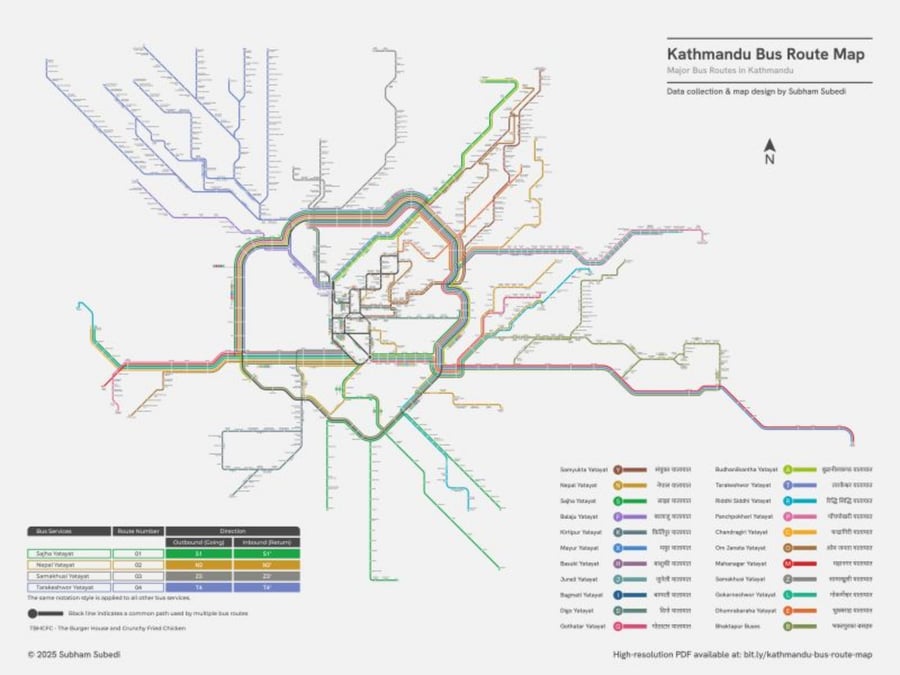
At a critical moment, attention is being diverted from fixing the Valley's bus system, which remains the backbone of the Valley’s urban mobility. Building a metro rail system is expensive, complex and time-consuming, and requires us first to overcome fundamental institutional and implementation challenges. Over the years, even DPRs for modest projects have failed to fructify, such as bus rapid transit (BRT), monorail, and urban cable cars ('gondolas').
Moreover, global experience shows that urban rail cannot replace bus networks. Even in cities with well-established and highly successful metro systems, buses remain the backbone of urban transport. In India's capital, for instance, despite Delhi Metro's popularity and extensive network, Delhi Transport Corporation (DTC) buses continue to carry a larger share of daily passengers and provide indispensable connectivity across the sprawling city.
TRIGGERING MOVEMENT
The haphazard spread of the Valley's road network over past decades of urbanisation was overlain on old foot trails or followed trucking tracks that brought bricks from kilns to market. This has left us with few wide thoroughfares. The new boroughs and neighbourhoods are connected only by narrow, winding and undulating roads fit for small vehicles such as the iconic three-wheel Safa Tempo.
Traffic jams and delays, economic inefficiency, air pollution and the absence of night-time public transport all contribute to a dispirited public and weak commerce. The Valley contributes more than a quarter of the national GDP, making its economic efficiency, public health and psychosocial wellbeing vital for the country as a whole.
The Balendra Shah Government has an opportunity to deliver tangible relief, but to do so it must replace grandiose visions with practical solutions. Three-wheelers, microbuses and buses must remain integral components of our public transport system. Sadly, the Ministry of Infrastructure Development continues to prioritise roads and bridges over mobility systems. Incidentally, 'transport' was recently dropped from the Ministry's name, and 'public transport' was mentioned only once in the recent budget, in a passing reference to electric buses.
The single most important action the Government can do to generate movement in public transport is to energise the Valley Transport Authority (VTA), the institution meant to coordinate among local, provincial and federal tiers but neglected by successive governments. (The official name of VTA is Federal Capital City Public Transport Authority, even though its mandate covers the entire Valley.)
THE AUTHORITY
Rather than be waylaid into 'mass transit', including metro rail, the Government must take a step back and concentrate on ‘public transport’ planning. The goal should be an integrated transport system that encourages citizens to abandon motorbikes and cars in favour of buses, vans and three-wheelers. As roads become less congested and the air cleaner, cycling and walking will revive as modes of transport for work and recreation.
Forgetting flamboyant proposals, over the next couple of years the Authority must systematise the Valley's public transport by concentrating on three areas. First, rationalise Valley-wide tertiary, secondary and primary routes and assign large buses, minibuses, microbuses, vans and three-wheelers accordingly. Second, ensure seamless, digitally supported fare collection and routing that allows transfers across routes and operators. Third, support electrification of public transport (battery and grid-powered), from financing to technical assistance.
Private operators have always served as the backbone of the Valley's public transport, and an empowered VTA must engage with them while ensuring coordination among the three tiers of government. The Valley's two metropolitan cities and 16 municipalities, which for all practical purposes now constitute a single urban unit, must cooperate with the Authority.
Nepal has been an innovator in electric three-wheeler transport, and now the fleet of Safa Tempos must be expanded exponentially to serve the tertiary areas (traditionally known as kaanth). For secondary routes, the surge in battery-powered microbuses and minibuses means that both technology and financing are already in place.
For primary routes, we must scale up the deployment of 10–12-metre electric buses, supplemented where needed by articulated buses that can carry double the number of passengers. At the same time, we should consider reintroducing trolleybuses and exploring tram systems. These modes are well suited to Nepal's context, as they draw power directly from the electricity grid, offering higher efficiency and lower vehicle and operating costs.
Even as we develop an intergrated public transport spectrum from Safa Tempos to vans, electric buses, trolleybuses and trams, the time will come when we need—and can afford—a metro rail network to move the Valley's people. We can plan for that future, but we need reliable and affordable mobility right away. Let us stop chasing headlines and get the system—and the buses—moving.