
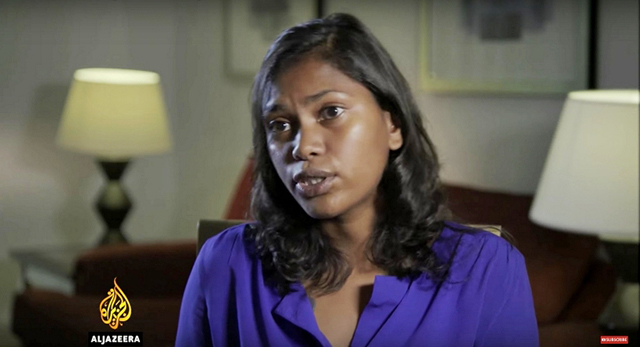
She packed a suitcase on 31 August 2016 telling her family that she would be back as soon as possible, probably in a week. There had been threats in different forms against her: a machete hung on the door of her newspaper office, a text message saying she would be the next journalist attacked or disappeared and vague government harassment, but her work on the documentary Stealing Paradise was the tipping point that forced Zaheena Rasheed to leave the Maldives. Today she remains in exile.
Rasheed’s investigative reporting as former editor of the Maldives Independent has uncovered ongoing censorship and high-level political corruption in the country. Stealing Paradise, an Al Jazeera English investigative film, presented recorded interviews, data and correspondences from the former Maldivian vice president's phones.
The investigation, which received a One World Media Corruption Reporting award, exposed international money laundering of up to $1.5 billion and countless instances of government negligence and criminal behaviour, including the sale of islands for the gain of President Abdulla Yameen's inner circle.
A former colleague at the Maldives Independent approached Zaheena to work with the team on the documentary, for which she did translations and data analysis. Apart from a few close friends and colleagues, she didn’t talk about the work she was doing for Stealing Paradise. “All of it was so shocking,” Rasheed said of the leaked material. “It was all things we had heard but hadn’t seen the evidence for.”
STEALING PARADISE: Watch the full documentary that Maldivian journalist Zaheena Rasheed made for Al Jazeera and forced her to flee her country last year.
Just weeks before the film aired in September 2016, Parliament pushed through new laws criminalising defamation and allowing the government to close independent publications. The government also threatened to take action against all Maldivian contributors to the documentary and fined a cable TV broadcaster for airing the film. Hours after its release – one week after Rasheed left the country – all seven floors of the office building occupied by Maldives Independent were raided.
Preceding years have seen many assaults on press freedom, including the torching of a TV station, the forced shutdowns of independent media outlets, a near fatal attack on a journalist on his motorbike, and the disappearance of Maldives Independent journalist Ahmed Rilwan in 2014.
In April 2017, blogger Yameen Rasheed was killed outside of his apartment.
“A year has passed since I left and the situation in the Maldives has only gotten worse,” Rasheed, recipient of the Index on Censorship Press Freedom Award 2017, said at a conference organised by the International Federation of Journalists in Kathmandu on 8 September.