Aftershocks were still rocking Kathmandu four years ago this month when top leaders decided to fast-track the long lingering Constitution. The government was facing criticism for not doing enough on rescue and relief, and wanted to make its presence felt.
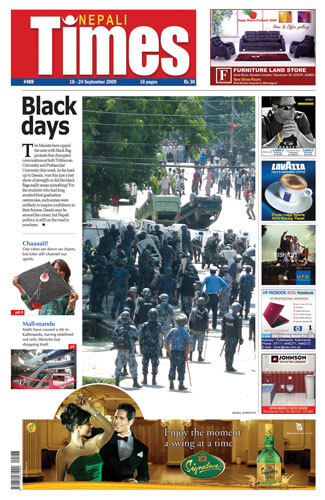
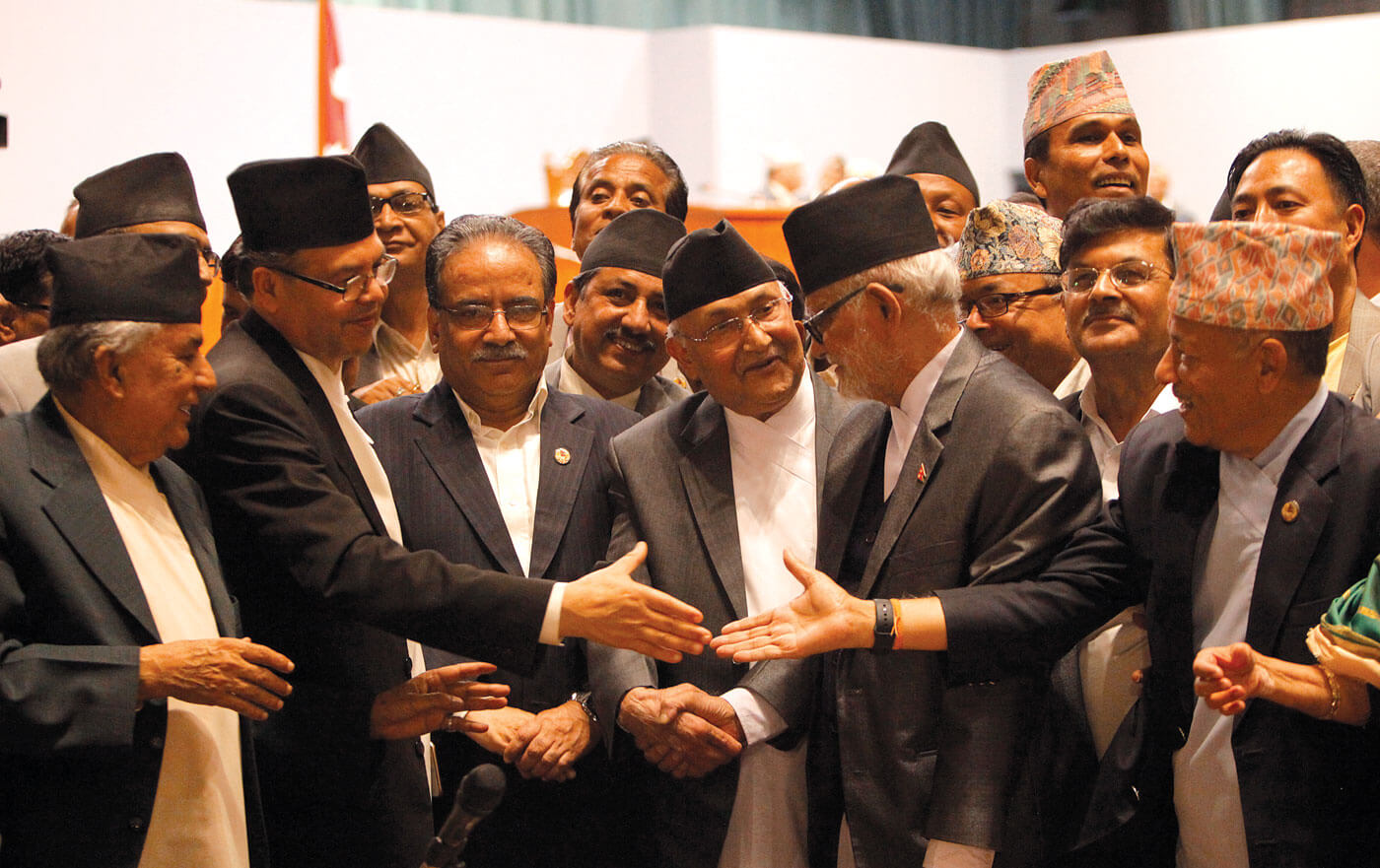
It was seven years in the making and took elections of two constituent assemblies for the Constitution to be drafted and finally promulgated on 20 September 2015. A photograph in this paper that week (above) shows the main protagonists beaming and shaking hands, congratulating themselves. All of them, except Prime Minister Sushil Koirala of the NC, are still around.
But they do not have much to show for it, and the euphoria of that day has long evaporated. The Constitution was not popular among Madhesi activists, who had demanded a separate province spanning the Tarai, among various janjati groups, who wanted an ethnically-defined federalism, and India was livid because Nepali leaders had not listened to then-Indian Foreign Secretary S Jaishankar’s advice to delay promulgation by two weeks. New Delhi’s displeasure manifested itself in a five-month Blockade, for which the unrest that spread across the plains became a convenient cover.
The UML’s KP Oli portrayed himself as a David against India’s Goliath and rode the nationalist wave to sweep the 2017 elections. The UML’s electoral partnership with the Maoists and the NCP’s near two-thirds majority in federal, provincial and municipal assemblies made it a formidable political force.
But to describe the four years since the promulgation of the Constitution — especially the past two under the NCP government — as a letdown would be an understatement. There were very high expectations among Nepal’s long-suffering people, even those who did not support the Communists, that stability would attract investment, create jobs and improve accountability and governance.
What a disappointment it has been. The politicians and the party have squandered their mandate, and have worked to undermine the very Constitution they spent so much time and effort to write. In fact, the strongest government in Nepal’s democratic history behaves as if it is the weakest. It sees threats everywhere, lashes out and threatens critics. Party Co-chair Pushpa Kamal Dahal last week exhorted his gofers to ‘counter’ critics, echoing Prime Minister Oli’s call to unleash hornets on them.
Ruling party youth have been used much like the Alsatian puppies in Animal Farm to intimidate and assault anyone who dare oppose its leaders. In this increasingly Orwellian world, people who post videos are hounded and physically assaulted and ‘banned’ from certain districts by NCP youth. YouTubers are threatened and ordered to take down satirical videos that go viral about corruption in high places.
Our comrades seem to have learnt from despotic regimes around the world to silence critics with trolling, strong-arm tactics, verbal intimidation, physical assaults or by unleashing ’bot armies. The Information and Communication Minister has been trying desperately to get a new Media Council Bill, an Information Technology Bill and the Mass Communication Act through Parliament. Human Rights Watch this month described the Acts as containing ‘numerous loosely defined and draconian measures… criminalising free speech on vague grounds.’