
Life in the hills and villages of Nepal has always been harsh. For generations, that difficulty has led many Nepalis to leave their families behind and go to the plains in search of opportunities-food, service, security, and a better life. In the face of continuous stagnation at home, that search process opened different life trajectories for migrants, taking them and their children as far away from their ancestral villages as Surinam, Fiji, and Guam.
Closer to home, Ashutosh Tiwari recently caught up with Nepali migrants and their children in Bangladesh. What follow are some of their stories in their own words.
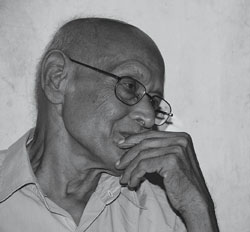
Bhakta Bahadur Thapa Chettri, 80,
ALL PICS: ARPAN SHRESTHA
Dayagunj, Dhaka
"I was born in Pokhara. I left Nepal the year Juddha Shumshere died in the late 1940s. I was 14. There was a gallawala (manpower agent) from Gulmi who took a group of us to lahur, Assam to work for the British army. Many people from Nepal's hills were in Assam at the time, and Assam was a big state that included large parts of today's Bangladesh. Passports and visas were not required. We could move from Nepal to any part of the greater Indian plains easily. We worked as coolies, labourers, and security guards. In 1953, I started working as a security guard in a ship-repair company in Narayanganj, on the outskirts of Dhaka. Many Gorkahlis worked nearby in leather tanneries and textile, and sugar mills. We had a large community, and regularly held puja gatherings, just like in the villages of Nepal.
"My wife is a Nepali. She was born and brought up in Bangladesh. We've stayed together as a family with our eight children, five of whom are married to other Bangladeshi Nepalis. We've always lived close to Hindu temples, which aren't easy to find these days in Bangladesh. We wanted our children to grow up learning about our festivals such as Kali Puja and Bhai Puja.
"When I think of Nepal, I think of dukha, of brutally hard work one has to do to survive there. Up in the hills, you work very, very hard to collect fodder for the cattle and to gather firewood. In Shillong, India, I once met a group of Nepalis. Seeing how hard they worked made me realise how lazy I had become living in the plains." 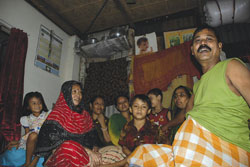 Mir Bahadur Upadhyay (Galu Dai), 51,
Nakkhal Para, Dhaka
"My father was from Ramechhap. Like many young Gorkhali men, he came to Assam to work as a security guard. He married and I am a second-generation Bangladeshi Nepali. Here in Nakkhal Para we have about 42 Bangladeshi-Nepali family. Across Bangladesh, there are about 1,000 or so families of about 7,000 Nepalis who are permanently settled here. We are in touch with one another because we need to know who is where in order to get our children married to others of Nepali ancestry. Whenever possible, most young Nepalis marry other Nepalis of any caste. But lately, some have married Bangladeshi Hindus and Muslims too. From time to time, we have tried to get a Bangladesh Nepali Council going to air our concerns to the government here, but we have not made progress due to misunderstandings amongst ourselves. We Gorkhalis can be too touchy about perceived slights and insults.
"Bangladeshi Nepalis are gradually doing better. One Bangladeshi Nepali, Bir Bahadur Chakma (Lama), represents Bandarban district as an Awami League member in parliament. The younger ones are better educated. Some won DV lotteries and moved to the US. Others have worked in the Middle East as maids, security guards, and drivers. Some have visited their relatives in ancestral villages in Nepal. I have a government job. Most Bangladeshi Nepalis do not have their own land or homes. This is partly because Gorkhalis did not understand Bangladesh's land laws, and did not want to get into unnecessary trouble with the law.
"We follow news from Nepal. When King Birendra and his family were killed, many of us mourned and did not eat one meal. We were ashamed, and we did not know how to explain the killings to our Bangladeshi neighbours. Last year, about forty of us protested the present monarch's rule in front of the Nepali embassy in Dhaka. In the 1980s, Ganesh Thapa was a popular football player here, and Bangladeshis still talk about him in ways that make all of us proud to be Gorkhalis." 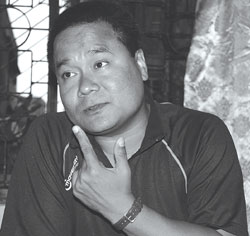 Babu Bahadur Thapa, 36,
Nakkhal Para, Dhaka
"I am a third-generation Bangladeshi Nepali. My grandfather was a soldier in the British Army. In 1950, after the war, some of my grandfather's friends went to other parts of India. Some returned to their villages in Nepal. Some, like my grandfather, stayed in what is now Bangladesh. I was born and raised in Dhaka. I have a job with an international development agency here and am married to a Bangladeshi Nepali. I consider myself 'Made in Bangladesh'.
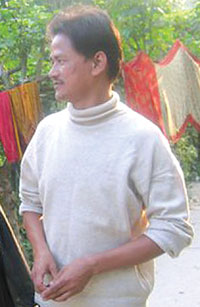 Vunta Narayan Shrestha, Mymensingh,