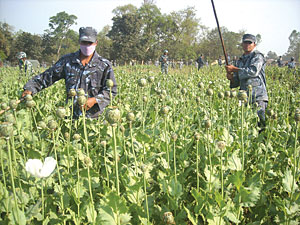
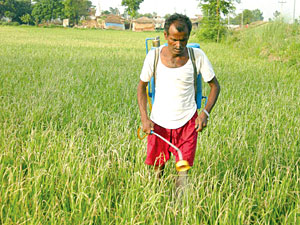
 RAJU SHRESTHA BEFORE AND AFTER: Opium fields being destroyed by police in Parsa last year (above) and a farmer who has switched from poppy to paddy sprays chemicals on his fields last week in Subarnapur.
|
'Nepal is turning into Afghanistan' read the headline of a magazine cover two years ago. It wasn't talking about a return to war, but the trend among farmers to grow opium poppy.
Even until a year ago, Parsa district was regarded as a centre for cannabis and opium production, which was sold across the open border in India. They were openly cultivated right next to government offices and under the very noses of the police. Many marijuana farmers had graduated to opium, and there were even heroin processing factories in the jungles of Parsa.
The local economy used to run on the drug trade, with the related rise in organised crime and addiction. Elections were financed with drug money, and Tarai militant groups bought weapons with cash from smuggling opium to India. Dowries for daughters depended on the cannabis harvest. From farmers to teachers to the police and government officials, everyone was in it. Sixty per cent of the arable land in Parsa was under cannabis and poppy.
What a difference a year makes. Travelling through Bara and Parsa last week, the poppy fields were gone. Poppies had been replaced with paddy and the marijuana with vegetables. This was a result of political will, strong and clean policing and effective coordination within government to support alternative crops.
"You will not see a single cannabis plant in Parsa now," asserts Ram Chandra Prakash Kurmi, former DDC member and himself cannabis farmer. Locals give a lot of credit to the leadership taken by former Parsa police chief, Rajendra Man Shrestha.
Back in Kathmandu, we caught up with Shrestha who has been reassigned to head the peacekeeping wing of Nepal Police. "When I started, everyone warned me that stopping cannabis cultivation in Parsa was impossible," he told Nepali Times, "They said everyone was involved and it would lead to unrest."Â (See box below)
It was not an empty threat. Drug cultivation enjoyed political protection and wide local support. Cannabis cultivation had always existed in Parsa and was used to generate support for the Panchayat in the 1980 referendum. When the Birgunj Sugar Mill was closed down ten years ago, farmers switched from sugarcane to cannabis and poppy. Police were attacked when they tried to destroy crops. In Bhauratar two years ago, villagers set fire to a house with policemen inside. In the ensuing violence, three people were killed as the police opened fire.
In Subarnapur, most homes still have tightly sealed plastic drums full of unsold marijuana. The price of cannabis went down sharply after the crackdown and farmers switched to vegetables. A kilogram of ganja which used to sell for Rs 900 till two years ago now fetches barely Rs 200 from Indian wholesalers.
"No one grows cannabis here anymore. But there are still stocks like this in every home," explains a Subarnapur resident, "the police have made selling almost impossible and there is more profit in vegetables anyway."