
|
|
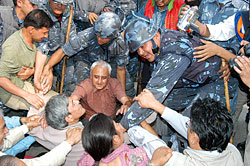
DUWAKOT-Taken in by Kathmandu's royal regime with two dozen other protesters last week for willfully (and with prior announcement) breaking the curfew order, this writer had an opportunity to see how a 'militarising' autocratic state machinery can ride rough-shod over some of the weakest members of society. It was an opportunity to take a look at the underbelly of the monster that the government can be. What we have seen during our incarceration is something that the privileged with contacts in high places or money to buy oneself safe passage rarely care to see or understand.
There are three types of inmates in this makeshift detention centre at the Duwakot armed police barracks outside Kathmandu. The relatively well-known human rights activists have little fear of violence once they are taken in. Then there are political activists both senior and junior, who receive some protection from party affiliations and linkages. But here in Duwakot there is also an entire category of true innocents.
Most of these young adults, some of them mere boys, are migrants who have left their families in faraway hills and plains, to work in menial jobs. They represent the rural poor of all ethnicities and castes but they are united in their lack of influence anywhere in the state structure. This lack of agency is only matched by their absolute poverty. The trauma that these boys of Duwakot have faced and are facing exists at several levels. Firstly, it is the chase on the streets, the attacks by batons and staffs, the abuse and the bundling into the back of trucks.
Once in the holding center, the toilet facilities are non-existent, then they are transported from one detention centre to another, provided with no information whatsoever. No food is provided for more than a day, and when it is it is of the lowest grade imaginable. There is fear that authorities in need of proving Maoist 'infiltration' of the democratic movement can with the flick of a pen declare you an insurgent and do away with your life and prospects.