
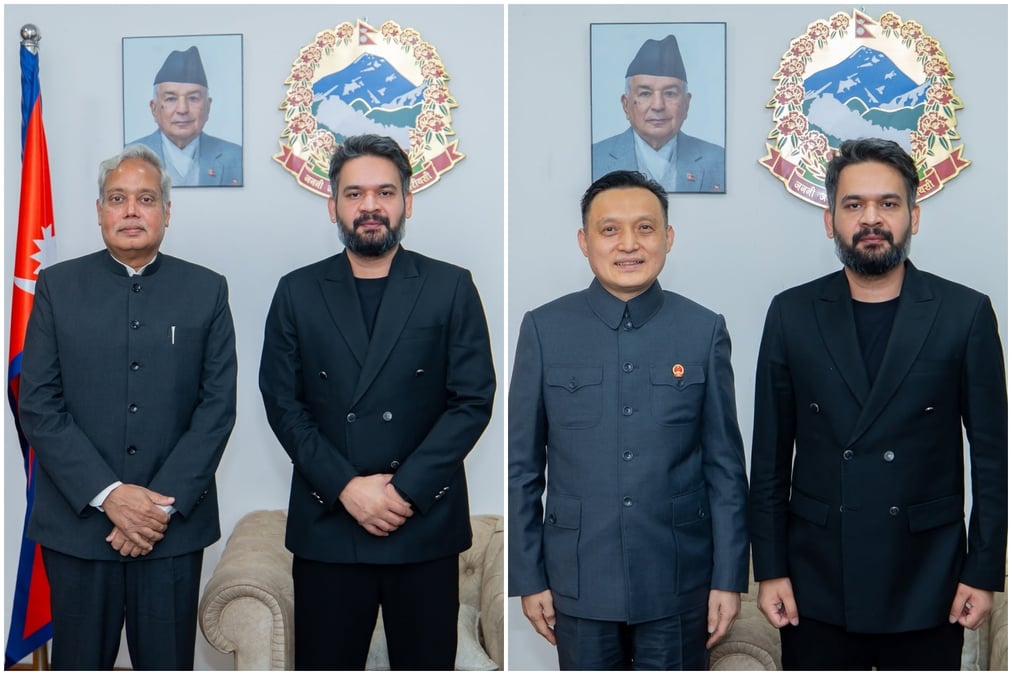
Suddenly, after nearly five months in office, Prime Minister Balendra Shah has come out of his cave to meet with business leaders, bankers and investors.
Then this week in a departure from his earlier practice of meeting diplomats in a group setting, he sat down for one-on-ones with Indian Ambassador Naveen Srivastava and Chinese Ambassador Zhang Maoming.
Diplomats representing Nepal’s giant neighbours and Prime Minister Shah finally had the chance to size each other up. The previous meetings were collective and largely photo-ops.
All this set the stage for what looks like a geopolitical convention season in Nepal.
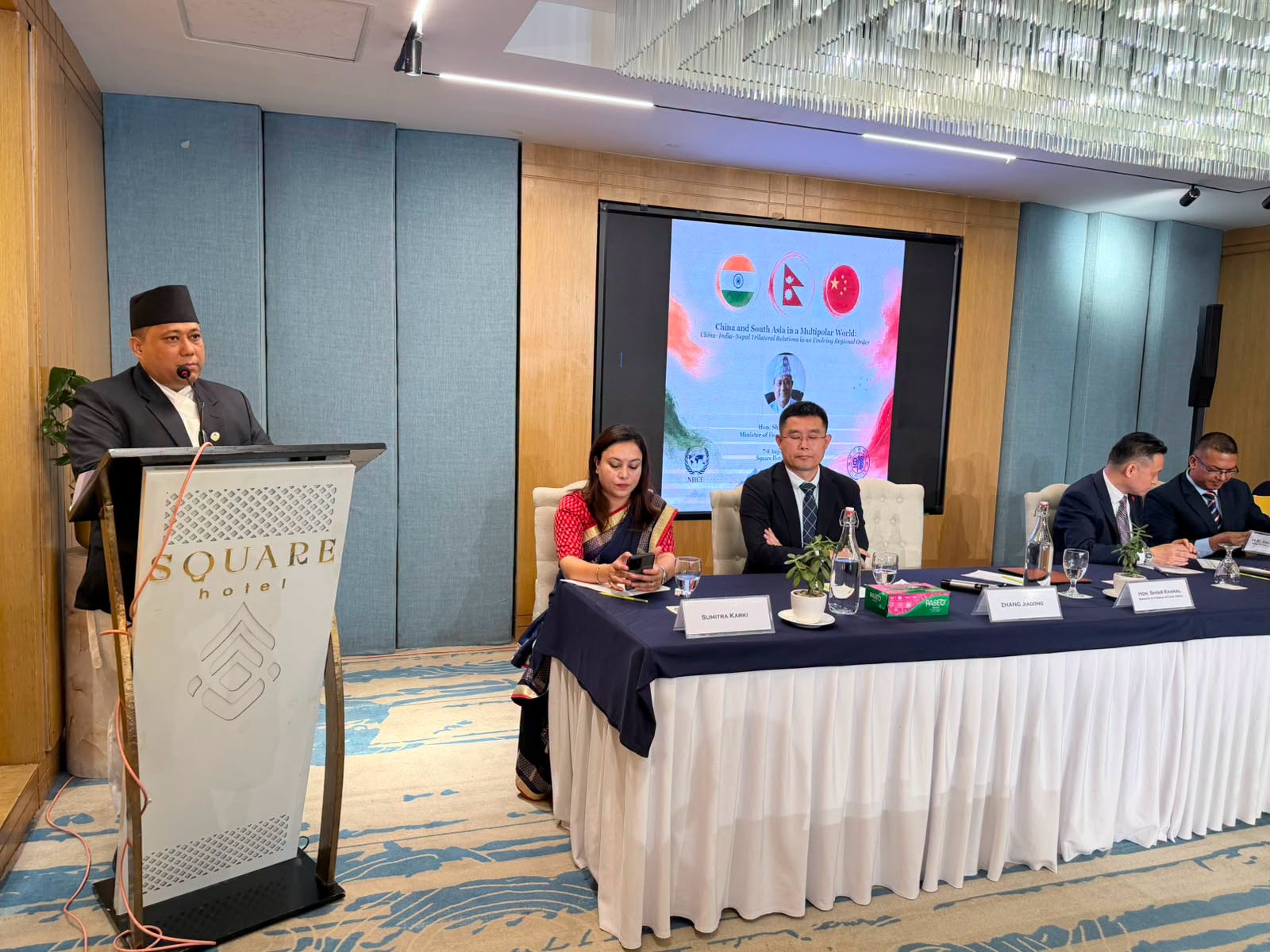
Last week, geopolitical experts, diplomats and policymakers from the region convened at an international conference titled ‘China and South Asia in a Multipolar World,’ organised by the Nepal Institute for International Cooperation and Engagement (NIICE) and the Center for South Asian Studies of China’s Fudan University, to discuss trilateral connectivity, security, and emerging challenges in the region.
“The key takeaway was that improved relations between India and China would help reduce geopolitical pressure on Nepal and create a more conducive environment to pursue an independent and balanced foreign policy,” Nepal Institute for International Cooperation and Engagement (NIICE) director Sumitra Karki told us.
India and China’s capital investment, technology, and infrastructure capacity could enhance Nepal’s hydropower potential, making energy one of the most promising areas for trilateral cooperation.
“Both India and China expect Nepal to benefit from the rise of their respective economies,” says Karki. “Nepal should therefore pursue an equidistant and pragmatic foreign policy, deepen economic engagement with both countries, and avoid being drawn into great-power rivalry.”
But dealing with China has been a geopolitical minefield for Nepal because of Beijing’s sensitivity about pro-Tibet activities and its growing concern about American inroads in the region.
In July, the Dalai Lama’s birthday celebration in Nepal saw the participation of faith leaders and foreign diplomats, drawing flak from pro-Chinese Nepali diplomats, ministers, and current lawmakers.
Amidst this heightened sensitivity, another Tibet-focused international academic conference scheduled in Kathmandu this month was abruptly cancelled this week, ostensibly after pressure from the Chinese embassy.
The Seminar of the International Association for Tibetan Studies (IATS), an academic convention that was being hosted by Kathmandu University (KU) was called off despite previous assurances by Home Minister Sudan Gurung that the event could proceed.
The Prime Minister’s office denied ordering the cancellation, but it later emerged that Chief Secretary Govinda Bahadur Karki and Foreign Secretary Amrit Rai had bypassed the cabinet and overruled Nepal’s security institutions to instruct KU to cancel the event after behind-the-scenes pressure from China.
IN LIMBO
The last-minute cancellation left 700 participants, including 100 delegates from China itself, in limbo. It drew flak from across academia and civil society both at home and internationally. KU eventually handed over its role to the IATS, and the conference will now be held virtually on the scheduled date.
This week, the IATS wrote a strongly-worded letter to Education Minister and government spokesperson Sasmit Pokharel saying there was no official communication regarding the cancellation of an academic event. It listed losses to participants, academic institutions, and businesses in Nepal.
‘The consequences of a cancellation would also be detrimental to Tibetan and Himalayan studies, in which Nepal has so much academic expertise,’ said the letter from the IATS advisory board. ‘It is also likely to cause reputational damage to Nepal through negative press coverage, and will have longterm repercussions in terms of economy, tourism, and academic collaborations.’
Indeed, the cancellation has raised questions about Nepal’s credibility as a space for open academic discussion, as well as negatively impact Nepal’s status as an emerging regional hub for Himalayan studies and as one of the few open societies for free expression in South Asia.
“From a broader foreign policy perspective, this episode also highlights the practical constraints Nepal faces in managing relations with its powerful neighbours,” notes Karki from NIICE. “Nepal remains committed to non-alignment, sovereign decision-making and an independent foreign policy, but it cannot afford to ignore the sensitivities and core concerns of either China or India.”
Next week, the Nepal Economic Forum (NEF) is also set to release its report Nepal-China 101, a study of Nepal's economic engagement with China in the business and trade, renewable energy, and tourism sectors.
The keynote for that conference is by Brian Wong of University of Hong Kong, who told Nepali Times in an interview: “By acting as a transparent, rule-abiding, and predictable partner, and in refusing to play one superpower off the other in a zero-sum game, Nepal can carve out a sovereign space that commands respect from all three capitals.”
Sumitra Karki agrees: “Nepal needs greater connectivity, investment, trade, technologyand access to China. It should approach China from the perspective of its own national interest. Engaging China economically does not mean choosing China over India or any other partner.”